Artificial Intelligence
Safely Releasing Frontier Models to Customers
It’s our goal for AWS to be the most secure place to run any workload, and in support of that we’ve been deeply investing in security across our services since AWS’s inception more than two decades ago. Our AI services like Amazon Bedrock are built on this foundation and with the same focus.
How frontier teams are reinventing AI-native development
Frontier teams are not just using AI to code faster. They’re redesigning how software gets built. The result is 4.5x productivity gains, in some cases more than 10x.
Building trust in AI agents: A production-ready evaluation framework with Amazon Bedrock AgentCore
Autonomous AI agents fail softly: latency stays flat while answer quality quietly erodes. This post shares a nine-stage evaluation framework, built on Amazon Bedrock AgentCore, that catches silent quality regressions across the full agent lifecycle, from first commit to live production.
Introducing Reflection Beam: an open-weight model for agentic coding on AWS
Reflection AI’s Beam is an open-weight model for agentic coding and long-horizon tasks. This post shows how to deploy Beam on AWS: start with an Amazon SageMaker JumpStart real-time endpoint, or use Amazon SageMaker HyperPod Inference with JumpStart, SGLang, or vLLM for Kubernetes-native control over distributed GPU infrastructure.
Meta’s Muse Spark Open now available in Amazon SageMaker JumpStart
Muse Spark Open, Meta’s coding-optimized open-weight model, is now available in Amazon SageMaker JumpStart. Deploy it to a SageMaker AI endpoint in your own AWS account using SageMaker Studio or the SageMaker Python SDK, and run your first inference request.
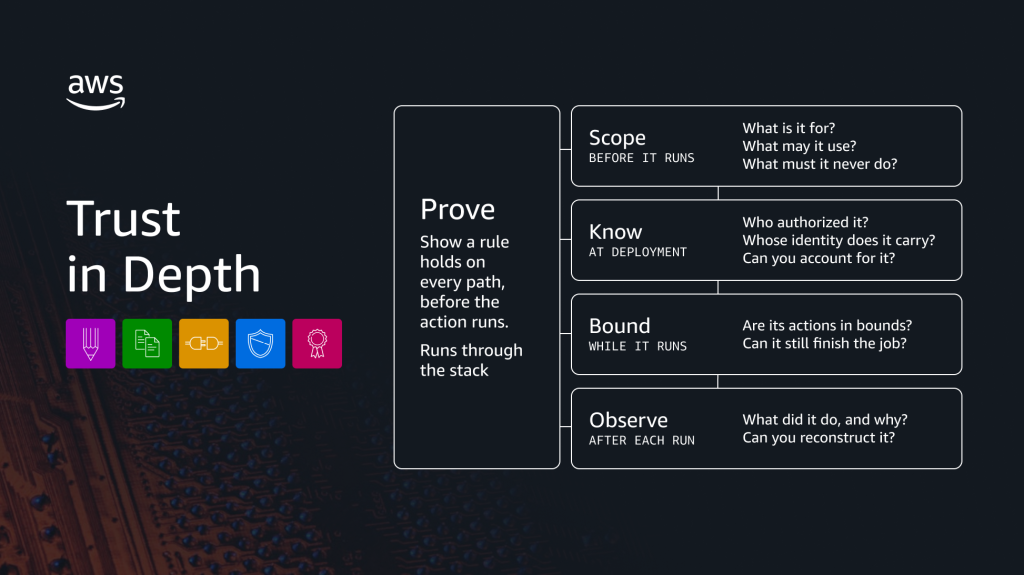
Trust in Depth: Giving agents more autonomy without losing control
Enterprise leaders want AI agents to take on more work but don’t fully trust them to act correctly every time. Trust in Depth is AWS’s layered approach-scope, know, bound, observe, and prove-that lets agents act on their own when their actions can be verified, reserving human judgment for the decisions that need it.
Build self-improving document processing using Amazon Bedrock AgentCore
Learn how to build an agentic intelligent document processing (IDP) system using Amazon Bedrock AgentCore that classifies, extracts, validates, and learns from business documents with minimal human intervention, automatically handling new document formats without manual template configuration.
Generate presentations with Amazon Bedrock AgentCore
This post walks you through building an AI agent system with Amazon Bedrock AgentCore that automates PowerPoint presentation creation from enterprise documents. A supervisor agent, Retrieval Augmented Generation, and Amazon Bedrock Guardrails generate grounded presentations in under 90 seconds.
How Tamnoon built AI-powered cloud security remediation with Amazon Bedrock
Learn how Tamnoon built Tami, an agentic cloud remediation orchestrator on Amazon Bedrock that autonomously investigates and safely remediates cloud security findings from CNAPP and cloud-native sources. The approach drove a 90%+ reduction in critical cloud exposure in 90 days with zero production issues.
Deploy and evaluate models with Amazon SageMaker JumpStart
Learn how to deploy an available model from Amazon SageMaker JumpStart, run a lightweight and repeatable performance test using the SageMaker Python SDK, and delete the endpoint when testing is complete.
Building agents that transact with Anchor Browser and AgentCore payments
Learn how the AWS Generative AI Innovation Center Partner Agent Factory and Anchor Browser built AI agents that autonomously pay for x402-protected web resources and APIs. Amazon Bedrock AgentCore payments checks budgets, signs transactions, and retries requests without exposing wallet credentials to the agent runtime.
Manage private pricing offers for Amazon Bedrock with managed entitlements
Managing AI model access across dozens or hundreds of AWS accounts creates friction when each account must accept AWS Marketplace Private Pricing Offers individually. This post shows two ways to activate MPPO entitlements in AWS License Manager: a lightweight script for a one-time fix, and CDK automation for ongoing event-driven processing.