What Is AI Hardware?
What Is AI Hardware?
AI hardware is specialized hardware necessary to run AI algorithms or models. AI models require large-scale computing power and memory to work and generate results. AI hardware provides the necessary computing capacity by combining powerful hardware components into distributive architectures that can process large data components in parallel.
How is AI hardware different from regular hardware?
AI hardware performs the same functions as regular hardware but on a much larger scale. Its distinct structures allow for parallel data processing and ensure it can work with large data volumes. AI hardware is often custom-built for AI workloads and offers more resources than regular hardware can provide.
Processing at scale
AI hardware utilizes specialized processing units, such as graphics processing units (GPUs), tensor processing units (TPUs), and natural processing units (NPUs). These more advanced processing units can handle a larger volume of operations concurrently, which is vital for complicated and resource-demanding AI workloads. While GPUs are effective at handling parallel tasks due to having many smaller processing cores that can distribute and manage several tasks at once, TPUs and NPUs are optimized for neural network processes.
Specialized electronics
AI hardware also uses application-specific integrated circuits (ASICs) for specific applications and functions. Unlike general-purpose processors, ASICs are custom-designed for a narrow range of functions, such as machine learning inference or specific types of computations required in AI applications. Optimization includes both computational logic and the integration of other components like memory and input/output interfaces that are fine-tuned for the specific AI workload, The AI hardware system can handle large datasets and complex algorithms at high speeds to improve efficiency.
Improved memory
AI systems also need much more storage and memory than regular hardware permits. Rapid Access Memory (RAM) and Solid-State Drives (SSDs) are two central components of AI hardware. RAM provides quick access to data for processors, while SSDs offer a high read-write speed to complement AI workloads.
What are the benefits of AI hardware?
AI hardware accelerates AI training speed and AI model performance.
Improved performance
AI hardware, like GPUs, ASICs, TPUs, and NPUs, can increase the speed at which AI systems can complete their computations. For specific AI tasks like natural language processing, image recognition, or other deep learning tasks, available AI hardware helps models offer better performance. Researchers can also train new models faster and accelerate the deployment of new artificial intelligence functionalities and systems.
Energy efficiency
By improving energy usage, AI hardware reduces the environmental footprint of running AI systems. Specialized processors and systems mean AI systems can consume less power while providing the same results. Efficient energy use within AI training and performance also means less energy is spent on cooling towers, reducing operational costs and energy consumption.
Scalability
Researchers can add more processing units to an AI system for horizontal scaling. They can run their models in the cloud to increase processing power and meet model demands.
Businesses can also scale AI hardware vertically by enhancing the individual processing units that make up the system. For example, a researcher could upgrade GPUs to ASICs for a specific task to vertically scale the system's workload potential.
Flexibility
Businesses can customize artificial intelligence hardware components like ASICs to help support a specific function of AI. Using this specialized hardware, you can maximize performance for specific tasks.
What are AI hardware components?
Several core components allow for effective data processing and computation within AI algorithms.
Processors
AI hardware uses specialized processors to provide artificial intelligence systems with the computational resources for optimal performance. For example:
- Graphics processing units (GPUs) facilitate parallel processing that AI algorithms rely on.
- Tensor processing units (TPUs) effectively manage mathematical operations in deep learning algorithms and applications.
- Neural processing units (NPUs) use an architectural structure that resembles the human brain to process information as effectively as possible.
Application-specific integrated circuits are also GPUs that focus on one specific task. They offer high performance for AI applications with a specific task in mind.
Each of these comes as an evolution to the traditional central processing units that are common in traditional hardware.
Memory
Alongside computational resources, artificial intelligence hardware needs to offer models a large volume of memory and storage to run their processes. As previously discussed, AI hardware primarily uses RAM and SSDs to provide rapid data access and effective storage.
Here are a few types of memory that researchers may use in AI hardware.
- High-bandwidth memory (HBM) offers low latency and high data throughput to support quick data access for AI computations.
- Graphics Double Data Rate (GDDR) is a hyper-performance form of memory that is better able to handle the demands of parallel processing.
- Dynamic Random-Access Memory (DRAM) stores data bits in an integrated circuit, providing low write and erase times with low power demands.
Interconnects
Interconnects refers to a model's pathways for transferring data between its storage and memory components and its processors. Interconnects ensure that there are no bottlenecks in data processing and computation that could slow down artificial intelligence systems.
What are AI hardware architectures?
AI hardware can use various hardware structures, each of which offers different benefits to the model.
Von Neumann architecture
Von Neumann architecture is the traditional approach to hardware infrastructure. This style involves a central processing unit, main memory banks, and an interconnection between the CPU and memory. The CPU has a control unit for deciding what the program will do and a datapath for computing instructions.
While this architecture is traditional, the separation between memory and CPU can cause the Von Neumann bottleneck. This bottleneck can reduce performance and hinder utility, especially for AI models.
Neuromorphic architecture
Neuromorphic architecture is any hardware that researchers design to mimic the structure of the human brain. This infrastructure prioritizes parallel processing and event-driven computation, aiming to lower power consumption. While information processing is promising in neuromorphic architecture, it is still under development.
Dataflow architectures
Dataflow architectures differ from the von Neumann structure in that they do not have one central processing unit. Instead, data flows through the architecture and triggers certain operations as and when they are necessary. For AI technologies with predictable data flows, this architecture can provide a high degree of efficiency.
How can AWS help with your AI hardware requirements?
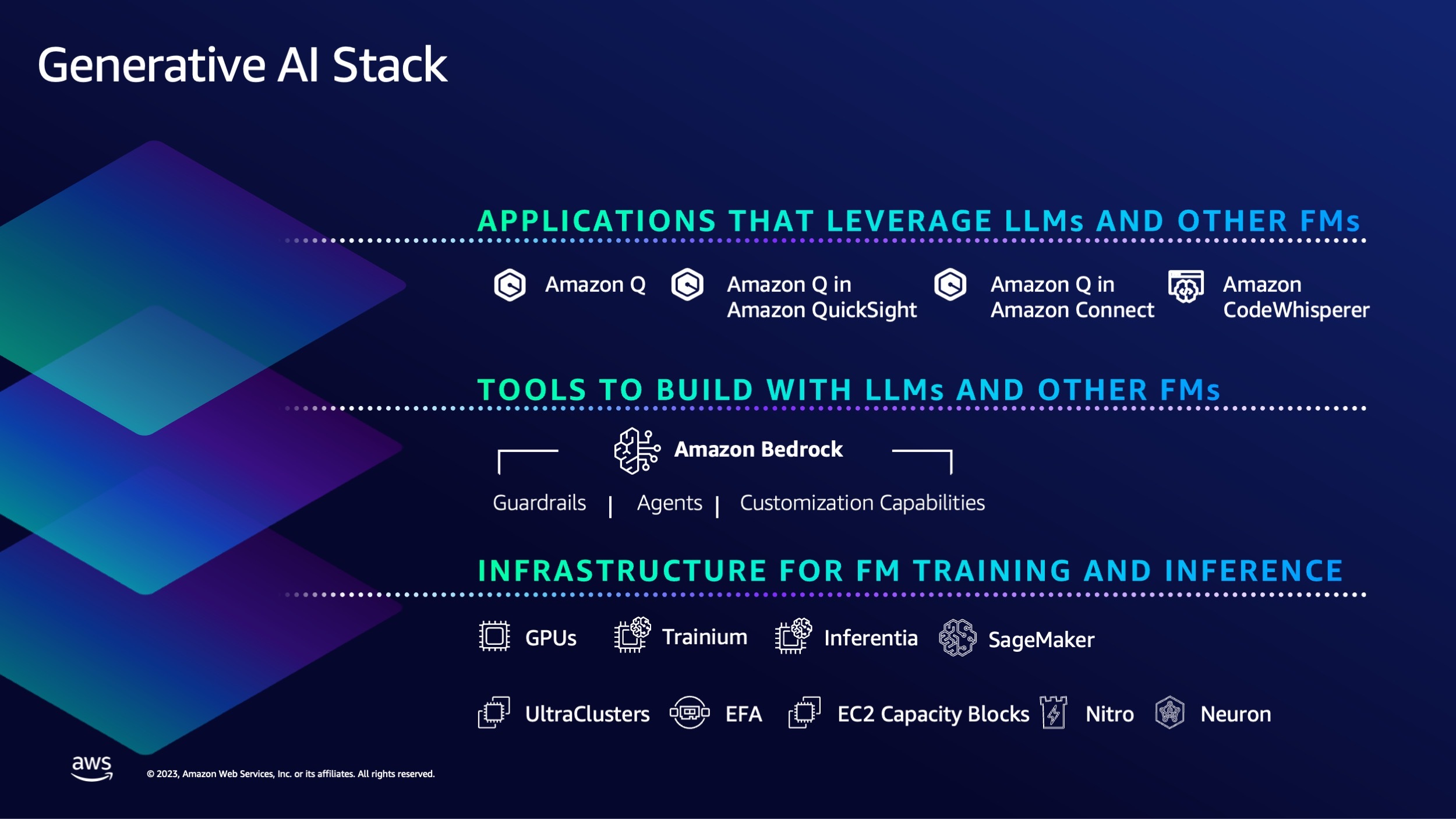
AI infrastructure on AWS provides the most comprehensive, secure, and price-performant AI infrastructure—for all your training and inference needs. Build with the broadest and deepest set of AI and ML capabilities across computing, networking, and storage. Run distributed training jobs using the latest purpose-built chips or GPUs with managed services. For example
- Amazon Elastic Compute Cloud (EC2) Trn1 instances, powered by AWS Trainium accelerators, are purpose-built for high-performance deep learning (DL) training of generative AI models, including large language models (LLMs) and latent diffusion models.
- Amazon Elastic Compute Cloud (Amazon EC2) P5 instances, powered by the latest NVIDIA H100 Tensor Core GPUs, deliver the highest performance in Amazon EC2 for deep learning (DL) and high-performance computing (HPC) applications.
- Amazon EC2 G5 instances are the latest generation of NVIDIA GPU-based instances that can be used for a wide range of graphics-intensive and machine learning use cases.
Get started with AI hardware on AWS by creating a free account today.
Browse all cloud computing concepts
Browse all cloud computing concepts content here:
Did you find what you were looking for today?
Let us know so we can improve the quality of the content on our pages