AWS Partner Network (APN) Blog
Runtime governance for AI agents with Noma Security and AgentCore Gateway
By: Tal Bronfer, Principal Solution Architect – Noma Security
By: Amir Hazoom, Partner Solutions Architect – AWS
By: Len Gomes, Partner Solutions Architect – AWS

An agent asked to summarize a vendor renewal proposal may also have permission to change that vendor’s payment details. The permission is legitimate; using it during a summary request isn’t. Runtime governance checks the proposed action, what prompted it, and whether it matches the user’s request. Identity and access controls define which tools an agent can use. Runtime governance also considers whether a permitted action makes sense for the task.
Noma Security‘s AI Detection and Response (AI-DR) integration with Amazon Bedrock AgentCore brings these runtime checks to traffic that passes through Amazon Bedrock AgentCore Gateway. Content inspection and policy enforcement happen at one shared control point, so you can protect supported workloads without adding security code to each agent.
Noma complements Amazon Bedrock AgentCore Policy and Amazon Bedrock Guardrails. AgentCore Policy provides deterministic authorization through Cedar-based policies and session-based temporal rules. Amazon Bedrock Guardrails provides configurable content-safety and privacy checks. Noma adds semantic evaluation of content and intent, assessing what prompts, tool results, and proposed actions mean in the context of the user’s task and connected interaction history. Security teams can evaluate intent alignment and investigate the interactions behind a decision alongside their AWS controls.
Three questions for runtime governance
Agentic runtime governance comes down to three questions:
- Can the content be trusted? Prompts and tool results can carry injected instructions or sensitive information. A document should inform the task, not rewrite it.
- Is the actor entitled? Consider the user, the agent acting on their behalf, and the harness and model in use. These checks complement AWS Identity and Access Management (IAM) permissions.
- Does the action match the user’s intent? A permitted tool call can still be wrong. Changing payment details doesn’t follow from a summary request.
Noma applies your configured runtime guardrails to assess the meaning of content and whether proposed actions match the user’s task, using connected session history as context.
Where the integration fits in your agentic stack
AgentCore Gateway connects agents to tools, other agents, and models, alongside AgentCore Runtime for agent execution. A single gateway created without a protocol type can host all three target categories:
| Target | What Noma inspects | Scope and limits |
|---|---|---|
| MCP | Tool calls and results exposed through the gateway’s unified Model Context Protocol (MCP) interface. | Inspection covers tool calls and results, with limited visibility into streaming status updates. |
| HTTP | AgentCore Runtime invocations and HTTP passthrough traffic, including agent-to-agent (A2A) services. | Inspection covers gateway-routed traffic and may add response latency. |
| Inference | Prompts and model responses for Amazon Bedrock, OpenAI, Anthropic, and other OpenAI-compatible providers. | Coverage depends on supported payload formats, and inspection may add response latency. |
A shared AWS Lambda integration connects both interception points to Noma, bringing consistent policy evaluation to supported gateway traffic.
For evaluation, choose the Noma-managed service or a customer-managed broker on Amazon Elastic Kubernetes Service (Amazon EKS) in your AWS account. Figure 1 shows these alternative deployment paths.
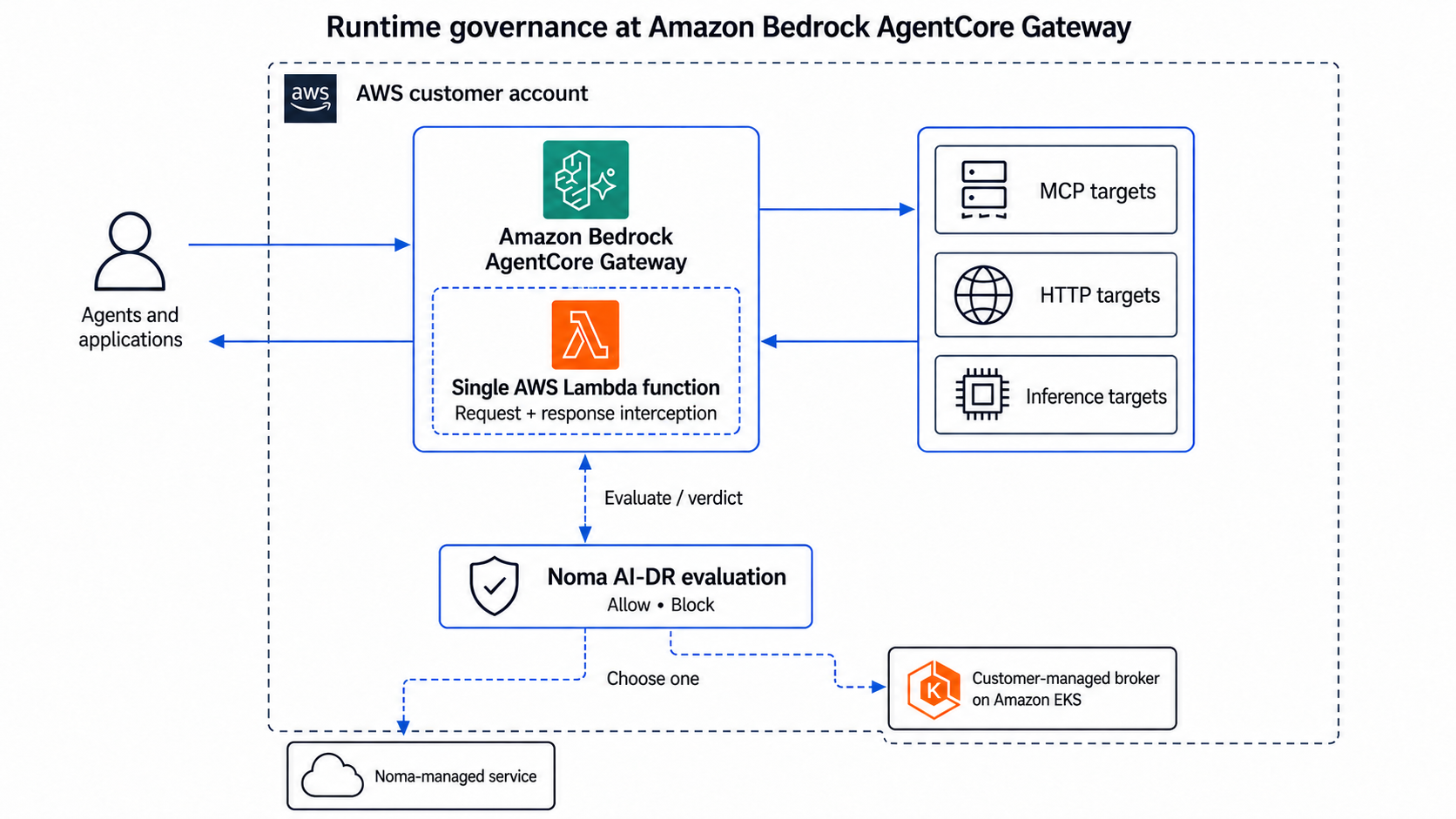 Figure 1 – One Lambda function connects both interception points to either the Noma-managed service or a customer-managed broker on Amazon EKS.
Only traffic routed through gateway targets is visible. A Runtime agent behind the gateway does not expose its internal calls; route those through the gateway too, and restrict direct access to prevent bypass.
How runtime governance works
The gateway enforces Noma’s verdicts at its interception points. Figure 2 summarizes how evaluation, enforcement, and session recording relate.
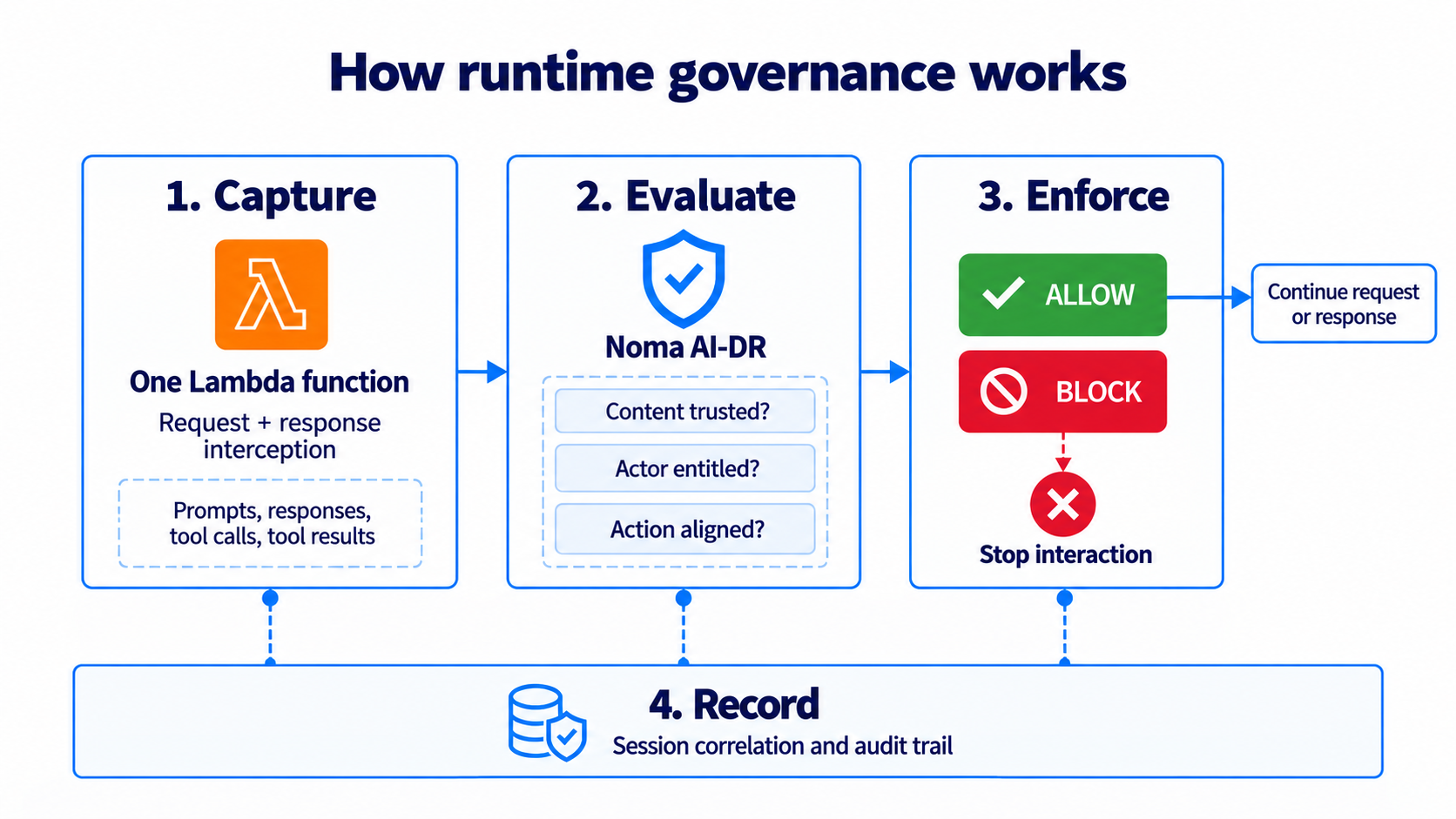
Figure 2 – Evaluation of supported requests and responses, with policy enforcement and a shared session record.
- Capture. The interceptor extracts supported prompts, responses, tool calls, and results with available application and session identifiers.
- Evaluate. Configured detectors assess the interaction and connected session context. Your policy determines which findings are monitored and which trigger enforcement.
- Enforce. Policy decisions determine whether supported requests proceed and responses reach the user.
- Record. A shared session history connects requests, responses, and decisions so security teams can investigate related interactions.
Keeping a procurement task read-only
The procurement agent routes the user’s summary request, relevant model calls, and vendor-tool traffic through the gateway with a shared session identifier. This gives Noma the context to compare a proposed update with the original task. The renewal document contains an instruction to replace the vendor’s bank account details. Two checks address the risk:
- Content inspection flags the embedded instruction as untrusted.
- Intent evaluation compares a proposed payment update with what the user actually asked for: a review and a summary.
With enforcement enabled, Noma can block the update despite the agent’s permission to use the tool. The session record brings together the user’s request, document content, proposed action, and decision. The agent can complete the review without letting the document expand its authority.
What this changes for security teams
Teams can apply configurable semantic checks for content and intent, then investigate decisions in a shared session history. This connects an action to the content and user intent that preceded it, complementing AWS authorization and content controls. Session evidence also supports security information and event management (SIEM) workflows. Teams can balance protection, availability, and response speed within the integration’s inspection limits.
Getting started
Choose Noma-managed evaluation or a broker on Amazon EKS. Noma provides an AWS CloudFormation deployment that sets up the integration, scopes invocation permissions narrowly, and correlates related requests into one session. Traffic already routed through the gateway needs no added agent security code; other model clients or tools may need endpoint changes.
Start in monitor mode, review findings, then turn on blocking as you refine your policies. Before rollout, confirm that protection, session visibility, and the user experience meet your requirements. To get deployment guidance for your environment, contact Noma through the Noma Security listing in AWS Marketplace.
Conclusion
Permissions define what an agent can access; the user’s task defines what it should do. Alongside AWS authorization and content controls, Noma AI-DR adds semantic evaluation of content and intent to help detect untrusted instructions and assess whether proposed actions match the user’s task.
To learn more, explore Noma AI-DR through the Noma Security listing in AWS Marketplace, or visit noma.security to request a demo of the AgentCore Gateway integration.

Noma – AWS Partner Spotlight
Noma Security is an AWS Advanced Technology Partner whose agent security and governance solution helps enterprise security teams enable agent adoption without losing control. Its coverage spans cloud, software as a service (SaaS), and endpoint environments. Teams define runtime governance policies, and Noma enforces them at supported agent control points, including AgentCore Gateway.