AWS Architecture Blog
How ALS GeoAnalytics LITHOLENS ™ revolutionizes core logging through machine learning with Amazon EKS
In the mining industry, accurate geological analysis is required for improving mine design and development. Traditionally, this involved labor-intensive and time-consuming on-site inspections of drill core samples, often conducted in remote and challenging environments. ALS GeoAnalytics has streamlined this process through its LITHOLENS ™ platform, a machine learning (ML)-powered system that uses deep learning and machine vision to automate core logging. LITHOLENS ™ significantly enhances data consistency, operational efficiency, and scalability while significantly reducing logging-related costs and lowering greenhouse gas emissions to support sustainable mineral extraction.
This post explores how ALS GeoAnalytics successfully deployed LITHOLENS ™ with Amazon Elastic Kubernetes Service (Amazon EKS) to scale model training and inference while minimizing cost.
The challenge
Development of a new mine involves the creation of a 3D map of the ore body, known as a geological or resource model. This model drives all future design decisions and creating it requires drilling thousands of holes throughout the ore body to examine the structure and composition of the samples extracted. This process is subject to numerous challenges that affect both active and historical drilling campaigns. Challenges such as:
- Remote site access requiring geologists to travel long distances to visually inspect physical core boxes
- Subjective interpretations led to inconsistencies, with different experts often producing varying geological logs
- Underutilized historical imagery from past campaigns lacked standardized tools for meaningful analysis
- Lost or degraded physical samples made it difficult to revisit legacy data or validate past interpretations
- Limited transparency in logging and decision-making processes hindered collaboration and accountability
- Scheduling bottlenecks arose from reliance on a small pool of qualified experts
- Non-standardized data collection methods prevented effective scaling and cross-project comparison
These limitations not only delayed project timelines but also restricted the ability to generate reliable, high-resolution geological insights—ultimately impeding the speed and effectiveness of exploration strategies.
Machine learning at geological scale
ALS GeoAnalytics developed a comprehensive suite of machine learning and computer vision models to automate geological and geotechnical logging, transforming raw core imagery and data into actionable insights.
A machine learning pipeline formed the foundation for high-resolution visual analysis. It begins with the Color Extraction module, which scans each image to identify unique pixel colors and store the results in Amazon Simple Storage Service (Amazon S3). This data is fed into the Color Clustering module, where users can specify clustering parameters and choose from algorithms such as K-Means, which assigns pixels to clusters based on proximity to centroids, or the Gaussian Mixture Model (GMM), which uses probabilistic distributions to capture more complex variance structures within the color data. These methods effectively reduced image complexity and helped highlight mineralogical variation.
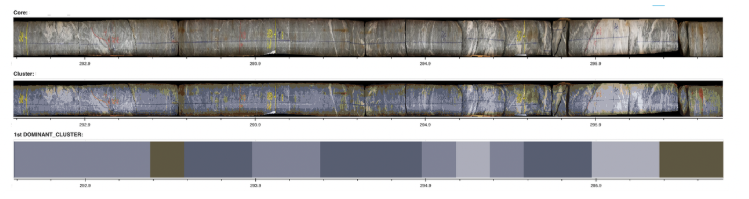
To quantify color composition along the core, the Percentage Report module was introduced. It segmented each image into user-defined sections (for example, 20 cm intervals) and calculated the proportional distribution of each color cluster, enabling spatial analysis of lithological patterns.
On the deep learning front, the team developed and deployed an advanced suite of models tailored for geological and geotechnical analysis. A highlight of this work was the development of RoQE Net, a state-of-the-art neural network designed for geotechnical parameter extraction. RoQE Net demonstrated exceptional accuracy in computing Rock Quality Designation (RQD) and extracting alpha angles, key metrics for assessing core integrity and rock mass quality. In parallel, VeinNet and CobbleNet were engineered to identify and map complex geological features such as veins, cobbles, and lithological structures with high precision. These models were benchmarked against industry standards and consistently outperformed traditional methods in terms of accuracy, reliability, and scalability.Together, these machine learning and deep learning components form the backbone of the LITHOLENS ™ platform—delivering automated, scalable, and highly accurate geological intelligence that accelerates decision-making and enhances the efficiency of exploration and resource modeling workflows.
Solution architecture
ALS GeoAnalytics built LITHOLENS ™ on AWS using a hybrid architecture that combines containerized workloads with serverless components. The system uses Amazon EKS for compute-intensive machine learning tasks, AWS Lambda for API operations, Amazon S3 for data storage, and Amazon Relational Database Service (Amazon RDS) for structured data management.
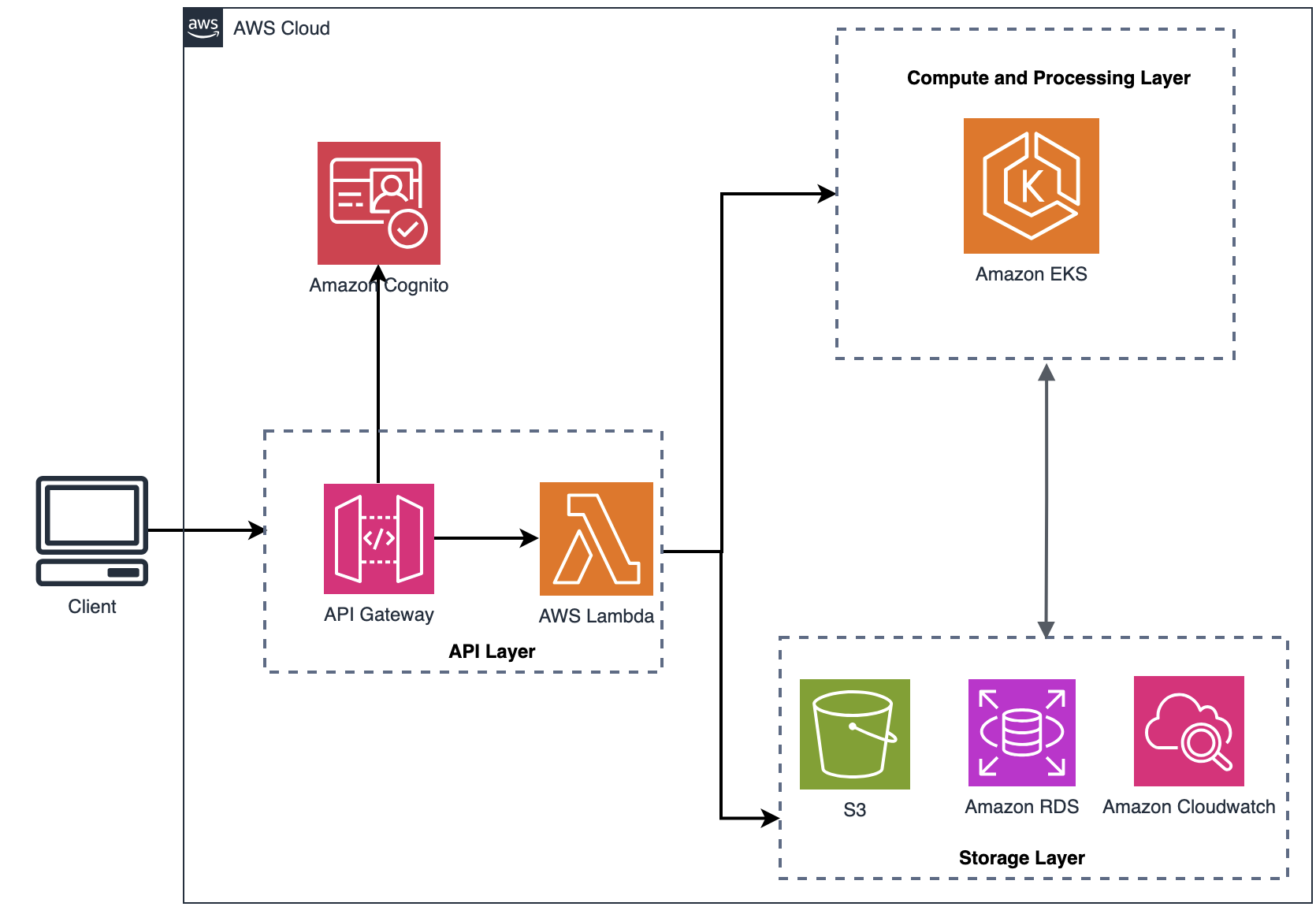
Figure 1: Architecture Diagram
LITHOLENS ™ uses a unified API model to drive next-generation rock and mineral data analysis. This unified API created is a unified application programming interface that combines multiple services, data streams, and analytic capabilities into a single, powerful access point. Unlike traditional APIs—which might deliver basic, one-dimensional data—you can use the unified API to connect, analyze, and automate complex workflows across departments, vendors, and a wide variety of data sources all at once. With the unified REST API, users can submit geological analysis jobs, monitor progress, and retrieve results through a single interface. This API combines multiple services and data streams into one access point, so users can automate complex workflows across departments and data sources.
Architecture flow:
- Request Intake – Jobs are submitted through Amazon API Gateway with a payload specifying job parameters and EKS configuration.
- Job Orchestration – The API backend, running on AWS Lambda, provisions EKS containers with the appropriate configuration. User data scripts bootstrap each instance with required setup and execution commands.
- Execution and Data Flow
- Input data is retrieved from Amazon S3.
- Computation is performed on EKS pods using G6 instances.
- Logs and intermediate results are continuously tracked.
- Results are stored in S3 or persisted into RDS through dedicated API calls.
- Resource Management – Upon job completion, EKS containers instances automatically shut down, reducing costs.
Architecting for scale and efficiency
To handle variable workloads efficiently, ALS GeoAnalytics implemented a hybrid architecture that’s designed for both performance and cost. The system uses Amazon EKS for compute-intensive ML tasks while using AWS Lambda for lightweight API operations and job orchestration.
Key architectural decisions:
- Amazon EKS for ML Workloads – Deep learning model training and inference require sustained compute power with GPU acceleration. EKS provides the container orchestration needed to manage these workloads across G6 instances, with automatic scaling based on job queue depth.
- Lambda for API Gateway – Job submission, status checking, and result retrieval are handled through serverless functions. This removes the overhead of maintaining always-on API servers for sporadic client requests, reducing costs during low-usage periods.
- Pre-configured AMIs – Custom Amazon Machine Images contain all required dependencies and model artifacts, reducing container startup time from several minutes to under 30 seconds. This approach improves job throughput and reduces compute costs by minimizing idle time.
- Automated Resource Management -–EKS clusters scale down to zero when no jobs are queued, so compute resources are only consumed during active processing. Combined with S3 for data persistence and RDS for metadata, this creates a cost-effective architecture that scales with actual usage.
This design addresses the geological industry’s unpredictable workload patterns while maintaining the performance needed for complex computer vision tasks.
Business impact and results
LITHOLENS ™ has seen success with 10 different mining companies on over 40 active projects, with substantially accelerated project completion and a standard analysis process used across all projects. This new approach has made mineral detection and classification more accurate while reducing the need for experts to visit sites. Teams can now trace how analysis decisions are made, grade minerals more consistently, and plan projects and assign resources more effectively. Real-time monitoring and reporting give managers up-to-the-minute information on how projects are progressing.
Conclusion
The massive scalability of Amazon EKS has allowed ALS GeoAnalytics to fundamentally transform how core logging and analysis is conducted. AWS suite of services enables LITHOLENS ™ to efficiently implement computer vision and machine learning, bringing new operational capabilities to our customers and opening business opportunities throughout the mining industry. The success of LITHOLENS ™ demonstrates how cloud computing and AI can help modernize a long-standing industry like mining, creating value through improved operational efficiency, accuracy, and scalability. ALS GeoAnalytics continues to evolve its platform on AWS, using cloud computing to push the boundaries of what’s possible, and looking to grow LITHOLENS ™ in to promising applications in oil and gas, civil engineering, and even space exploration.