AWS Architecture Blog

Accelerate deployments on AWS with effective governance
Amazon Web Services (AWS) users ask how to accelerate their teams’ deployments on AWS while maintaining compliance with security controls. In this blog post, we describe common governance models introduced in mature organizations to manage their teams’ AWS deployments. These models are best used to increase the maturity of your cloud infrastructure deployments. Governance models […]
Let’s Architect! Architecting for big data workloads
Big data is often defined by 3 Vs: greater variety, volumes, and velocity. Because of the three Vs, big data poses data management challenges that cannot be solved with traditional databases. Not only that, but trying to overcome these issues can lead to scaling problems, bottlenecks, and spiraling costs. To help with this, you need to […]

Coordinating large messages across accounts and Regions with Amazon SNS and SQS
Many organizations have applications distributed across various business units. Teams in these business units may develop their applications independent of each other to serve their individual business needs. Applications can reside in a single Amazon Web Services (AWS) account or be distributed across multiple accounts. Applications may be deployed to a single AWS Region or […]

Web application access control patterns using AWS services
The web application client-server pattern is widely adopted. The access control allows only authorized clients to access the backend server resources by authenticating the client and providing granular-level access based on who the client is. This post focuses on three solution architecture patterns that prevent unauthorized clients from gaining access to web application backend servers. […]

How to track AWS account metadata within your AWS Organizations
United Services Automobile Association (USAA) is a San Antonio-based insurance, financial services, banking, and FinTech company supporting millions of military members and their families. USAA has partnered with Amazon Web Services (AWS) to digitally transform and build multiple USAA solutions that help keep members safe and save members’ money and time. Why build an AWS […]

How ERGO built an on-call support solution in a week
ERGO’s Technology & Services S.A. (ET&S) Cloud Solutions Department is a specialist team of cloud engineers who provide technical support for business owners, project managers, and engineering leads. The support team deals with complex issues, such as failed deployments, security vulnerabilities, environment availability, etc. When an issue arises, it’s categorized as Priority 1 (P1) or […]

How Munich Re Automation Solutions Ltd built a digital insurance platform on AWS
Underwriting for life insurance can be quite manual and often time-intensive with lots of re-keying by advisers before underwriting decisions can be made and policies finally issued. In the digital age, people purchasing life insurance want self-service interactions with their prospective insurer. People want speed of transaction with time to cover reduced from days to […]
Let’s Architect! Designing Well-Architected systems
Amazon’s CTO Werner Vogels says, “Everything fails, all the time”. This means we should design with failure in mind and assume that something unpredictable could happen. The AWS Well-Architected Framework is designed to help you prepare your workload for failure. It describes key concepts, design principles, and architectural best practices for designing and running workloads […]

Augmentation patterns to modernize a mainframe on AWS
Customers with mainframes want to use Amazon Web Services (AWS) to increase agility, maximize the value of their investments, and innovate faster. On June 8, 2022, AWS announced the general availability of AWS Mainframe Modernization, a new service that makes it faster and simpler for customers to modernize mainframe-based workloads. In this post, we discuss […]
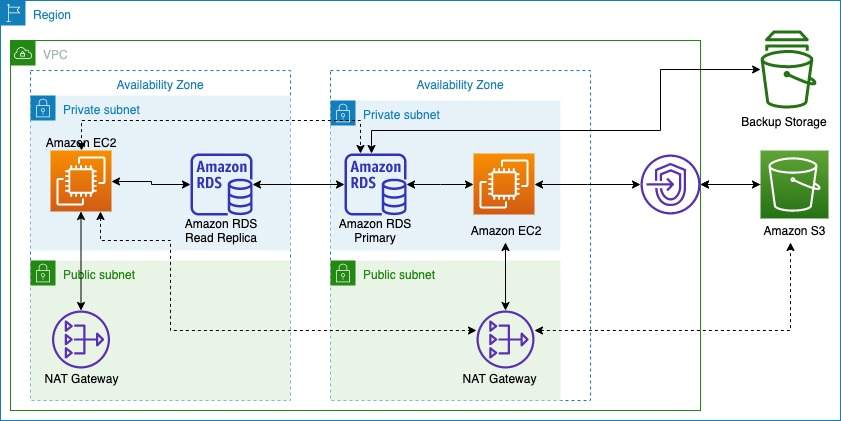
Journey to Cloud-Native Architecture Series #6: Improve cost visibility and re-architect for cost optimization
After we improved our security posture in the 5th blog of the series, we discovered that operational costs are growing disproportionately higher than revenue. This is because the number of users grew more than 10 times on our e-commerce platform. To address this, we created a plan to better understand our AWS spend and identify cost […]