AWS Architecture Blog
Category: Amazon Aurora
Consistency is the new latency: AI at the data layer
As AI agents move from chatbots to taking action, their reliability depends on the consistency of the data layer beneath them. This post examines how replication lag poisons an agent’s context and shows how to match Amazon Aurora, Amazon DynamoDB, and Amazon Keyspaces replication models to each task’s consistency requirements.
Eclipse Dataspace Components on AWS: Cost optimization strategies
When you deploy Eclipse Dataspace Components (EDC) connectors on AWS, one of the first challenges you face is predicting and controlling the cost of the required infrastructure. Without clear benchmarks, it is difficult to make informed decisions about workload sizing, environment configuration, and long-term investment. Part 1 of this 3-part blog series covered the fundamentals […]
Eclipse Dataspace Components on AWS: Architecture patterns in production
Running Eclipse Dataspace Components (EDC) connectors in production on AWS requires deliberate architecture decisions around isolation, managed services, and security layering. In Part 1 of this series, we covered the fundamentals of data space architectures and EDC per the International Data Space Association’s (IDSA) standards. If you are new to EDC, we recommend starting there. […]
Eclipse Dataspace Components on AWS: Data sharing fundamentals
This three-part blog series guides you through implementing Eclipse Dataspace Components (EDC) on AWS, from foundational concept to production deployment. Part 1 establishes the theoretical foundation with IDSA standards, the Dataspace Protocol (DSP), and core EDC architecture. Part 2 provides production-ready AWS deployment patterns using services like Amazon Elastic Container Service (Amazon ECS), Amazon Aurora, […]
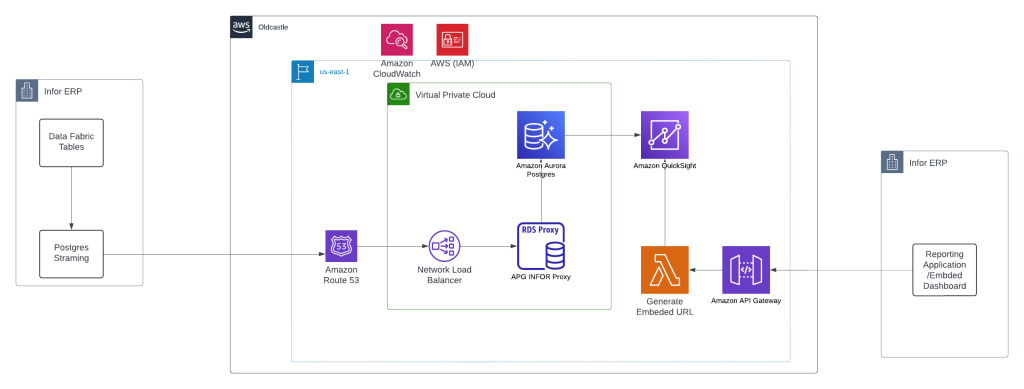
Real-time analytics: Oldcastle integrates Infor with Amazon Aurora and Amazon Quick Sight
This post explores how Oldcastle used AWS services to transform their analytics and AI capabilities by integrating Infor ERP with Amazon Aurora and Amazon Quick Sight. We discuss how they overcame the limitations of traditional cloud ERP reporting to deploy real-time dashboards and build a scalable analytics system. This practical, enterprise-grade approach offers a blueprint that organizations can adapt when extending ERP capabilities with cloud-native analytics and AI.
Let’s Architect! Leveraging SQL databases on AWS
April, 2026: Aurora Serverless v2 has been renamed Aurora serverless. No action required. SQL databases in Amazon Web Services (AWS), using services like Amazon Relational Database Service (Amazon RDS) and Amazon Aurora, offer software architects scalability, automated management, robust security, and cost-efficiency. This combination simplifies database management, improves performance, enhances security, and allows architects to […]

Realtime monitoring of microservices and cloud-native applications with IBM Instana SaaS on AWS
Customers are adopting microservices architecture to build innovative and scalable applications on Amazon Web Services (AWS). These microservices applications are deployed across multiple AWS services, and customers are looking for comprehensive observability solutions that can help them effectively monitor and manage the performance of their applications in real-time. IBM Instana is a fully automated application […]

Architecting your security model in AWS for legacy application migrations
Application migrations, especially from legacy/mainframe to the cloud, are done in phases that sometimes span multiple years. Each phase migrates a set of applications, data, and other resources to the cloud. During the transition phases, applications might require access to both on-premises and cloud-based resources to perform their function. While working with our customers, we […]
Let’s Architect! Optimizing the cost of your architecture
Written in collaboration with Ben Moses, AWS Senior Solutions Architect, and Michael Holtby, AWS Senior Manager Solutions Architecture Designing an architecture is not a simple task. There are many dimensions and characteristics of a solution to consider, such as the availability, performance, or resilience. In this Let’s Architect!, we explore cost optimization and ideas on […]

What to consider when modernizing APIs with GraphQL on AWS
In the next few years, companies will build over 500 million new applications, more than has been developed in the previous 40 years combined (see IDC article). API operations enable innovation. They are the “front door” to applications and microservices, and an integral layer in the application stack. In recent years, GraphQL has emerged as […]