AWS Architecture Blog
Category: Amazon Simple Storage Service (S3)
Deploy open source Regional availability tools in your VPC
Deploy AWS Regional availability data as infrastructure you own. Capability Insights for AWS runs a self-hosted dashboard in your VPC that auto-refreshes daily, and Workload Analysis narrows the catalog to the services your account actually runs, so your Regional expansion gap analysis focuses only on what you deploy.
How CSIRO built scalable, cost-optimized genomic variant querying on AWS
Learn how researchers at CSIRO, Australia’s national science agency, built Serverless Beacon (sBeacon), a scalable serverless solution for securely querying genomic variant data on AWS. sBeacon implements the GA4GH Beacon standard using Amazon S3, AWS Lambda, Amazon DynamoDB, and Amazon Athena to support production-scale clinical and research applications.
Unlocking the future of video data: March Networks cloud storage on AWS
Enterprise video surveillance is operating at an unprecedented scale as organizations across retail, banking, quick-service restaurants (QSR), convenience stores, and transportation networks generate petabytes of video data across thousands of distributed locations. As retention requirements grow and organizations seek to extract more operational insights from video, traditional on-premise storage models are becoming increasingly difficult and […]
Specification-driven composition for flexible data workflows
Specification-driven composition addresses a common scalability bottleneck in data pipelines. Data pipelines often start as simple scripts, but as they grow, you duplicate transformation logic and small changes cascade across multiple workflows. Copying and modifying data transformation logic across scripts leads to workflows that become difficult to manage at scale. Tracking what each pipeline does […]
Modernizing financial analytics with Amazon SageMaker Unified Studio
Avanse Financial Services, India’s leading education loan providers, migrated to a cloud-native lakehouse architecture using Amazon SageMaker Unified Studio, which unified their data engineering, analytics, and artificial intelligence (AI) workflows in a single governed environment on AWS. In this post, we walk through their migration journey so you can adapt their approach to your own environment.
Automating contract intelligence with Doczy.ai™ on AWS
In this post, we show you how Doczy.ai™ uses generative AI on AWS to automate contract intelligence at scale, transforming unstructured documents into structured, actionable insights, so organizations can automate critical business processes and unlock the full value of their data.
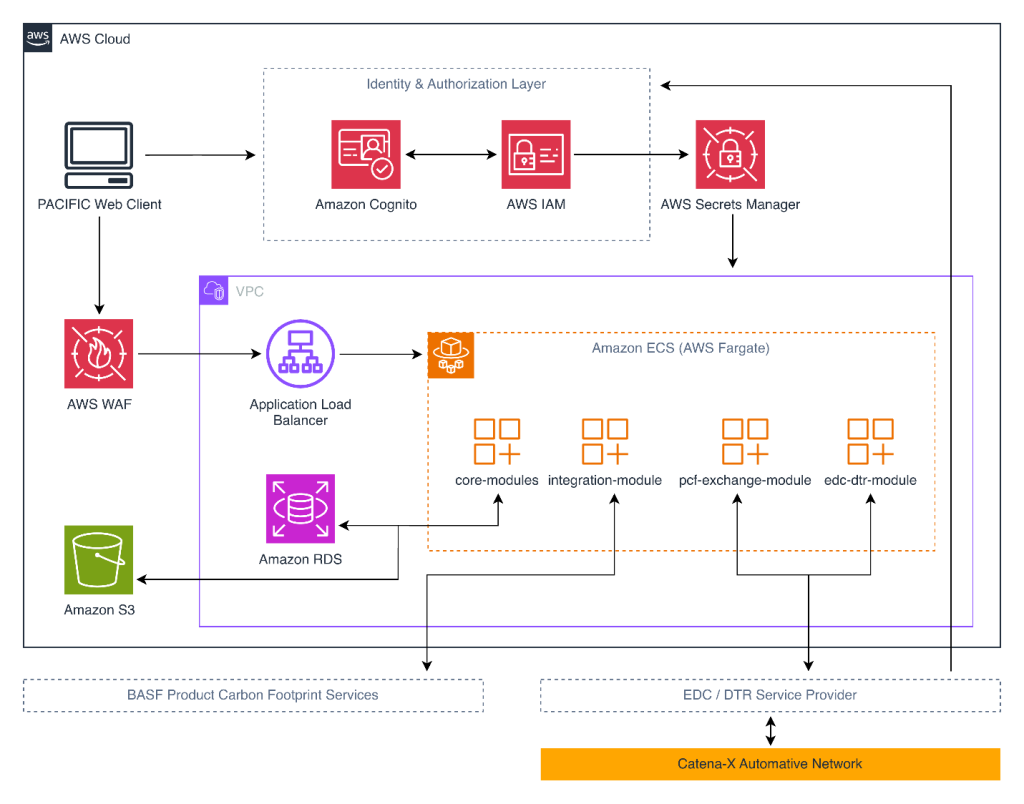
PACIFIC enables multi-tenant, sovereign product carbon footprint exchange on the Catena-X data space using AWS
This post explores how PACIFIC enables multi-tenant, sovereign PCF exchange on the Catena-X data space using Amazon Elastic Container Service (Amazon ECS) on AWS Fargate, Amazon Cognito, and AWS Identity and Access Management (IAM) to deliver measurable environmental impact and competitive advantage in a carbon-conscious marketplace.
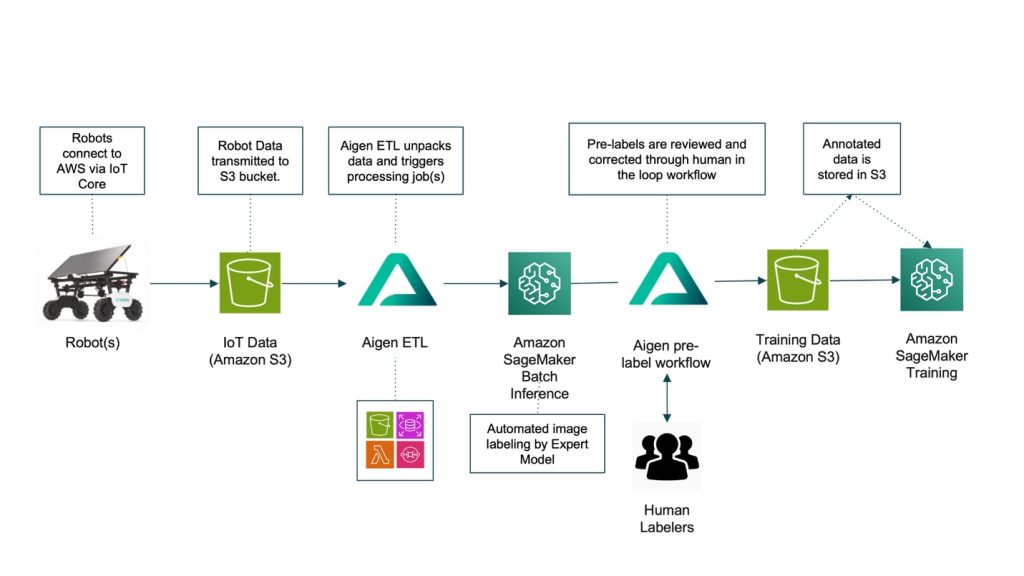
How Aigen transformed agricultural robotics for sustainable farming with Amazon SageMaker AI
In this post, you will learn how Aigen modernized its machine learning (ML) pipeline with Amazon SageMaker AI to overcome industry-wide agricultural robotics challenges and scale sustainable farming. This post focuses on the strategies and architecture patterns that enabled Aigen to modernize its pipeline across hundreds of distributed edge solar robots and showcase the significant business outcomes unlocked through this transformation. By adopting automated data labeling and human-in-the-loop validation, Aigen increased image labeling throughput by 20x while reducing image labeling costs by 22.5x.
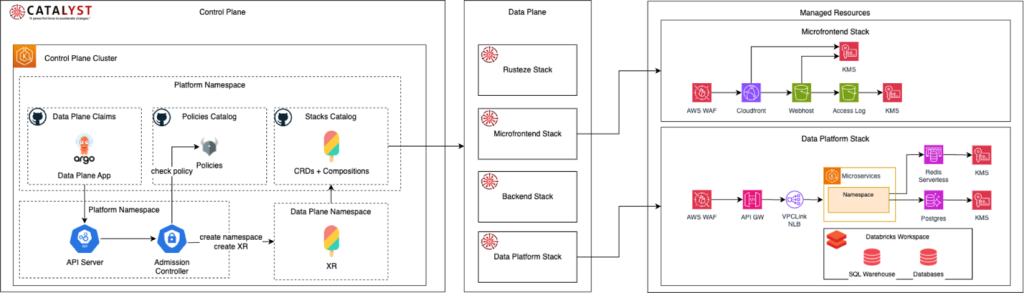
Digital Transformation at Santander: How Platform Engineering is Revolutionizing Cloud Infrastructure
Santander faced a significant technical challenge in managing an infrastructure that processes billions of daily transactions across more than 200 critical systems. The solution emerged through an innovative platform engineering initiative called Catalyst, which transformed the bank’s cloud infrastructure and development management. This post analyzes the main cases, benefits, and results obtained with this initiative.

BASF Digital Farming builds a STAC-based solution on Amazon EKS
This post was co-written with Frederic Haase and Julian Blau with BASF Digital Farming GmbH. At xarvio – BASF Digital Farming, our mission is to empower farmers around the world with cutting-edge digital agronomic decision-making tools. Central to this mission is our crop optimization platform, xarvio FIELD MANAGER, which delivers actionable insights through a range […]