AWS Big Data Blog

Author: Harsha Tadiparthi
Harsha Tadiparthi is a Specialist Sr. Solutions Architect, AWS Analytics .He enjoys solving complex customer problems in Databases and Analytics and delivering successful outcomes. Outside of work, he loves to spend time with his family, watch movies, and travel whenever possible.

Scale read and write workloads with Amazon Redshift
Amazon Redshift is a fast, fully managed, petabyte-scale cloud data warehouse that enables you to analyze large datasets using standard SQL. The concurrency scaling feature in Amazon Redshift automatically adds and removes capacity by adding concurrency scaling to handle demands from thousands of concurrent users, thereby providing consistent SLAs for unpredictable and spiky workloads such […]

Sharing Amazon Redshift data securely across Amazon Redshift clusters for workload isolation
Amazon Redshift data sharing allows for a secure and easy way to share live data for read purposes across Amazon Redshift clusters. Amazon Redshift is a fast, fully managed cloud data warehouse that makes it simple and cost-effective to analyze all your data using standard SQL and your existing business intelligence (BI) tools. It allows […]
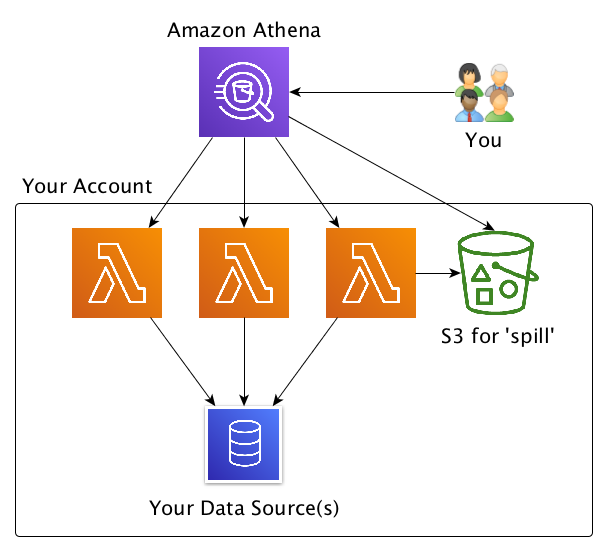
Configure and optimize performance of Amazon Athena federation with Amazon Redshift
This post provides guidance on how to configure Amazon Athena federation with AWS Lambda and Amazon Redshift, while addressing performance considerations to ensure proper use.

Restrict Amazon Redshift Spectrum external table access to Amazon Redshift IAM users and groups using role chaining
With Amazon Redshift Spectrum, you can query the data in your Amazon Simple Storage Service (Amazon S3) data lake using a central AWS Glue metastore from your Amazon Redshift cluster. This capability extends your petabyte-scale Amazon Redshift data warehouse to unbounded data storage limits, which allows you to scale to exabytes of data cost-effectively. Like Amazon EMR, you get the benefits of open data formats and inexpensive storage, and you can scale out to thousands of Redshift Spectrum nodes to pull data, filter, project, aggregate, group, and sort. Like Amazon Athena, Redshift Spectrum is serverless and there’s nothing to provision or manage. You only pay $5 for every 1 TB of data scanned. This post discusses how to configure Amazon Redshift security to enable fine grained access control using role chaining to achieve high-fidelity user-based permission management.