AWS Big Data Blog
Enable cross-cloud analytics with Amazon S3 Tables and Google BigQuery, Part 1: IAM-based access control
Organizations running analytics workloads across multiple clouds often hit the same friction: the data lives on one cloud, but the engine querying it lives on another. Copying data across the boundary creates a second dataset that must be kept in sync, adding cost, latency, and reconciliation overhead. In this post, we address a specific instance of that pattern: your Google BigQuery users need to work with data that lives in Amazon S3 Tables, a capability of Amazon Simple Storage Service (Amazon S3), on AWS. The ideal outcome is a single, governed dataset that serves teams in both clouds without a standing replication pipeline between them.
With Amazon S3 Tables, you get managed Apache Iceberg tables with built-in compaction, snapshot management, and an integration with the AWS Glue Data Catalog. Because S3 Tables stores data in the open Iceberg format, supported external engines can read it directly if the right access path exists.
This two-part blog series demonstrates how you can connect Google BigQuery to Amazon S3 Tables using the cross-cloud lakehouse with AWS Glue. We cover two access control approaches:
- AWS Identity and Access Management (IAM): You can define a single policy that uses IAM permissions to set up access to both table metadata and data.
- AWS Lake Formation: You can use temporary vended credentials for data access, with metadata access managed by Lake Formation permissions.
This post focuses on the IAM-based approach. Part 2 covers the Lake Formation approach for organizations that need credential-vended access across multiple engines.
By the end, you will have BigQuery querying Iceberg tables stored on S3 Tables without data copy or duplication, providing live access to Iceberg data.
Cross-cloud analytics scenarios
There are several scenarios where organizations benefit from cross-cloud querying capabilities. Here are some of the common patterns this architecture addresses:
Schema evolution across cloud boundaries
When source schemas change frequently, streaming pipelines writing to BigQuery-managed store require coordinated DDL changes on the BigQuery table and downstream views. Teams often work around this challenge by storing payloads as untyped columns and parsing them later.
With Iceberg on S3 Tables, schema evolution is tracked in table metadata. When the writing engine adds a new column, BigQuery’s Lakehouse refresh picks up the updated schema automatically on the next sync cycle.
Multi-cloud analytics without data duplication
A company has its production data environment on AWS (data lakes, warehouses, streaming) but acquired a business unit that runs analytics exclusively on BigQuery. In-place querying from BigQuery keeps your data in Amazon S3 Tables, so you pay for one copy, work from live data, and avoid the operational overhead of a synchronized second store.
Cost optimization for infrequently queried datasets
An organization has hundreds of datasets on AWS, but only a fraction is queried daily from BigQuery. Replicating all of them to Google Cloud Storage drives unnecessary storage and transfer costs. With Lakehouse catalog federation, you keep your data on S3 Tables. BigQuery reads data only when queried, so you pay per query rather than per-copy storage.
Decoupled compute across engines
Data team wants storage on AWS with the flexibility for multiple engines to read the same data: BigQuery and Amazon Redshift for data warehousing use cases, Amazon Athena for interactive ad-hoc querying, Amazon SageMaker AI for machine learning (ML). With Apache Iceberg’s open format, you can use one storage layer, many compute engines, no data copies between them.
Solution overview
You use the AWS Glue Iceberg REST Catalog (IRC) as the bridge between BigQuery and S3 Tables. BigQuery’s cross-cloud Lakehouse creates a federated catalog that syncs metadata from the Glue IRC, then uses the synced metadata to read Iceberg data files directly.
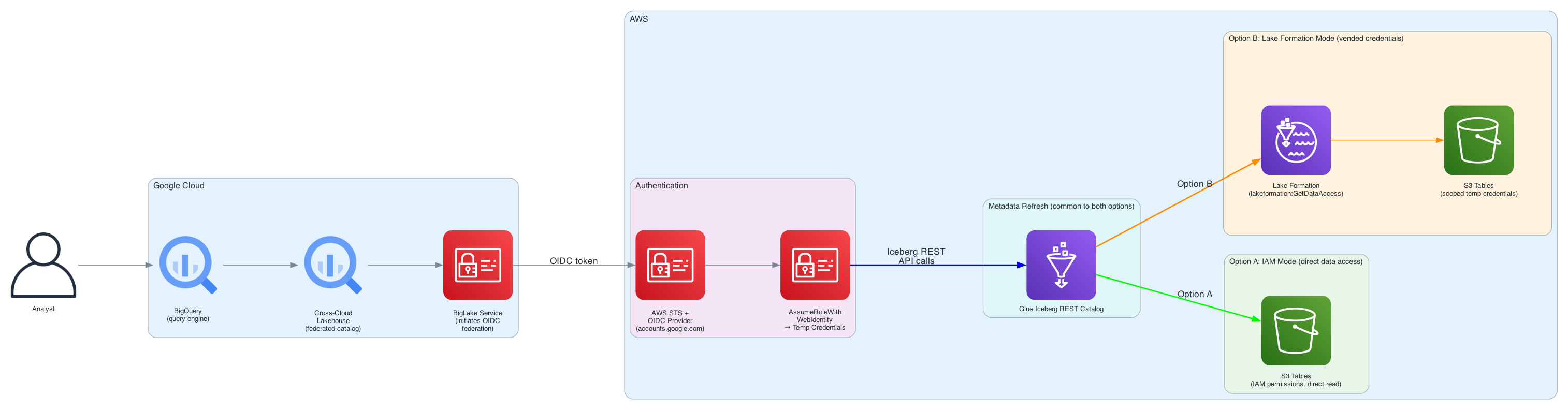
Figure 1: Architecture diagram showing BigQuery connecting to Amazon S3 Tables through the AWS Glue Iceberg REST Catalog
The key components in this architecture:
- Amazon S3 Tables: With Amazon S3 Tables, you get a fully managed Apache Iceberg table experience in Amazon S3, optimized for analytics workloads. You can register table metadata in the AWS Glue Data Catalog for discovery and governance.
- AWS Glue Data Catalog: With AWS Glue Data Catalog, you can access the federated
s3tablescatalogcatalog that maps S3 Tables resources (table buckets, namespaces, tables) into a catalog hierarchy from supported analytics engines. The standard Iceberg REST endpoint of Glue Data Catalog serves table metadata to external engines. BigQuery connects through this endpoint. - Google Cross-Cloud Lakehouse: With Google Cross-Cloud Lakehouse, you can connect BigQuery to external Iceberg catalogs. It assumes an AWS IAM role using OpenID Connect (OIDC), calls the Glue Iceberg REST endpoint, and syncs metadata on a configurable refresh interval.
Prerequisites
Before you begin, you need:
- An AWS account with Amazon S3 Tables available in your AWS Region.
- A Google Cloud project with billing enabled and the BigLake API activated.
- AWS Command Line Interface (AWS CLI) and gcloud CLI installed and configured.
- An S3 table bucket with at least one namespace and table containing data.
Setting up Amazon S3 Tables
If you already have S3 Tables with data, skip to the next section. Otherwise, create a table bucket, namespace, and populate a table.
Create a table bucket and namespace
Use the AWS CLI to create resources as follows:
Integrating S3 Tables with the Glue Data Catalog
For BigQuery to access S3 Tables, the tables must be discoverable through the Glue Data Catalog. S3 Tables integrates with Glue through a federated catalog called s3tablescatalog.
Set up S3 Tables integration with the Glue Data Catalog using IAM mode
Open the Amazon S3 console:
- In the navigation pane, choose Table buckets.
- Choose Enable integration, and then choose Enable integration again to confirm.
This creates the s3tablescatalog federated catalog in Glue, where access is controlled entirely by IAM policies on the calling role. This is a one-time setup per account and Region. After you enable it, the analytics integration applies to all table buckets in your account.

Figure 2: Enabling the S3 Tables integration in the Amazon S3 console
Alternatively, create the catalog using the AWS CLI:
Create a table and insert data
Now, to create the table and insert data, open the Amazon Athena console. In the query editor, select s3tablescatalog/<TABLE_BUCKET_NAME> as your data source and <NAMESPACE> as the database. Then run the following SQL statements one by one:
Configuring cross-cloud access
BigQuery assumes an AWS IAM role via OIDC federation to access the Glue IRC. This section walks through creating the role, OIDC provider, and permissions.
Create the OIDC identity provider
Register Google as an OIDC identity provider in your AWS account. This allows AWS to validate tokens issued by Google’s identity service:
The –thumbprint-list parameter is optional. When omitted, IAM automatically retrieves the thumbprint from the OIDC provider’s certificate. See AWS documentation for details.
Create the cross-cloud IAM role
Login into AWS Console, and create the role with a placeholder trust policy. You will update it with the actual BigLake service account ID after you create the federated catalog in Google Cloud.
The --max-session-duration 43200 allows sessions up to 12 hours, which is needed for long-running BigQuery queries.
Attach permissions
The permissions policy differs based on your access control approach. For the IAM-based approach, attach the following policy:
Connecting BigQuery to S3 Tables
With the AWS side configured, create the federated catalog in Google Cloud that connects BigQuery to the Glue IRC.
Create the federated catalog
Authenticate to Google Cloud using gcloud auth login, or use Cloud Shell, which is pre-authenticated. Verify that the BigLake API is enabled:
For IAM mode:
The --glue-warehouse parameter uses the format <AWS_ACCOUNT_ID>:s3tablescatalog/<TABLE_BUCKET>. This tells the Glue IRC to scope requests to your specific S3 Tables bucket within the federated catalog hierarchy.
The --primary-location refers to the Google Cloud region where the federated catalog metadata is stored. Use the AWS to Google Cloud region mapping to find the corresponding GCP region for your AWS Region. For example, AWS us-east-1 maps to GCP us-east4.
Retrieve the BigLake service account ID
After catalog creation, Google provisions a dedicated service account for your federated catalog. Retrieve its numeric ID:
Update the AWS trust policy
Back on AWS, replace the placeholder in the IAM role’s trust policy with the actual service account ID:
Register the service account ID in the OIDC provider’s audience list. Without this step, AWS rejects the token because the aud claim doesn’t match any registered client:
Set up metadata sync
Wait 3–5 minutes for IAM changes to propagate globally, then set up background refresh:
The --refresh-interval (300 seconds in this example) determines how often BigQuery syncs metadata from the Glue IRC. New tables and schema changes appear in BigQuery within this interval.
Querying from BigQuery
After the catalog refresh completes, BigQuery automatically creates external datasets corresponding to the synced namespaces. No manual CREATE SCHEMA is required.
Verify the sync:
Run a query in BigQuery:
Sample Query Output:
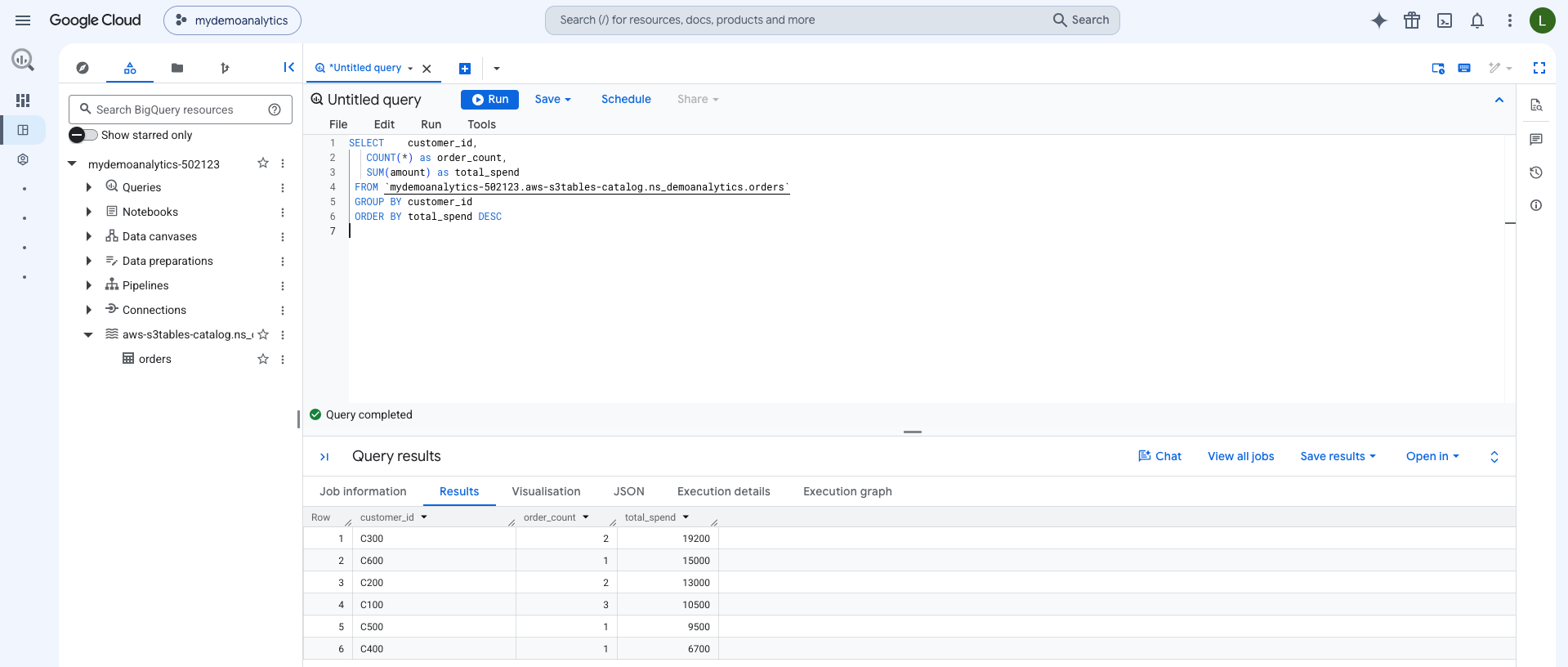
Figure 3: BigQuery query results returned directly from the Amazon S3 Tables data
BigQuery reads the Iceberg metadata to identify which Parquet data files contain relevant data. It also applies partition pruning where applicable, and fetches only the necessary files from S3 Tables managed storage.
Schema evolution
When new columns are added to an Iceberg table on the AWS side (through Spark, Athena, or the Glue IRC), the schema change is captured in Iceberg’s metadata. On the next Lakehouse refresh cycle, BigQuery picks up the new columns automatically. No DDL changes are needed in BigQuery.
Metadata freshness
The s3tablescatalog in Glue is a federated catalog that resolves table metadata live from the S3 Tables service on each request. When a streaming job commits new data to an S3 Table, the latest metadata is immediately available through the AWS Glue IRC. BigQuery sees the update on its next refresh cycle (as configured by --refresh-interval).
OIDC identity federation
The trust relationship between Google Cloud and AWS uses OpenID Connect. When BigQuery Lakehouse needs to access your data, it presents a signed JWT token containing:
iss:accounts.google.com(the issuer)sub: The BigLake service account ID (identifies which catalog is making the request)aud: The same service account ID (the intended audience)
AWS validates this token against the registered OIDC provider and trust policy conditions before issuing temporary credentials. Each federated catalog receives a unique service account ID, providing per-catalog isolation and auditability through AWS CloudTrail.
Network path
By default, traffic between BigQuery and AWS travels over the public internet. For workloads requiring private connectivity, Google Cloud supports Cross-Cloud Interconnect or Partner Interconnect. This helps routing queries over a dedicated network path. Refer to the Google Cloud documentation for private interconnect configuration.
Clean up
To avoid ongoing charges, remove the resources created in this walkthrough.
On AWS:
On Google Cloud:
Conclusion
This post demonstrated how to query Amazon S3 Tables from Google BigQuery using the open Apache Iceberg format and the AWS Glue Iceberg REST Catalog as the metadata bridge. Using Apache Iceberg’s open format, you can write data once on AWS and read it from supported engines that speak Iceberg, including BigQuery. We used IAM-based access control to govern access to both Glue Data Catalog metadata and the underlying Amazon S3 Tables data. This is the simpler configuration path with fewer components. In Part 2, we walk through configuring AWS Lake Formation to vend temporary, scoped credentials to BigQuery for data access.
To get started with this pattern in your environment:
- Review the Amazon S3 Tables documentation for table bucket setup.
- Follow the Google Cloud cross-cloud Lakehouse setup guide for the BigQuery federation configuration.
- Explore the AWS Glue Iceberg REST Catalog APIs for programmatic access patterns.