AWS Big Data Blog
Verisk cuts processing time and storage costs with Amazon Redshift and lakehouse
This post is co-written with Srinivasa Are, Principal Cloud Architect, and Karthick Shanmugam, Head of Architecture Verisk EES (Extreme Event Solutions).
Verisk, a catastrophe modeling SaaS provider serving insurance and reinsurance companies worldwide, cut processing time from hours to minutes-level aggregations while reducing storage costs by implementing a lakehouse architecture with Amazon Redshift and Apache Iceberg. If you’re managing billions of catastrophe modeling records across hurricanes, earthquakes, and wildfires, this approach eliminates the traditional compute-versus-cost trade-off by separating storage from processing power.
In this post, we examine Verisk’s lakehouse implementation, focusing on four architectural decisions that delivered measurable improvements:
- Execution performance: Sub-hour aggregations across billions of records replaced long batch process
- Storage efficiency: Columnar Parquet compression reduced costs without sacrificing response time
- Multi-tenant security: Schema-level isolation enforced complete data separation between insurance clients
- Schema flexibility: Apache Iceberg support column additions and historical data access without downtime
The architecture separates compute (Amazon Redshift) from storage (Amazon S3), demonstrating how to scale from billions to trillions of records without proportional cost increases.
Current state and challenges
In Verisk’s world of risk analytics, data volumes grow at exponential rates. Every day, risk modeling systems generate billions of rows of structured and semi-structured data. Each record captures a micro-slice of exposure, event probability, or loss correlation. To convert this raw information into actionable insights at scale, experts need a data engine designed for high-volume analytical workloads.
Each Verisk model run produces detailed, high-granularity outputs that include billions of simulated risk factors and event-level results, multi-year loss projections across thousands of perils, and deep relational joins across exposure, policy, and claims datasets.
Running meaningful aggregations (such as, loss by region, peril, or occupancy type) over such high volumes created performance challenges.
Verisk needed to build a SQL service that could aggregate at scale in the fastest time possible and integrate into their broader AWS solutions, requiring a serverless, open, and performant SQL engine capable of handling billions of records efficiently.
Prior to this cloud-based release, Verisk’s risk analytics infrastructure operated on an on-premises architecture centered around relational database clusters. Processing nodes shared access to centralized storage volumes through dedicated interconnect networks. This architecture required capital investment in server hardware, storage arrays, and networking equipment. The deployment model required manual capacity planning and provisioning cycles, limiting the organization’s ability to respond to fluctuating workload demands. Database operations depended on batch-oriented processing windows, with analytical queries competing for shared compute resources.
Amazon Redshift and lakehouse architecture
Lakehouse architecture on AWS combines data lake storage scalability with data warehouse analytical performance in a unified architecture. This architecture stores vast amounts of structured and semi-structured data in cost-effective Amazon S3 storage while maintaining Amazon Redshift’s massively parallel SQL analytics.
Amazon Redshift is a fully managed, petabyte-scale cloud data warehouse service that delivers fast query performance using massively parallel processing (MPP) and columnar storage. Amazon Redshift eliminates the complexity of provisioning hardware, installing software, and managing infrastructure, keeping focus on deriving insights from their data rather than maintaining systems.
To meet their challenge, Verisk designed a hybrid data lakehouse architecture that combines the storage scalability of Amazon S3 with the compute power of Amazon Redshift. The following diagram shows the foundational compute and storage architecture that powers Verisk’s analytical solution.
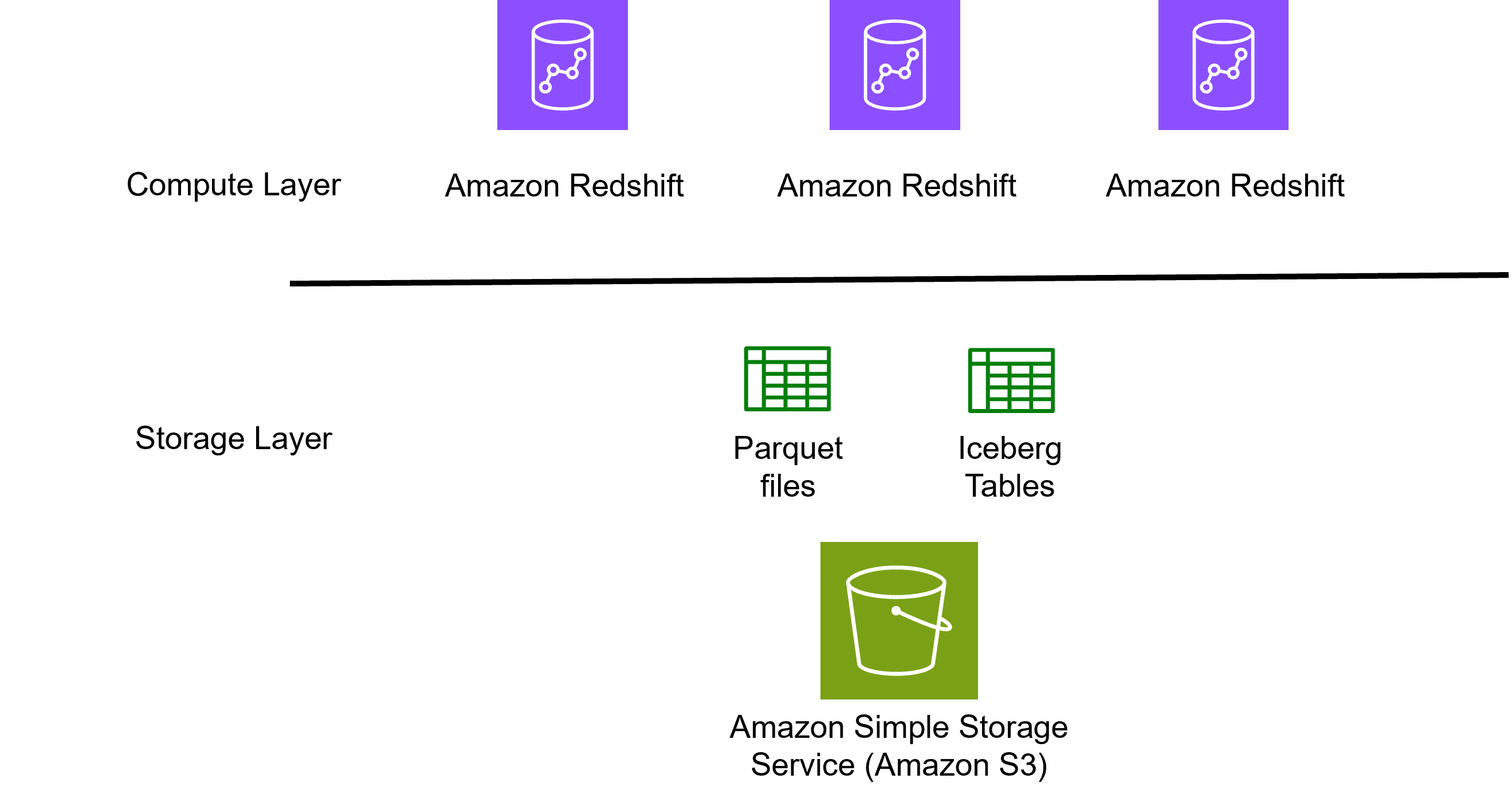
Architecture Overview
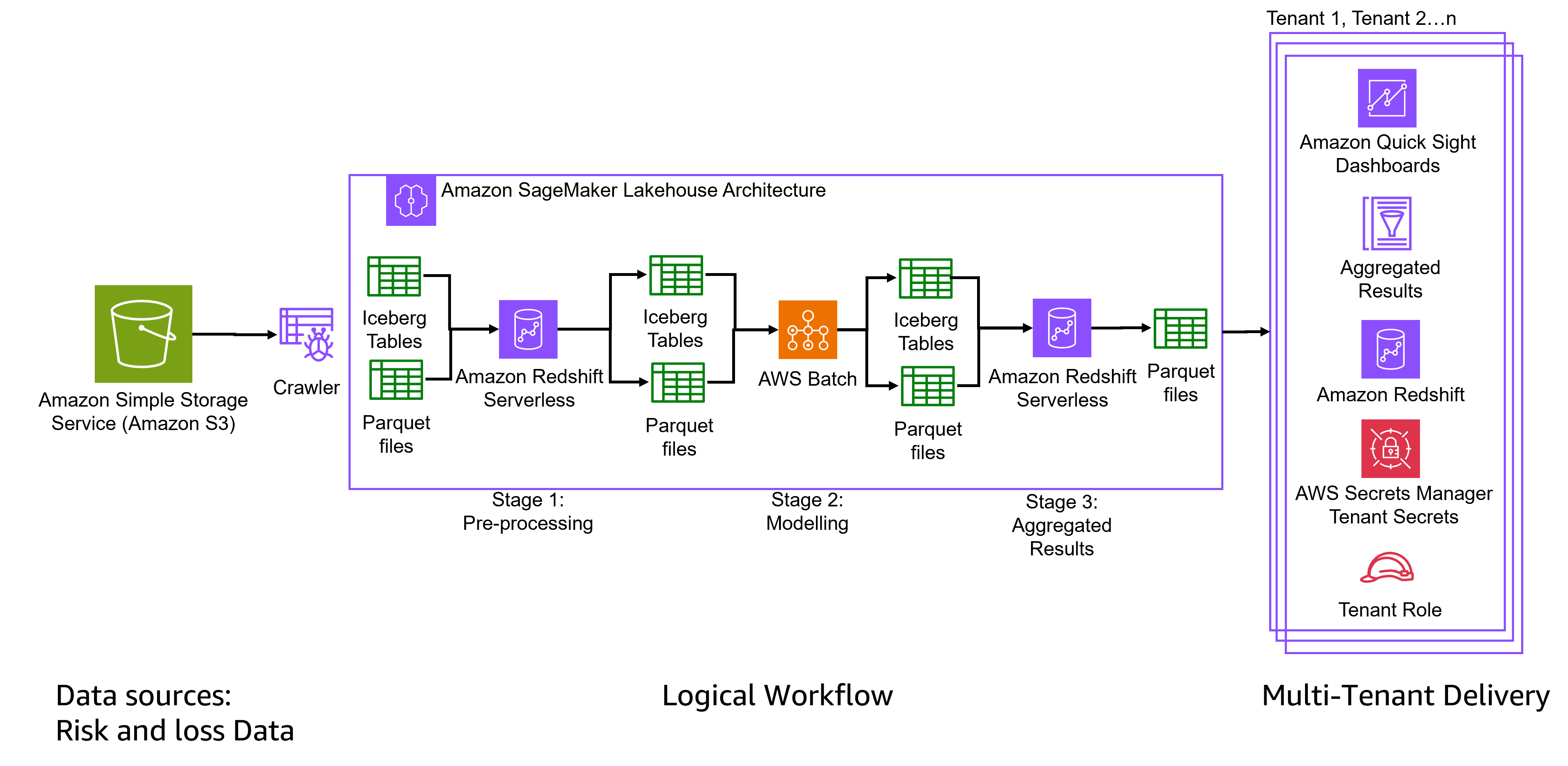
The architecture processes risk and loss data through three distinct stages within the lakehouse architecture, with comprehensive multi-tenant delivery capabilities to maintain isolation between insurance clients.
Amazon Redshift allows retrieving data directly from S3 using standard SQL for background processing. This solution collects detailed result outputs, join them with internal reference data, and executes aggregations over billions of rows. Concurrency scaling guarantees that hundreds of background analyses using multiple serverless clusters can run simultaneous aggregation queries.
The following diagram shows the architecture designed by Verisk
Data ingestion and storage foundation
Verisk stores risk model outputs, location level losses, exposure tables, and model data in columnar Parquet format within Amazon S3. An AWS Glue crawler extracts metadata from S3 and feeds it into the lakehouse processing pipeline.
For versioned datasets like exposure tables, Verisk adopted Apache Iceberg, an open table format that addresses schema evolution and historical versioning requirements. Apache Iceberg provides transactional consistency through atomicity, consistency, isolation, durability ACID-compliant operations that maintain consistent snapshots during concurrent updates. Snapshot-based time travel allows data retrieval at previous points in time for regulatory compliance, audit trails, and model comparison with rollback capabilities. Schema evolution supports adding, dropping, or renaming columns without downtime or dataset rewrites. Incremental processing uses metadata tracking to process only changed data, reducing refresh times. Hidden partitioning and file-level statistics reduce I/O operations, improving aggregation performance. Engine interoperability allows accessing the same tables across Amazon Redshift, Amazon Athena, Spark, and other engines without data duplication.
Verisk built a foundation that combines S3’s cost-effectiveness with data management by adopting Apache Iceberg as open table format for this solution.
Three-stage processing pipeline
This pipeline orchestrates data flow from raw inputs to analytical outputs through three sequential stages. Pre-processing prepares and cleanses data, modeling applies risk calculations and analytics, and post-processing aggregates results for delivery.
- Stage 1: Pre-processing transforms raw data into structured formats using Iceberg Tables and Parquet files, then processes it through Amazon Redshift Serverless for initial data cleaning and transformation.
- Stage 2: Modeling takes place with a process built on AWS Batch the pre-processed data and applies advanced analytics and feature engineering. Results are stored in Iceberg Tables and Parquet files.
- Stage 3: Aggregated Results are obtained during post-processing using Amazon Redshift Serverless, it produces the final analytical outputs in Parquet files, ready for consumption by end users.
Multi-tenant delivery system
The architecture delivers results to multiple insurance clients (tenants) through a secure, isolated delivery system that includes:
- Amazon Quick Sight dashboards for visualization and business intelligence
- Amazon Redshift as the data warehouse for querying aggregated results
- AWS Batch for modelling processing.
- AWS Secrets Manager to manage tenant-specific credentials
- Tenant Roles implementing role-based access control to provide data isolation between clients
Summarized results are exposed through Amazon Quick Sight dashboards or downstream APIs to underwriting teams.
Multi-tenant security architecture
A critical requirement for Verisk’s SaaS solution was supporting comprehensive data and compute isolation between different insurance and reinsurance clients. Verisk implemented a comprehensive multi-tenant security model that provides isolation while maintaining operational efficiency.
Our solution implements an isolation strategy in two layers combining logical and physical separation. At the logical layer, each client’s data resides in dedicated schemas with access controls that prevent cross-tenant operations. Amazon Redshift Metadata security restricts tenants from discovering or accessing other clients’ schemas, tables, or database objects through system catalogs. At the physical layer, for larger deployments, dedicated Amazon Redshift clusters provide workload separation at the compute level, preventing one tenant’s analytical operations from impacting another’s performance. This dual approach meets regulatory requirements for data isolation in the insurance industry through schema-level isolation within clusters for standard deployments and complete compute separation across dedicated clusters for larger-scale implementations.
The implementation uses stored procedures to automate security configuration, maintaining consistent application of access controls across tenants. This defense-in-depth approach combines schema-level isolation, system catalog lockdown, and selective permission grants to create a security model.
For data architects interested in implementing similar multi-tenant architectures, review Implementing Metadata Security for Multi-Tenant Amazon Redshift Environment.
Implementation considerations
Verisk’s architecture reveals three decision points for companies building similar systems.
When to adopt open table formats
Apache Iceberg proved essential for datasets requiring schema evolution and historical versioning. Data engineers should evaluate open table formats when analytical workloads span multiple engines (Amazon Redshift, Amazon Athena, Spark) or when regulatory requirements demand point-in-time data reconstruction.
Multi-tenant isolation strategy
Schema-level separation combined with metadata security prevented cross-tenant data discovery without performance overhead. This approach scales more efficiently than database-per-tenant architectures while meeting insurance industry compliance requirements. Security experts should implement isolation controls during initial deployment rather than retrofitting them later.
Stored procedures or application logic
Redshift stored procedures standardized aggregation calculations across teams and constructed dynamic SQL queries. This approach works best when business logic changes frequently or when multiple teams need different aggregation dimensions on the same datasets.
Conclusion
Verisk’s implementation of Amazon Redshift Serverless with Apache Iceberg and lakehouse architecture shows how separating compute from storage addresses enterprise analytics challenges at billion-record scale. By combining cost-effective Amazon S3 storage with Redshift’s massively parallel SQL compute, Verisk achieved aggregations across billions of catastrophe modeling records, reduced storage costs through efficient parquet compression, and eliminated ingestion delays. Now underwriting teams can run ad-hoc analyses during business hours rather than waiting for long-running batch jobs. The combination of open standards like Apache Iceberg, serverless compute with Amazon Redshift, and multi-tenant security provides the scalability, performance, and cost efficiency needed for modern analytics workloads.
Verisk’s journey has positioned them to scale confidently into the future, processing not just billions, but potentially trillions of records as their model resolution increases.