AWS Compute Blog
Category: Amazon EC2

Bringing Datacenter-Scale Hardware-Software Co-design to the Cloud with FireSim and Amazon EC2 F1 Instances
The recent addition of Xilinx FPGAs to AWS Cloud compute offerings is one way that AWS is enabling global growth in the areas of advanced analytics, deep learning and AI. The customized F1 servers use pooled accelerators, enabling interconnectivity of up to 8 FPGAs, each one including 64 GiB DDR4 ECC protected memory, with a […]
Automating Security Group Updates with AWS Lambda
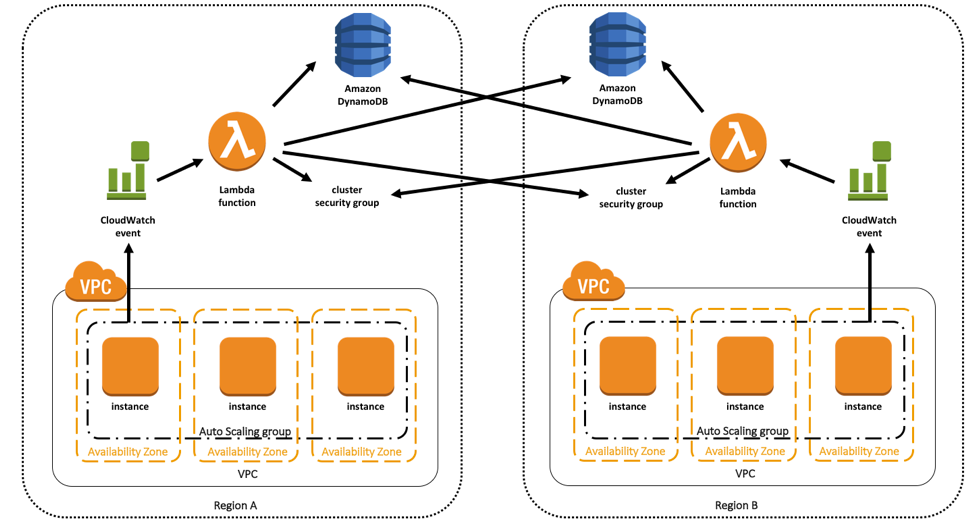
Customers often use public endpoints to perform cross-region replication or other application layer communication to remote regions. But a common problem is how do you protect these endpoints? It can be tempting to open up the security groups to the world due to the complexity of keeping security groups in sync across regions with a […]

Automating Amazon EBS Snapshot Management with AWS Step Functions and Amazon CloudWatch Events
Brittany Doncaster, Solutions Architect Business continuity is important for building mission-critical workloads on AWS. As an AWS customer, you might define recovery point objectives (RPO) and recovery time objectives (RTO) for different tier applications in your business. After the RPO and RTO requirements are defined, it is up to your architects to determine how to […]
Disabling Intel Hyper-Threading Technology on Amazon EC2 Windows Instances
NOTE: In May of 2018, AWS announced Optimize CPUs for Amazon EC2 Instances. This feature allows customers to disable Hyper-Threading for workloads that perform well with single-threaded CPUs, like certain high-performance computing (HPC) applications. You can read more in the EC2 User Guide. In a prior post, Disabling Intel Hyper-Threading on Amazon Linux, I investigated how […]
Building Loosely Coupled, Scalable, C# Applications with Amazon SQS and Amazon SNS
Stephen Liedig, Solutions Architect One of the many challenges professional software architects and developers face is how to make cloud-native applications scalable, fault-tolerant, and highly available. Fundamental to your project success is understanding the importance of making systems highly cohesive and loosely coupled. That means considering the multi-dimensional facets of system coupling to […]
Using Amazon SQS Dead-Letter Queues to Control Message Failure
Michael G. Khmelnitsky, Senior Programmer Writer Sometimes, messages can’t be processed because of a variety of possible issues, such as erroneous conditions within the producer or consumer application. For example, if a user places an order within a certain number of minutes of creating an account, the producer might pass a message with an […]
Building High-Throughput Genomics Batch Workflows on AWS: Workflow Layer (Part 4 of 4)
This post is courtesy of Aaron Friedman – Healthcare and Life Sciences Partner Solutions Architect at AWS and Angel Pizarro – Scientific Computing Technical Business Development Manager at AWS This post is the fourth in a series on how to build a genomics workflow on AWS. In Part 1, we introduced a general architecture, shown below, and […]
Building Scalable Applications and Microservices: Adding Messaging to Your Toolbox
Jakub Wojciak, Senior Software Development Engineer Throughout our careers, we developers keep adding new tools to our development toolboxes. These range from the programming languages we learn, use, and become experts in, to architectural components such as HTTP servers, load balancers, and databases (both relational and NoSQL). I’d like to kick off a series of […]
Disabling Intel Hyper-Threading Technology on Amazon Linux
This post is courtesy of Brian Beach, AWS Solutions Architect Update – July 31, 2020: It has been brought to our attention that certain AWS EC2 instance types will have different delimiters in the thread_siblings_list depending on CPU architecture and Operating System (either a comma or a dash). To determine the delimiter for your instance run […]
Automating the Creation of Consistent Amazon EBS Snapshots with Amazon EC2 Systems Manager (Part 2)
Nicolas Malaval, AWS Professional Consultant In my previous blog post, I discussed the challenge of creating Amazon EBS snapshots when you cannot turn off the instance during backup because this might exclude any data that has been cached by any applications or the operating system. I showed how you can use EC2 Systems Manager to […]