AWS Compute Blog
Category: Uncategorized

Blue/Green Deployments with Amazon Elastic Container Service
This post and accompanying code was generously contributed by: Jeremy Cowan Solutions Architect Anuj Sharma DevOps Cloud Architect Peter Dalbhanjan Solutions Architect Deploying software updates in traditional non-containerized environments is hard and fraught with risk. When you write your deployment package or script, you have to assume that the target machine is in a particular […]

Deploying a 4x4K, GPU-backed Linux desktop instance on AWS
Contributed by Amr Ragab, HPC Application Consultant, AWS Professional Services AWS currently supports many managed desktop delivery mechanisms. Amazon WorkSpaces and Amazon AppStream 2.0 both deliver managed Windows-based machine images with GPU-backed instances. However, many desktop services and applications are better served through a Linux backed instance. Given the variety of Linux distributions as well […]

Monitoring your Amazon SNS message filtering activity with Amazon CloudWatch
This post is courtesy of Otavio Ferreira, Manager, Amazon SNS, AWS Messaging. Amazon SNS message filtering provides a set of string and numeric matching operators that allow each subscription to receive only the messages of interest. Hence, SNS message filtering can simplify your pub/sub messaging architecture by offloading the message filtering logic from your subscriber systems, as well […]

New Amazon EC2 Spot pricing model: Simplified purchasing without bidding and fewer interruptions
Contributed by Deepthi Chelupati and Roshni Pary Amazon EC2 Spot Instances offer spare compute capacity in the AWS Cloud at steep discounts. Customers—including Yelp, NASA JPL, FINRA, and Autodesk—use Spot Instances to reduce costs and get faster results. Spot Instances provide acceleration, scale, and deep cost savings to big data workloads, containerized applications such as […]
Taking Advantage of Amazon EC2 Spot Instance Interruption Notices
Amazon EC2 Spot Instances are spare compute capacity in the AWS Cloud available to you at steep discounts compared to On-Demand prices. The only difference between On-Demand Instances and Spot Instances is that Spot Instances can be interrupted by Amazon EC2 with two minutes of notification when EC2 needs the capacity back. Customers have been […]

Applying the Twelve-Factor App Methodology to Serverless Applications
The Twelve-Factor App methodology is twelve best practices for building modern, cloud-native applications. With guidance on things like configuration, deployment, runtime, and multiple service communication, the Twelve-Factor model prescribes best practices that apply to a diverse number of use cases, from web applications and APIs to data processing applications. Although serverless computing and AWS Lambda […]
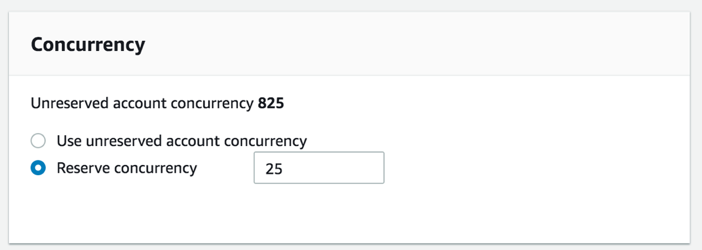
Managing AWS Lambda Function Concurrency
One of the key benefits of serverless applications is the ease in which they can scale to meet traffic demands or requests, with little to no need for capacity planning. In AWS Lambda, which is the core of the serverless platform at AWS, the unit of scale is a concurrent execution. This refers to the […]

Implementing Dynamic ETL Pipelines Using AWS Step Functions
This post contributed by: Wangechi Dole, AWS Solutions Architect Milan Krasnansky, ING, Digital Solutions Developer, SGK Rian Mookencherry, Director – Product Innovation, SGK Data processing and transformation is a common use case you see in our customer case studies and success stories. Often, customers deal with complex data from a variety of sources that needs […]

AWS Fargate: A Product Overview
It was just about three years ago that AWS announced Amazon Elastic Container Service (Amazon ECS), to run and manage containers at scale on AWS. With Amazon ECS, you’ve been able to run your workloads at high scale and availability without having to worry about running your own cluster management and container orchestration software. Today, […]
Simplify Your Pub/Sub Messaging with Amazon SNS Message Filtering
Contributed by: Stephen Liedig, Senior Solutions Architect, ANZ Public Sector, and Otavio Ferreira, Manager, Amazon Simple Notification Service Want to make your cloud-native applications scalable, fault-tolerant, and highly available? Recently, we wrote a couple of posts about using AWS messaging services Amazon SQS and Amazon SNS to address messaging patterns for loosely coupled communication between highly cohesive components. For […]