AWS Compute Blog
Category: Uncategorized

Working with AWS Lambda and Lambda Layers in AWS SAM
The introduction of serverless technology has enabled developers to shed the burden of managing infrastructure and concentrate on their application code. AWS Lambda has taken on that management by providing isolated, event-driven compute environments for the execution of application code. To use a Lambda function, a developer just needs to package their code and any […]

Learn about hourly-replication in Server Migration Service and the ability to migrate large data volumes
This post courtesy of Shane Baldacchino, AWS Solutions Architect AWS Server Migration Service (AWS SMS) is an agentless service that makes it easier and faster for you to migrate thousands of on-premises workloads to AWS. AWS SMS allows you to automate, schedule, and track incremental replications of live server volumes, making it easier for you […]

Migrate Wildfly Cluster to Amazon ECS using Service Discovery
This post is courtesy of Vidya Narasimhan, AWS Solutions Architect 1. Overview Java Enterprise Edition has been an important server-side platform for over a decade for developing mission-critical & large-scale applications amongst enterprises. High-availability & fault tolerance for such applications is typically achieved through built-in JEE clustering provided by the platform. JEE clustering represents a […]
Migrating your Amazon ECS deployment to the new ARN and resource ID format
Update – August 21, 2020 – Added a section with the latest timeline. Starting today you can opt in to a new Amazon Resource Name (ARN) and resource ID format for Amazon ECS tasks, container instances, and services. The new format enables the enhanced ability to tag resources in your cluster, as well as tracking […]

Encrypting messages published to Amazon SNS with AWS KMS
Post by Otavio Ferreira, Software Development Manager, Amazon SNS — Amazon Simple Notification Service (Amazon SNS) is a fully managed pub/sub messaging service for decoupling event-driven microservices, distributed systems, and serverless applications. To address the requirements of highly critical workloads, Amazon SNS provides message encryption in transit, based on Amazon Trust Services (ATS) certificates, as well as message encryption at rest, using AWS Key Management Service (AWS KMS) keys.
Deploying a Burstable and Event-driven HPC Cluster on AWS Using SLURM, Part 2
Contributed by Amr Ragab, HPC Application Consultant, AWS Professional Services In part 1 of this series, you deployed the base components to create the HPC cluster. This unique deployment stands up the SLURM headnode. For every job submitted to the queue, the headnode provisions the needed compute resources to run the job, based on job […]

Automating rollback of failed Amazon ECS deployments
Contributed by Vinay Nadig, Associate Solutions Architect, AWS. With more and more organizations moving toward Agile development, it’s not uncommon to deploy code to production multiple times a day. With the increased speed of deployments, it’s imperative to have a mechanism in place where you can detect errors and roll back problematic deployments early. In […]
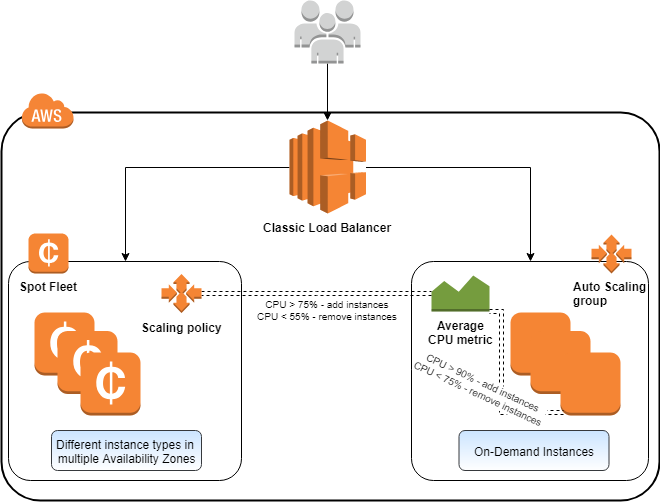
Running high-scale web applications on Amazon EC2 Spot Instances
NOTE: Amazon EC2 Auto Scaling groups now lets you mix On-Demand, Spot and RIs, as well as different instance types, as described here. In the architecture described below, the Spot Fleet component can be replaced by an EC2 Auto Scaling groups. Contributed by Ran Sheinberg, Spot Specialist Solutions Architect, and the Appnext team At re:Invent […]

Migrating a multi-tier application from a Microsoft Hyper-V environment using AWS SMS and AWS Migration Hub
This post courtesy of Shane Baldacchino, AWS Solutions Architect Many customers ask for guidance to migrate end-to-end solutions running in their on-premises data center to AWS. This post provides an overview of moving a common blogging platform, WordPress, running on an on-premises virtualized Microsoft Hyper-V platform to AWS, including re-pointing the DNS records associated to […]
Improving application performance and reducing costs with Amazon EBS-Optimized Instance burst capability
Contributed by Sooraj Prasannan, Senior Product Manager, Amazon Elastic Block Store In November 2017, Amazon EC2 introduced C5 compute-intensive instances and M5 general-purpose instances. In the first half of 2018, we released EC2 C5d instances and M5d instances by adding high-speed, ultra-low latency local NVMe storage to the EC2 C5 and M5 instance families. EC2 […]