AWS Database Blog

Set alarms on Performance Insights metrics using Amazon CloudWatch
Amazon RDS Performance Insights recently released a feature that sends key performance metrics from Performance Insights to Amazon CloudWatch. Using this feature, you can set alerts on these metrics. When Performance Insights is enabled, it automatically sends the following three metrics to CloudWatch: DBLoad DBLoadCPU DBLoadNonCPU I describe these three metrics following. DBLoad The first […]

Migrate Apache Cassandra databases to Amazon DynamoDB more easily
Customers tell us that migrating data between different database engines—also known as a heterogeneous migration—can be challenging and time consuming. Some customers such as Samsung had to figure out on their own how to migrate their Apache Cassandra databases to Amazon DynamoDB (see Moving a Galaxy into the Cloud: Best Practices from Samsung on Migrating […]

Using Amazon EBS elastic volumes with Oracle databases (part 1): Introduction
August, 2024: This post has been reviewed and updated for accuracy. With Amazon EBS feature Amazon EBS Elastic Volumes you can increase your EBS volume size, change IOPS or volume type while the volume is in use. You can make this change without having an impact on operations. In this series of three blog posts, […]

Migrate to native partitioned tables in PostgreSQL 10 using AWS Database Migration Service
We’re excited to introduce AWS Database Migration Service (AWS DMS) version 2.4.3, which includes support for migrating data to native partitioned tables in PostgreSQL 10. In this post, we discuss how you can use AWS DMS version 2.4.3 to migrate data from Oracle partitioned tables to PostgreSQL 10 natively partitioned tables. You can do so […]

Analyze Amazon Aurora MySQL Workloads with Performance Insights
In this blog post, we will take a quick tour of the Performance Insights dashboard for the Amazon Aurora MySQL-Compatible Edition and learn to analyze certain performance issues.
Replace SQL Server Agent Job with AWS Step Functions
If you’re migrating from Microsoft SQL Server to Amazon Aurora PostgreSQL, you might have discovered that the SQL agent jobs cannot be easily moved. The job agent tools are not supported for Aurora PostgreSQL. You can overcome this limitation though, by using AWS Step Functions to replace a SQL agent job. In this blog post […]

Monitor Amazon ElastiCache for Redis (cluster mode disabled) read replica endpoints using AWS Lambda, Amazon Route 53, and Amazon SNS
In Amazon ElastiCache for Redis, your applications use the provided endpoints to connect to an ElastiCache node or cluster. According to Amazon ElastiCache for Redis Components and Features in the ElastiCache for Redis User Guide, a multiple-node Redis (cluster mode disabled) cluster has two kinds of endpoints: “The primary endpoint always connects to the primary […]

Replicate data from Amazon Aurora to Amazon S3 with AWS Database Migration Service
In this blog post, I’ll cover how to use an AWS CloudFormation template to automate the configuration that allows you to replicate data between a relational database like Amazon Aurora to Amazon Simple Storage Service (Amazon S3). I’ll walk you through a sample CloudFormation template so that you can customize for your needs. The AWS […]

In-place version upgrades for Amazon Elasticsearch Service
September 8, 2021: Amazon Elasticsearch Service has been renamed to Amazon OpenSearch Service. See details. Today, Amazon Elasticsearch Service (Amazon ES) announces support for in-place Elasticsearch upgrades for domains that are running version 5.1 or later. This new feature lets you move to the latest release in the same major version (for example, 5.3 to […]
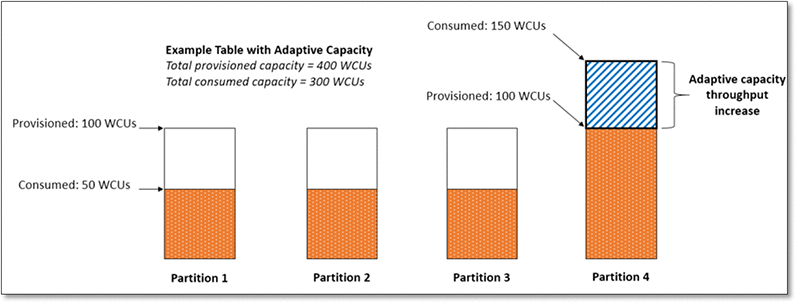
How Amazon DynamoDB adaptive capacity accommodates uneven data access patterns (or, why what you know about DynamoDB might be outdated)
May 24, 2019, update: Amazon DynamoDB adaptive capacity is now instant, instead of having a 5–30 minute reaction time. Instant adaptive capacity is now on by default for all DynamoDB tables and global secondary indexes. Amazon DynamoDB is a nonrelational database with high performance at any scale. It is a fully managed service that […]