AWS DevOps & Developer Productivity Blog
AWS Transform custom: Enterprise Code Modernization with the Learn-Scale-Improve Flywheel
Enterprise modernization has reached an inflection point. You can transform one repository easily. Existing tools, including AWS Transform custom, work well for individual repositories, and the process is understood. But what about 50 repositories? 100? 200? When you need to modernize at enterprise scale, transforming code is only part of the challenge. Coordinating people, capturing knowledge, and maintaining quality across your entire portfolio are also important.
In this post, we explore how AWS Transform custom’s bulk automation capabilities address the enterprise coordination problem through intelligent learning and scaled execution. You will see how one customer reduced end-to-end modernization timelines from 7-12 weeks to 2.5 weeks, delivering a 3-5x reduction in delivery time and 10-20x reduction in total effort hours. Most importantly, you will learn how to start your own transformation journey immediately.
The Coordination Problem at Enterprise Scale
Ask any enterprise architect about their last major modernization initiative, and you will hear familiar stories. As an example, an enterprise software company needed to migrate a large legacy codebase to a modern platform. Their projection: 12 weeks of intensive work coordinating across multiple teams.
The code transformation itself took days. The remaining weeks were consumed by the end-to-end activities surrounding it: orchestrating teams across time zones, ensuring consistent patterns across codebases with different histories, and managing dependencies so upstream changes did not break downstream systems. Teams tracked status through meetings and spreadsheets and captured tribal knowledge that existed only in senior developer heads.
This is the enterprise coordination problem. When you scale from one repository to hundreds, coordination overhead explodes. Each additional repository adds not just its own complexity, but new integration points, edge cases, and unanticipated coordination requirements.
The Hidden 70% Gap
In enterprise engagements, we have observed that code transformation represents approximately 30% of the modernization effort. The remaining 70% include things like test generation, validation, comprehensive documentation, business analysis, and organizational coordination across hundreds of moving pieces.
This gap explains why productivity gains from transformation tools rarely materialize. The tools handle code changes, but organizations still struggle with coordination, validation, and knowledge capture. The transformation is completed quickly, but the project takes months.
Here is what we see: traditional approaches fail at enterprise scale because they treat each repository as an independent challenge. Teams repeat work across codebases, make inconsistent decisions, and lose learnings when developers move to different projects. Organizational knowledge remains trapped in individual heads rather than becoming reusable assets.
A New Approach to Enterprise Modernization
AWS Transform custom takes a different approach to enterprise modernization. Rather than repeating the same operation hundreds of times, the service learns from every execution and applies that knowledge to improve future transformations.
The Learn-Scale-Improve Flywheel
The workflow follows a deliberate progression designed to maximize learning while minimizing risk. It begins with a focused learn pilot, scales through bulk automation, and improves through deliberate review, creating a flywheel where each cycle produces better results than the last (Figure 1).
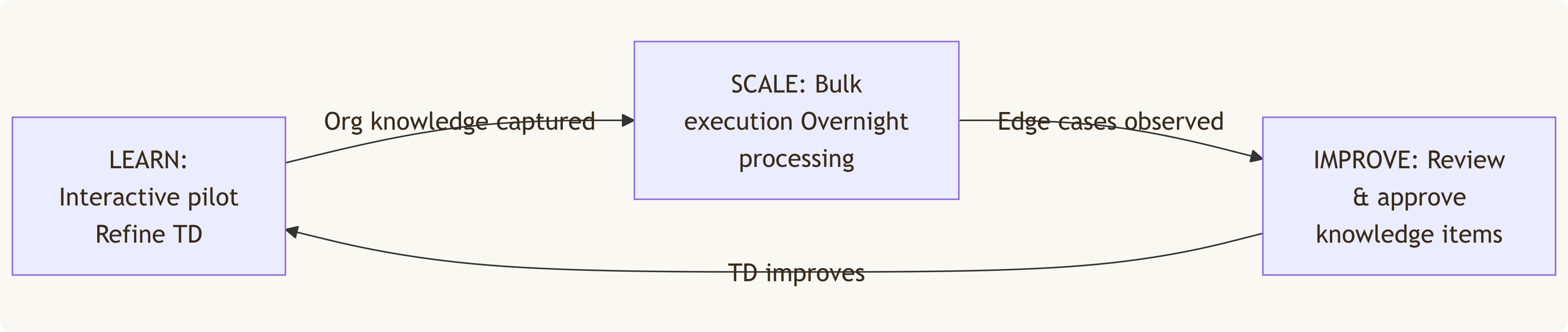
Figure 1: Learn Scale and Improve Flywheel for AWS Transform custom transformation
Learn — You start with two to three representative repositories and execute transformations in interactive mode. You work directly with the AI agent, providing feedback on decisions and validating quality at each step. When the agent encounters ambiguity, it asks questions. You provide guidance, and the system captures that context. At the end of the pilot, you review the feedback and modify the transformation definition. The result is a transformation definition enhanced with your organizational knowledge, ready to scale.
Scale — You shift to non-interactive mode for bulk execution. The system processes dozens or hundreds of repositories overnight without manual intervention, applying patterns learned during the pilot. It validates transformations using your build and test commands and tracks progress across your portfolio in real time. What previously required weeks of team coordination happens overnight. During execution, the system captures observations: new edge cases, unexpected patterns, and optimization opportunities the pilot did not encounter.
Improve — After each round of bulk execution, you review the knowledge items the system captured during processing. These observations surface patterns and edge cases specific to repositories the pilot did not cover. You approve the valuable learnings, and your transformation definition improves for the next iteration. This review step ensures quality control. The system does not self-modify. Transformation owners decide which learnings get incorporated.
The Scale-Improve cycle repeats. Each round of bulk execution generates insights that make the next round more effective. Transformation success rates increase, manual intervention decreases, and edge case handling improves with every iteration.
This flywheel transforms how enterprises capture and share institutional knowledge. Transformation definitions are not automation scripts. They are organizational assets that encode how your company approaches specific modernization scenarios. When an architect defines a transformation strategy, that strategy becomes a reusable definition stored in your registry. When your team identifies best practices, those practices become embedded within the transformation definition and automatically apply across all repositories. Previously, when a senior developer left your team, that knowledge disappears with them. With AWS Transform custom, their expertise is captured in transformation definitions and knowledge items available to the entire organization. Individual expertise becomes an organizational capability.
An Enterprise Customer Modernization Case Study
These productivity gains are production outcomes, not theoretical projections. An enterprise software company needed to migrate a large volume of production-grade Control-M workflows to Apache Airflow, a modernization requiring both technical precision and consistency across a complex, interdependent codebase. Their estimate was 12 weeks of intensive coordination across multiple teams, with risk of inconsistency and integration failures.
Using AWS Transform custom, the company executed an iterative learn-scale-improve workflow. During the pilot phase, they ran interactive transformations on representative repositories, reviewed results, and refined transformation definitions. With each iteration, transformation definitions improved in edge case handling and accuracy. They then shifted to non-interactive bulk execution across their portfolio and completed the full migration in 2.5 weeks.
The validation achieved a 100% success rate across all workflows in scope. Edge case handling improved by 60% compared to the customer’s existing approach, and the transformed code demonstrated a 19% runtime performance improvement while meeting industry expert code quality standards. This proves that organizations can achieve both migration speed and production readiness, with 3-5x faster delivery timelines and 10-20x reduction in total effort hours compared to traditional approaches.
Get Started: Transform Your Repository Portfolio
AWS Transform custom bulk automation capabilities are available as a solution in this Github repo. Follow the learn-scale-improve workflow to begin your transformation journey.
Prerequisites
Before beginning, ensure you have:
- An AWS account with AWS Transform custom access enabled
- AWS CLI configured with appropriate credentials
- Git installed on your local machine or CI/CD environment
- IAM permissions for AWS Transform custom operations
Your Implementation Path
AWS Transform custom supports Java upgrades (e.g., 8 to 17, 17 to 21), Python migrations (e.g., 3.7 to 3.11), Node.js updates (e.g., 14 to 20), AWS SDK migrations (e.g., boto2 to boto3, SDK v1 to v2), and other transformations. Beyond these AWS-managed transformations, you can create custom transformation definitions for organization-specific standards, proprietary framework migrations, and architectural patterns unique to your environment.
AWS Transform custom integrates naturally into your existing development processes. The CLI connects with CI/CD pipelines like Jenkins, GitLab CI, or GitHub Actions. Transformations create code in local Git branches that flow through your standard code review and merge processes. The web interface provides centralized visibility for tracking progress across teams. Validation commands execute automatically during transformation, ensuring code builds successfully and tests pass before changes are considered complete. At the end of the transformation, if validation criteria fail, the transformation is marked as failed.
To accelerate your path to scaled execution, AWS provides an open-source sample repository that gives you a production-ready starting point for running transformations across multiple repositories and transformation definitions simultaneously. The aws-transform-custom-samples scaled execution repository includes scripts that orchestrate bulk execution, manage repository queuing, and handle status tracking across your portfolio. Rather than building orchestration from scratch, you clone the sample, configure it with your repository list and transformation definitions, and begin executing scaled transformations immediately.
Conclusion
Enterprise modernization at scale requires more than code transformation tools. The real challenges are coordination across teams, learning from execution, and capturing knowledge as organizational assets. AWS Transform custom learn-scale-improve workflow addresses these challenges through continual learning that improves quality with every execution, organizational knowledge capture that transforms tribal expertise into reusable assets, and bulk automation that scales consistently across hundreds of repositories. When the next critical security vulnerability requires framework updates across your repositories, or a new runtime version unlocks performance improvements, you respond in days rather than months — using transformation definitions you have already proven.
Real customers have reduced delivery timelines by 3-5x and total effort hours by 10-20x, compressing modernization from months to weeks. These are not aspirational goals. They are production results from organizations using AWS Transform custom today.
Begin Your Transformation Today
Follow the learn-scale-improve workflow on two to three representative repositories, refine your transformation definitions, then scale across your portfolio.
To dive deeper into AWS Transform custom bulk automation capabilities, explore these resources:
-
-
- AWS Transform custom Documentation — Technical documentation covering all capabilities, API references, and integration guides: AWS Transform custom
- Scaled Execution Sample Repository — Open-source scripts for running transformations across multiple repositories and transformation definitions: aws-transform-custom-samples
- Transformation Registry — Discover AWS-managed transformations and create custom definitions: aws-transform-custom-samples
-
Contact your AWS account team or visit the AWS Transform custom documentation to begin your journey.