AWS DevOps & Developer Productivity Blog
How British Airways is accelerating the modernization of its Java services
At British Airways (BA), engineering at scale means supporting services used across the airline for millions of passengers, while simultaneously preparing for what comes next. After completing a major migration of legacy data center infrastructure to AWS, the next question was how BA could use its new cloud capabilities to improve scalability and efficiency. The team also wanted to accelerate the next phase of modernization.
As part of this next phase, BA began exploring how agentic AI could help accelerate the modernization of its technology estate. Working with AWS, the team identified AWS Transform custom as a way to support this at scale. This purpose-built solution is designed to modernize large legacy platforms using agentic AI and automation. The first major target was a legacy Java platform of more than 250 business services across around 750 code repositories. BA set out to migrate it from Amazon Elastic Compute Cloud (Amazon EC2) to a modern, cloud-native architecture on Amazon Elastic Container Service (Amazon ECS) with AWS Fargate and AWS Graviton. The new architecture is containerized, auto scaling, and resilient by design.
About British Airways
British Airways is the UK’s flag carrier airline, serving more than 40 million customers annually across more than 200 destinations worldwide, and a subsidiary of International Airlines Group (IAG).
Challenge
British Airways’ Java platform had supported the airline for many years, but maintaining and updating it required valuable engineering time that could be more efficiently spent advancing innovation. As BA continued to modernize its technology foundations, the team identified an opportunity to move services to a more scalable architecture and simplify their ongoing management.
“Can AI really transform hundreds of code repositories at enterprise scale? That was the question everyone asked when we started this journey. With more than 250 business services on a legacy platform, maintaining the estate demanded considerable engineering time. We needed a more efficient approach that would free our teams to focus on innovation rather than routine maintenance.”
— Gary Holland, Principal Platform Architect at British Airways
Solution
British Airways partnered with AWS to deploy AWS Transform custom, purpose-built to modernize large legacy estates using agentic AI and automation. Starting with an Experience Based Acceleration (EBA) using Amazon Q Developer, the team moved swiftly. When AWS Transform custom launched at AWS re:Invent 2025, BA was among the first to build with it. Its first fully transformed service went live in production shortly after.
How the transformation engine works
Each service passes through a 20-step transformation lifecycle that blends deterministic automation with agentic AI, designed to be repeatable across hundreds of services without manual re-engineering.
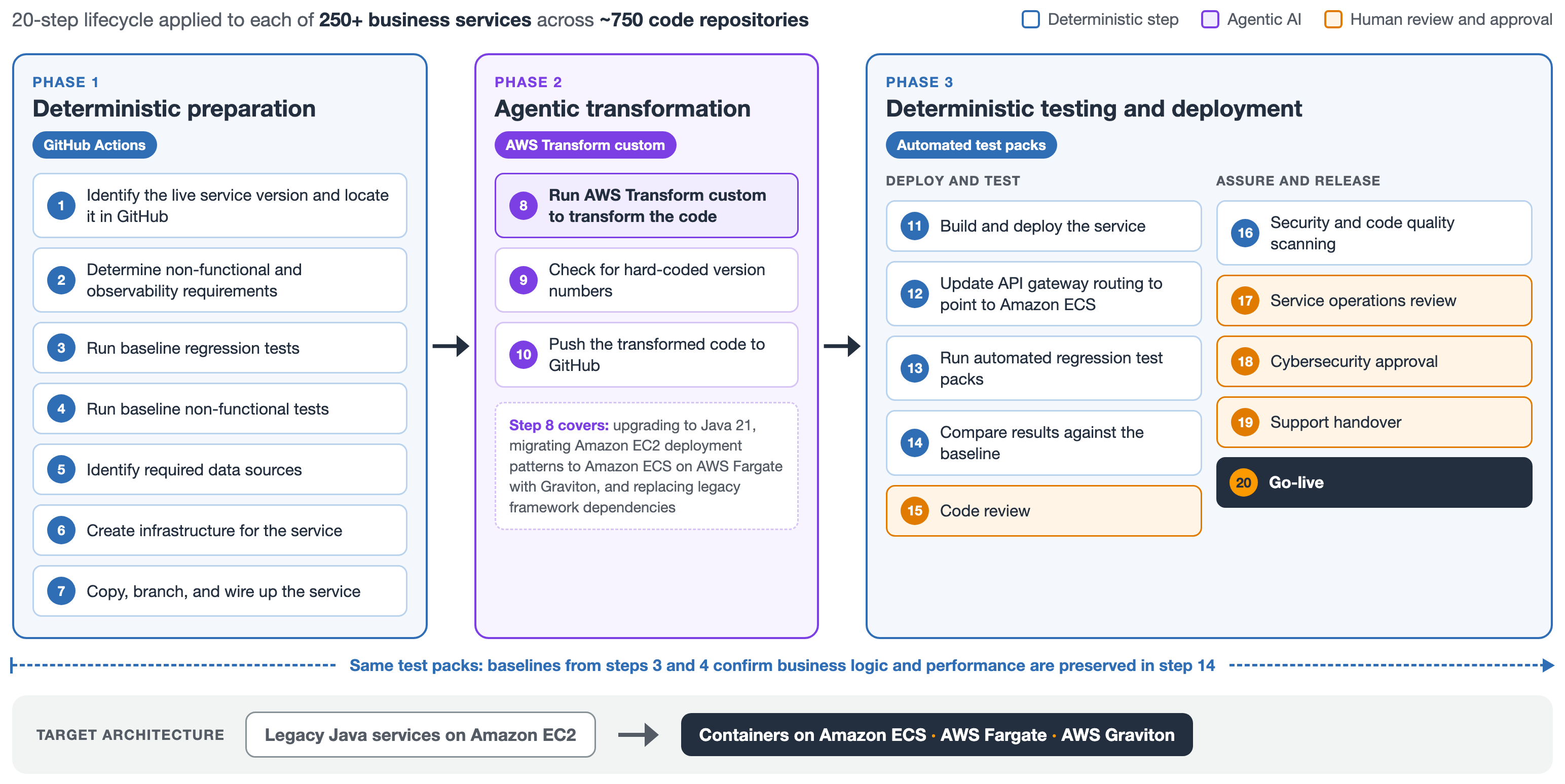
Figure 1: The 20-step transformation lifecycle British Airways uses with AWS Transform custom
Phase 1: Deterministic preparation. GitHub Actions workflows analyze each service repository to identify the production-versioned artifact currently deployed, then catalog its dependencies and data source configurations. Automation runs against live production logs to extract peak and mean traffic rates. It then infers the non-functional requirements (scaling thresholds, resource sizing, and observability settings) needed to configure each service’s new container on Amazon ECS. Baseline regression and performance test packs are executed against the existing platform to establish a known-good benchmark before any code is touched. The infrastructure for each service is then created, and the service code is copied, branched, and wired up, ready for transformation.
Phase 2: Agentic transformation. AWS Transform custom transforms the codebase for the target architecture. This includes upgrading to Java 21 and migrating from Amazon EC2 deployment patterns to Amazon ECS on AWS Fargate with Graviton. It also replaces legacy framework dependencies and resolves hard-coded version numbers that would otherwise block future patching. The agentic engine handles the complex transformation activity that would previously have consumed months of engineering time per service. The team then checks for any remaining hard-coded version numbers and pushes the transformed code to GitHub.
Phase 3: Deterministic testing and deployment. The transformed code is built and deployed into lower environments, and API gateway routing is updated to point to Amazon ECS. The service is then validated through the same automated regression and performance test packs run during Phase 1. Results are compared against the baseline to confirm that business logic is preserved. Human-in-the-loop code reviews, security and code quality scanning, a service operations review, and cybersecurity approval confirm that every service meets BA’s standards before support handover and go-live.
This separation of concerns is deliberate. Deterministic steps handle everything that should be repeatable and auditable. Agentic AI handles the complex transformation work that would otherwise consume months of engineering time. The result is a repeatable engine that can securely and accurately process hundreds of services far faster than a manual, service-by-service migration.
With AWS Transform custom, British Airways can:
- Accelerate the modernization of Java services while reducing the manual effort required from engineers.
- Move services from Amazon EC2 to a more scalable architecture using Amazon ECS on AWS Fargate with Graviton, supported by testing and assurance to confirm that business logic continues to perform as intended.
- Upgrade outdated software versions and frameworks, supporting a more resilient and maintainable platform.
- Apply lessons from the work to other engineering activities, including improving unit-test coverage.
Outcome
The benefits go beyond the technology itself. By reducing the manual effort involved in modernization, BA can give engineers more time to focus on resilient technology and better experiences for colleagues and customers.
“Modernising hundreds of code repositories is a significant engineering challenge. By combining agentic and generative AI and automation with human review and assurance, we’re accelerating that work and reducing the manual effort involved. Most importantly, it gives our engineers more time to focus on delivering value to the business and better experiences for our colleagues and customers.”
— Gary Holland, Principal Platform Architect at British Airways
“This is more than a technology upgrade. It is about building stronger, more resilient technology foundations for British Airways so our teams can deliver change more quickly and create better experiences for our customers. The early results are encouraging, and we are now applying what we have learned across the wider platform.”
— Liz Wright, Director of Delivery for BA Digital Customer and Commercial
Get started today
For British Airways, the work demonstrates how modern cloud technology, automation, and responsible use of AI can strengthen the airline’s technology foundations and create more capacity to innovate for customers.
If you’re planning to modernize your own Java applications, explore AWS Transform custom to see how agentic AI and automation, combined with human review, can reduce the manual effort involved.
To hear more about this work, register for session MAM318 at AWS re:Invent 2026.