IBM & Red Hat on AWS
Create smart city digital twins using IBM GICA on AWS
City leaders and municipal governments face challenges coordinating fragmented operations across departments managing traffic, waste collection, structural monitoring, and citizen services. As municipalities evolve toward smarter urban environments, unified digital representations of infrastructure and services optimize resource allocation and reduce operational costs.
IBM Consulting’s GICA (Garnet IoT Context-Aware) solution connects diverse urban data sources—from IoT sensors to legacy systems—into a comprehensive digital twin of the city. Municipalities using this solution can optimize resource allocation, make real-time data-driven decisions, and deliver enhanced citizen services. GICA maintains vendor independence through open standards compliance. By using FIWARE (Future Internet-ware) and the Garnet Framework, cities break down departmental silos and create contextual intelligence for urban innovation.
In this blog, you will learn how GICA creates unified digital twins that integrate data from traffic sensors, waste management systems, structural health monitors, and other urban infrastructure. You will explore practical use cases including ornamental fountain operations and bridge maintenance scheduling, and understand the technical architecture built on AWS services designed to provide scalability, security, and seamless integration with existing municipal systems.
IBM GICA Solution Overview
Cities can move from isolated services to unified, intelligent environments by connecting systems such as lighting, traffic, and waste collection. This integration provides holistic data management and cross-domain optimization, creating rich, real-time context for AI-driven decisions where AI systems operate with contextual understanding of urban operations.
Enabling Urban Intelligence Through Open Standards
IBM Consulting’s GICA solution integrates the Garnet Framework with AWS services to deliver context-aware smart city solutions. GICA creates a unified digital twin by connecting diverse urban data sources through open standards, establishing a semantic layer that enables different city services to understand and interact with each other.
The solution is built on FIWARE, an open-source framework supported by the European Commission that serves as the de facto standard for smart cities. More than 300 cities from over 30 countries worldwide use FIWARE technologies. Key components include the ETSI NGSI-LD API for standardizing context information sharing, the Context Broker for real-time data management, and Smart Data Models for consistency across city services.
The Garnet Framework builds living digital twins through dynamic knowledge graphs. Built on ETSI NGSI-LD standards and using FIWARE Context Broker technology, Garnet provides real-time context management with continuous adaptation to reflect real-world changes. Knowledge graph intelligence transforms fragmented data into interconnected contextual knowledge. For example, by mapping underground traffic sensor loops and pedestrian flow data, the system can recommend optimal locations for new waste bins. Open standards compliance provides full compatibility with ETSI NGSI-LD and FIWARE ecosystems.
Core solution components include:
- Data integration and standardization– GICA transforms diverse data from IoT sensors, legacy systems, and municipal databases
- Dynamic context management– The FIWARE Context Broker continuously manages context data and provides real-time responses
- AI-ready foundation– Provides rich, contextual datasets for AI applications, machine learning modules, and predictive analytics
- Citizen-centric services– From mobile apps providing real-time service information to digital engagement applications
Use Cases and Applications
Using GICA, cities can deploy smart services across multiple domains. benefit from real-time monitoring of wind and water flow conditions, providing automated adjustments to water features during adverse weather. This improves safety and operational efficiency while reducing manual intervention.
Figure 1 shows how GICA creates a comprehensive urban digital twin that integrates diverse data sources into a unified, contextually aware city representation.
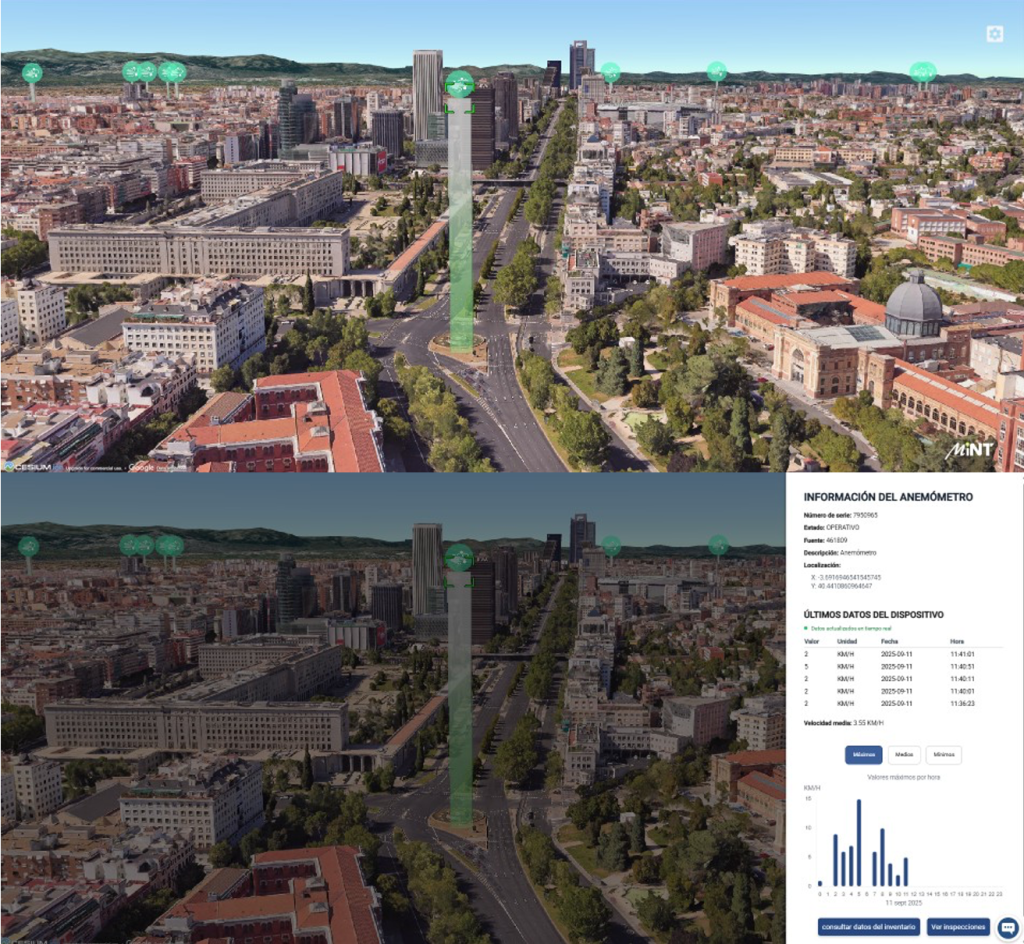
Figure 1.IBM GICA dashboard showing real-time data on 3D city model for ornamental fountain management.
Structural health monitoring provides continuous monitoring of bridges and overpasses with real-time data on structural integrity. This supports proactive maintenance strategies that reduce downtime and extend asset lifespan.
Additional deployment domains include street cleaning operations with GPS tracking and route optimization, waste collection management with IoT-enabled bin monitoring and dynamic scheduling, traffic flow measurement through inductive loop sensors, smart lighting with dynamic control based on pedestrian presence, municipal building energy optimization, emergency response coordination, citizen engagement applications, and environmental monitoring.
GICA Solution Architecture on AWS
The GICA solution on AWS is organized into four logical layers that support the complete lifecycle of urban data.
The Data Ingestion Layer provides a secure and performant entry point for both internal and external systems. Amazon API Gateway serves as the primary entry point, protected by AWS Web Application Firewall (AWS WAF), which inspects incoming traffic and mitigates threats such as SQL injection and cross-site scripting. Amazon Cognito handles token-based authentication for external systems, while internal systems connect through private network paths using API key authentication. Amazon Simple Queue Service (Amazon SQS) decouples ingestion from downstream processing, providing reliable and fault-tolerant message delivery. Amazon Kinesis Data Streams and Amazon Data Firehose handle high-throughput streaming and buffering of urban data across processing flows. AWS IoT Core routes events across audit, storage, and analytics flows in a fully decoupled manner. This layer authenticates data producers and supports ingestion of urban data in NGSI-LD format.
The Analytics Layer validates, enriches, and transforms incoming data. AWS Lambda functions check NGSI-LD schema and payload consistency before routing data to context management, storage, and analytics systems. This layer feeds analytical data pipelines, including integration with corporate data lakes, supporting advanced analytics and reporting without impacting transactional operations.
The Context Management Layer uses a FIWARE-compliant Scorpio Context Broker deployed on Amazon Elastic Container Service (Amazon ECS). The Scorpio Context Broker manages NGSI-LD entities and maintains the real-time contextual state of municipal assets, serving as the authoritative source of live urban context. Amazon Simple Storage Service (Amazon S3) provides durable storage for historical data, auditing, and offline analytics, separating operational context from long-term data retention.
The Application Layer exposes capabilities through secure APIs using Amazon API Gateway, enabling internal applications and municipal services to query and manage urban context data.
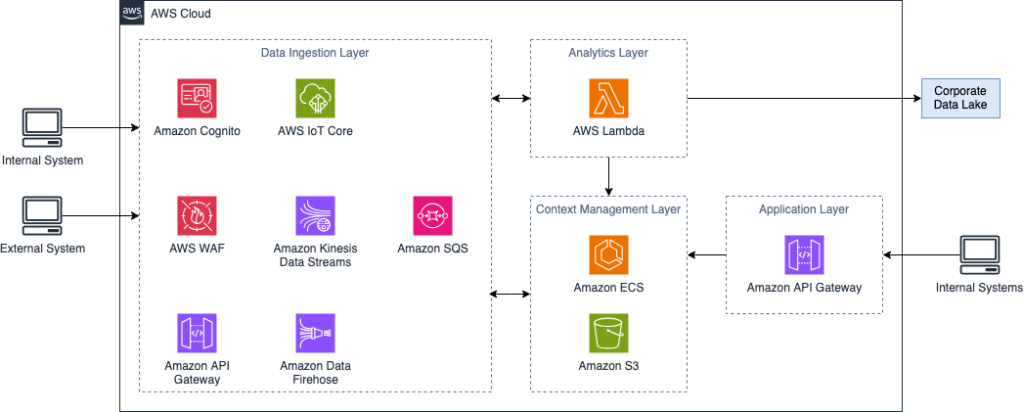
Figure 2. High-level architecture of GICA on AWS, with its logical layers supporting the lifecycle of urban data.
Benefits: Measurable Impact for Cities and Citizens
Cities implementing GICA achieve measurable operational improvements. Automated deployment using the AWS Cloud Development Kit (AWS CDK) and HashiCorp Terraform with standardized components accelerates implementation across departments. Open standards and validated modules reduce expenses compared to custom solutions, while the interoperable architecture reduces incremental costs when adding new domains.
City administrators gain actionable insights from contextualized data for evidence-based policy making. Automated response systems provide millisecond response times for critical events, improving continuity and public safety. Citizens experience faster response times, more reliable operations, and transparent service tracking.
Intelligent systems optimize water, energy, and waste management, reducing environmental impact. GICA aligns with the EU Mission for 100 climate-neutral and smart cities by 2030. Open APIs support rapid development of new applications by third parties, while enhanced city services attract businesses and support job creation.
Summary
In this blog, you learned how municipalities can transform fragmented urban operations into unified, intelligent environments by creating digital twins that connect previously siloed systems. You discovered how IBM GICA uses open standards like FIWARE and ETSI NGSI-LD to integrate diverse data sources while maintaining vendor independence and supporting future AI-driven decision-making.
Through examples including automated fountain management and proactive bridge maintenance, we’ve seen how contextual intelligence enables cities to optimize resource allocation, improve citizen services, and make evidence-based operational decisions. You also examined the phased implementation approach that enables municipalities to start with a single high-value use case and systematically expand across domains.
Begin your smart city transformation by identifying one municipal service that would benefit from real-time data integration and contextual awareness. Evaluate your existing IoT infrastructure to identify the highest-value use case for a pilot implementation.
Contact IBM to learn about GICA implementation options for your scenario.
Additional Resources
- FIWARE Foundation
- ETSI NGSI‑LD
- Scorpio Broker Docs, GitHub
- Scorpio Docker Hub