AWS for Industries
Is your AI Agent ready for prime time?
Daniele Stroppa recently wrote this post, framing a problem many teams are overlooking: the hidden costs when your AI agent makes bad decisions. Cody Shive then asked the obvious next question: “So what steps can we take to keep this from happening?”
Retailers have always stubbed their toes on early technology adoption—from scanned product barcodes ringing up at the wrong price, to self-checkout lanes that created more shrink than savings, to ecommerce platforms that oversold products they couldn’t ship. But every time, the retailers who learned to master the technology, instead of abandoning it, were the ones who pulled ahead. AI agents are no different.
This article has the prescriptive answer—the specific architecture patterns that turn an AI agent from a liability into the competitive advantage it was meant to be.
Building AI agents that deliver on their promise
You’re an ecommerce retailer, and you hear this buzz about using AI to boost your sales. And, with a click of a button in the AWS Management Console, you’re in! Only, there’s more to the story. A lot more.
Beyond the token bill: seeing the full picture
Token spend is the most visible line item on your AI bill. “We spent $2,400 on Amazon Bedrock this month.” You can see that on your monthly bill from AWS. But what you don’t see on that bill is everything associated with that purchase.
To understand that, we have to go back a few pages in the story. Why did we decide to use Bedrock and AI in the first place? If you’re like other retailers, you run various campaigns to entice customers to buy, sometimes by using a promotion, associated product recommendations based on loyalty purchase, you know the drill. But we can’t forget what we learned in the good old days (well, before AI, that is).
Lessons learned
Remember running promotional campaigns where, perhaps, category pricing drove the sale price of some items below their actual cost (or reduced your margin to nearly zero)? Automation back then did its job. It just wasn’t particularly smart about it. Or how about the time you created print ads for items that never made it to the shelf (break out the rain checks if you’re a grocery store). Online was worse, because it looked like you sold out before you got anything to sell.
We had to “experience” our way around these situations, and by now, shouldn’t we expect that AI will have our back? Well, when used correctly, the answer is a resounding “yes!”
Now, let’s revisit the story that was unfolding
Your actual cost of using an agent goes beyond the API bill. Just as Daniele wrote in the original post, a single agent could erroneously apply a discount (or one that it made up), resulting in thousands of dollars of lost revenue.
Or what if your agent recommended items that were either out-of-stock or too low in quantity to have been recommended to hundreds of customers? What did that result in? While this is just a story, not a report from an actual retailer, you could have any number of service tickets to correct the problem (and we all know how problems like that get corrected: by leaving money on the table to keep the customer happy). How about that hidden cost?
Or probably the worst one of them all: the agent that got into a payment retry loop, triggering a card servicer to flag the transaction as fraudulent. What did that cost the retailer? People take it very personally when their known-to-be-good credit card is declined.
Add those up. Compare them to your token bill. “Smart guardrails make the operational cost of agent decisions negligible compared to the revenue they generate.”
| Agent’s Bad Decision | Estimated Hidden Cost (fictitious) |
|---|---|
| Discount error: incorrect promo applied | $14,000 |
| Churn: out-of-stock recommendations | $8,000 |
| Manual resolution: payment retry storm | $4,500 |
| Total operational cost of bad decisions | $26,500 |
Figure 1: Agent Decisions vs. Hidden Costs
In Figure 1, where we see the agent’s decision on the left and the related hidden cost on the right, the agent’s bad decisions cost you $26,500.
Hopefully there’s another side to the story. You know, the part about how many net new sales were created and, in general, how well the combined campaigns worked. So, if the spend of $2,400 for a Bedrock agent resulted in $30,000 net-new revenue, that sounds like a win. That is until an auditor gets hold of it and takes away the $26,500 unnecessarily spent to make it happen. Not the best return on investment. But, just like we learned in the olden days of pricing and promotions by the seat of our pants, there’s a better way: don’t scrap it, learn from it.
Three challenges, three winning solutions
Every AI agent operating in a retail environment faces the same categories of risk: incorrect actions on business-critical data, stale context leading to bad recommendations, and uncontrolled automation loops. Each requires a different defensive pattern.
Expanding on our story, let’s address these one at a time: discount error, out-of-stock, payments loop. And let’s think about it this way: what if we had an agent watching over our other agents to make sure they acted properly?
Well, we can do that. Let’s address each problem.
1. No more discount errors
The scenario
An AI agent handling customer service inquiries applied a 40% loyalty discount to orders that didn’t qualify. By the time the team caught it, 350 orders had shipped at the wrong price.
Revenue impact: $14,000
The root cause
The team gave the agent access to a discount tool without constraints on when and how to use it. The LLM reasoned that the customer seemed loyal based on tone, and then it arbitrarily applied the discount without validating eligibility rules.
The winning strategy
Action-level guardrails
Use Amazon Bedrock Guardrails to define denied topics and content policies. An agent configured with a guardrail policy can be prevented from discussing, offering, or executing discounts that exceed defined thresholds, regardless of what the customer asks.
Confidence thresholds with human escalation
Before executing any price-changing action, you want to require that the agent has a confidence threshold. Below that threshold, the action routes to a human approver. This isn’t an LLM judgment call. It’s an orchestration-layer gate.
Deterministic validation
Hard-coded business logic that sits between the agent’s decision and the execution layer. “Is this customer loyalty tier X? Is the item eligible for this promotion? Is the discount within the approved range?” These checks don’t involve the LLM at all. They’re API calls to your rules engine that return yes or no.
The principle: Never let an LLM be the sole authority on a revenue-impacting action. The model proposes. Deterministic rules and human oversight are executed.
2. Eliminate out-of-stock recommendations
The scenario
A product recommendation agent suggested a popular item to 200 customers over a weekend. The item had gone out of stock Friday evening. By Monday, 47 customers had placed orders, received cancellation emails, and contacted support.
Estimated churn cost: $8,000
The root cause
The agent’s product knowledge was based on an index that is refreshed daily. Weekend inventory changes weren’t reflected until Monday morning. The agent had no mechanism to check whether its recommendations were still valid at the moment of delivery.
The winning strategy
Real-time inventory grounding
Before recommending any product, the agent must call a real-time inventory API which would return a current on-hand number (minus orders in-process). If the data source backing the recommendation is more than N minutes old, the agent should abstain or caveat: “This item was recently in stock. Let me verify availability.”
The LLM-as-judge pattern
A second model reviews the agent’s proposed response before it reaches the customer. This reviewer evaluates specific criteria:
- Inventory check: Does the recommendation reference a product currently confirmed in stock?
- Freshness check: Is the inventory source timestamp within the acceptable freshness window?
- Promise check: Does the response make promises about availability that aren’t backed by live data?
In practice, this is a lightweight model call with a focused prompt: “Evaluate this draft response against these criteria. Pass or fail each one.”
Source citation and staleness detection
The agent should cite the data source behind its recommendation (and its timestamp). If the freshness exceeds a defined threshold, the orchestration layer intercepts the response before delivery.
Amazon Bedrock Guardrails grounding checks
The ApplyGuardrail API can evaluate whether an agent’s response is grounded in the provided source material. If the agent hallucinates a product that isn’t in the current inventory feed, the grounding check catches it.
The principle: An agent that can’t verify its own context in real time shouldn’t be making promises to customers. Stale data + confident delivery = guaranteed support tickets.
3. Stop payment loops before they start
The scenario
An agent handling failed subscription renewals had been configured to retry payment methods automatically. When a customer’s card declined due to a temporary bank hold, the agent retried six times in rapid succession. This triggered the bank’s fraud detection system, which locked the customer’s card entirely. Resolution required the customer to call their bank, then call back to the retailer, requiring three hours of manual work per affected case.
Estimated resolution cost: $4,500 (across affected customers)
The root cause
The team delegated retry logic to the LLM, which interpreted “ensure payment is collected” as permission to retry aggressively. There was no circuit breaker, no retry budget, and no escalation path.
The winning strategy
Hard retry caps
Establish a maximum of three “retry” attempts, enforced by the orchestration system (AWS Step Functions, a Lambda middleware, or your agent framework’s tool configuration). We recommend a back-off algorithm, rather than a quick succession. Some banking systems notify the customer of a potential fraud attempt and ask if the customer (using a text or app message) was trying to make a purchase. That takes time, so thinking more of a back-off of a few minutes might prove successful (first attempt fails, back-off for 1 minute and try again. If that fails, back-off for 5 minutes before giving up and escalating). Remember: the LLM doesn’t get to decide how many times to retry. It gets three attempts with a back-off strategy, then the system takes over.
Circuit breaker pattern
After consecutive failures on the same action type, the agent stops attempting that action class entirely and routes to a human queue. This is a system-level protection, and it is not a prompt instruction.
Observability and anomaly detection
Amazon CloudWatch alarms on retry frequency, with anomaly detection models that flag unusual patterns. If an agent is retrying payments at 10 times the normal rate, an alert fires before the damage compounds.
Action classification by risk tier
Not all agent actions are equal. Classify them:
- Tier 1 (read-only): Check order status, look up product info. No restrictions needed.
- Tier 2 (reversible): Add item to cart, update preferences. Light guardrails.
- Tier 3 (irreversible/financial): Process payment, apply discount, cancel order. Maximum controls: retry budgets, human approval above threshold, circuit breakers.
The principle: Autonomy is earned, not assumed. The more consequential the action, the tighter the envelope around the agent’s ability to execute it independently.
The architecture: layers of defense
No single mechanism prevents all failure modes. Effective AI agent deployments use a layered approach where each layer catches what the previous layer missed:
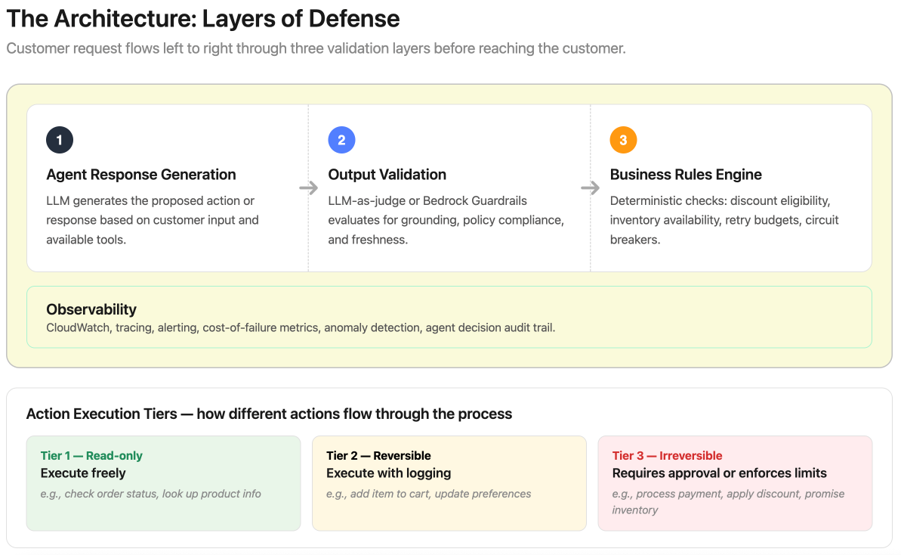
Figure 2: High-level architecture
In Figure 2, there is a progression from Agent Response Generation to Output Validation, then checked by a Business Rules Engine. The LLM-as-judge pattern allows you to catch hallucinations the primary agent produced. The business rules engine catches actions the judge approved, but those actions actually violate policy. The circuit breaker catches loops that passed individual action checks but are collectively harmful. Observability catches patterns that no individual check would flag.
The LLM-as-judge pattern in detail
The concept of an “LLM watching an LLM” is an established architecture pattern. Here’s how it maps to available implementations:
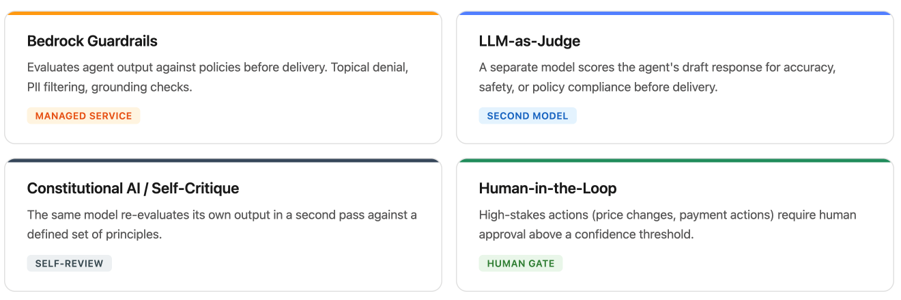
Figure 3: LLM watching an LLM
In the diagram above, we see Amazon Bedrock Guardrails as a managed service, a second model (LLM-as-Judge), self-review, and a human gate where high-stakes actions are checked by a human in the loop.
The metric that changes everything
The typical AI cost report covers only two things: token spend + infrastructure.
The winning formula is: token spend + infrastructure + investment in decision quality.
That third term is where the money is, and it’s where the investment should go. A $500/month increase within the guardrail infrastructure that prevents one $14,000 discount error per quarter has a 7 time return. A real-time inventory check that adds 200ms of latency but eliminates out-of-stock recommendations has an ROI measured in retained customers, not milliseconds.
Track these:
- Agent decision reversal rate. How often do humans override or undo what the agent did?
- Escalation rate by action type. Which actions consistently fall below confidence thresholds?
- Time-to-detection for bad decisions. How long between a bad agent action and someone noticing?
- Cost-per-incident by failure category. What does each type of mistake actually cost?
These metrics tell you where your agent architecture has gaps. Token spend tells you how much compute you used. They’re not the same conversation.
The rest of the story
Remember our ecommerce retailer from the beginning? The one who clicked a button in the AWS console and was “in”? They’re still in. The agent is still running. But now it has a confidence threshold on pricing actions, a real-time inventory check before every recommendation, and a circuit breaker that stops it after three payment retries (which are not in close succession).
The monthly Bedrock bill? Still $2,400. Maybe $2,900 with the judge model and guardrail calls. But that $26,500 in avoidable mistakes? Gone.
The lesson isn’t “don’t use AI agents.” The lesson is the same one retailers learned with promotional pricing, print ads for phantom inventory, and every other automation that ran ahead of good judgment: don’t scrap it, learn from it, and build the guardrails before the next campaign goes live.
Where to start?
If you’re running AI agents in a retail environment today:
- Classify your agent’s actions by risk tier. Anything touching pricing, payments, or inventory promises is Tier 3, and needs the full stack of controls.
- Add an output validation layer. Whether it’s Amazon Bedrock Guardrails, a dedicated judge model, or both, don’t let agent responses reach customers without a second check.
- Enforce action budgets at the system level. Retry limits, rate caps, and circuit breakers belong in your orchestration layer, not in your prompt.
- Instrument for cost-of-failure, not just cost-of-inference. Build dashboards that track decision quality, not just token consumption.
- Ground your agent in real-time data. If your agent is making recommendations based on data that could be stale, it needs a freshness gate.
The token bill is a line item. The cost of bad decisions is a P&L risk. Build accordingly.
For implementation details, see the Amazon Bedrock Guardrails documentation. Also, your AWS account team or an AWS Retail Partner Solutions Architect can help you design the right architecture for your environment.