AWS for Industries
Kite Advances Scalable Bioinformatics for Cell Therapy Research in Collaboration with AWS HealthOmics
Kite, a Gilead Company, is focused on achieving cures with cell therapy and evolved its bioinformatics infrastructure to support the scale and complexity of modern research. By transitioning from fragmented, project-specific workflows to a standardized, cloud-enabled approach, Kite has improved consistency, reduced operational burden and expanded access to computational tools across research teams.
This work supports Kite’s ability to translate complex biological data into insights that inform the development of potential cell therapies. These changes support reproducibility and scalability across programs while allowing scientists to focus more on generating insights from increasingly complex datasets. This transition included moving from a legacy SaaS platform to AWS HealthOmics, a managed service that helps accelerate bioinformatics workflows.
The migration improved efficiency and cost management for bioinformatics scientists, while also enabling broader, self-service access to computational workflows through existing laboratory systems.
The Challenge: Scaling Bioinformatics for Cell Therapy R&D
Kite’s Bioinformatics and Genomics Division leverages high-dimensionality omics data generated both in-house from their labs and from public repositories, to identify therapeutic targets and engineer novel cell therapies. However, the infrastructure supporting this mission needed to evolve alongside the science.
Each project required bioinformaticians to decide from scratch which tools to use for indexing, alignment, and quantification. Scripts lived on local machines, dedicated servers, or AWS Batch configurations with no consistency between projects. There was no standard process for logging, tracking runs, or registering output artifacts. When a project completed, it was unclear who owned the metadata or where it should be recorded.
“We needed something that could give us consistency in workflow and data management across multiple samples and projects, while improving reproducibility and accessibility across teams,” said Alexander Falk, Bioinformatics Director at Kite Pharma. “Prior to HealthOmics, running a bioinformatics pipeline required engaging individual bioinformaticians using their own tools and methods, resulting in inconsistent workflows, high coordination effort and communication silos. We also lacked a standardized approach for storing outputs and documenting results for reproducibility. Our goal was to implement standardized pipelines integrated with our existing LIMS, enabling broader, centralized access.”
Compounding these issues, the team was paying substantial license fees for a third-party SaaS workflow platform that was underutilized. The fixed-cost licensing model was misaligned with the sporadic batch processing patterns of pharma R&D. Meanwhile, scientists relied on their existing Electronic Laboratory Notebook (ELN) as the single source of truth for sample accessioning and experiment tracking. Any new compute infrastructure needed to integrate with this system, not replace it.
Single-cell transcriptomic analysis, one of Kite’s most computationally intensive workloads, made the scaling challenge especially acute. Local compute was not a viable option as sample counts grew across expanding clinical trial programs. The team needed elastic infrastructure without pre-provisioned capacity.
The goal was to transition from ad-hoc scripting to a more standardized and reproducible approach with full ELN integration, reducing operational complexity and improving the efficiency of generating insights from data.
Implementing a Scalable, Cloud-Enabled Bioinformatics Approach
In collaboration with AWS Professional Services, Kite designed and deployed a fully automated, event-driven genomics pipeline that connects their on-premises sequencing infrastructure to cloud-based bioinformatics workflows, all orchestrated through the scientists’ familiar ELN interface.
Event-Driven Architecture
At a high level, the solution follows an automated data flow from sequencer to scientist:
- Bioinformaticians trigger sequencing runs, perform demultiplexing within their data center to generate FASTQ data and AWS DataSync copies FASTQ files from Kite’s on-premises file share to Amazon S3 on an automated schedule, eliminating manual file transfers.
- When FASTQ files arrive in S3, an AWS Lambda function parses file headers to extract sequencing metadata (instrument ID, run ID, flowcell ID, sample identifiers) and creates structured records in the ELN via REST API.
- From the ELN interface, bioinformaticians associate FASTQ entries with a specific HealthOmics workflow and configure parameters.
- This action emits an event through the ELN’s native integration with Amazon EventBridge, which triggers a pre-processing Lambda function that constructs the input payload and submits an AWS HealthOmics private workflow run.
- AWS HealthOmics then executes the containerized Nextflow pipeline on fully managed, elastic compute, with no infrastructure to provision or maintain. It generates workflow outputs to a separate Amazon S3 bucket for processed data.
- Upon workflow completion, HealthOmics emits status events to EventBridge, which triggers a post-processing Lambda that writes results, quality metrics, and output file locations back to the ELN.
- A dedicated failure-handling Lambda function polls an Amazon SQS dead-letter queue and reprocesses any failed transactions, ensuring no data is lost.
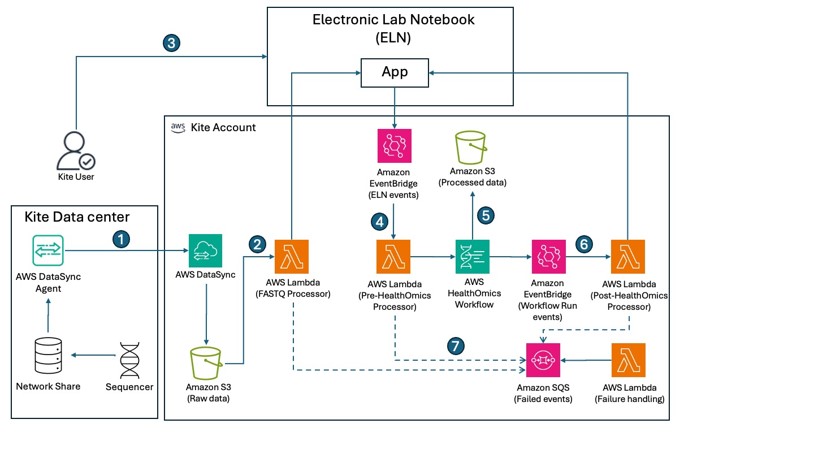
Figure: Kite Pharma’s event-driven architecture showing the integration of Kite’s on-premises storage, Kite’s ELN and AWS services that enables automated data transfers to AWS and abstracts infrastructure for the end-user to process omics data in AWS using ELN as the interface
The Scientist Experience
From the scientist’s perspective, the cloud infrastructure is invisible. A bioinformatician opens a pre-built ELN template for their workflow (for example, “scRNA-seq via nf-core”), fills in sample entities and parameters like reference genome or core counts, and registers the workflow run. Registration automatically triggers execution with no CLI, console access, or infrastructure knowledge required. The run status dynamically updates in the ELN as it progresses, and upon completion, output files are automatically linked back to the parent workflow run, maintaining full provenance and traceability.
“One of the remaining challenges is aligning on standardized workflows and parameters across teams, which highlights how much of the technical complexity has been abstracted from everyday use,” said Tanner MacPhee, Associate Scientist of Bioinformatics Engineering at Kite Pharma. “The goal of this project was not only to provide an avenue for running scalable bioinformatics workflows, but also to improve metadata capture, monitoring and accessibility across the broader scientific community at Kite. With the ELN as the entry point, users can integrate workflows directly into their ELN entries without needing to directly manage underlying infrastructure.”
Key Design Decisions
The design reflects several priorities aligned to Kite’s research and operational needs. A serverless-first approach with pay-per-invocation Lambda functions and pay-per-run HealthOmics helps reduce idle infrastructure costs. Bidirectional ELN integration ensures metadata is written to the ELN via REST API while the ELN triggers AWS workflows via EventBridge. Private workflows give Kite full control over containerized Nextflow pipelines, tool versions, and parameters. The entire solution is deployed via Terraform for reproducibility, and all Lambda functions run within Kite’s VPC for network-level security isolation.
The Impact: Efficiency and Scalable Access
Since going live, the solution has delivered operational improvements across cost efficiency, workflow execution, and scientist experience. The solution has been running in production for over 18 months, with 20 bioinformatics workflows deployed in AWS HealthOmics, processing single-cell RNA sequencing (scRNA-seq), bulk RNA-seq, whole-exome sequencing, protein structure prediction, and other next-generation sequencing workloads.
This approach has also enabled efficient use of computational resources aligned to research needs, eliminating inefficiencies of prior workflows. “This integration has reduced the number of manual steps and dependencies required to run analyses, improving efficiency and allowing teams to move more quickly from data to insight,” said Falk.
Bioinformatics scientists report substantial reductions in time spent on ad-hoc analyses. By reducing manual steps, from provisioning infrastructure to registering metadata, the team has more time for novel development and scientific work.
More than 100 researchers now have access to bioinformatics workflows through the ELN integration. Wiki-like context in workflow templates means that when a molecular biologist searches for “protein structure prediction,” they discover the available AlphaFold Multimer workflow directly, breaking down silos between teams without requiring bioinformatics intervention. Of the 20 deployed workflows, five are fully integrated with the ELN for self-service execution, with more being onboarded continuously.
The entire flow, from data coming directly off the sequencers through pre-processing, ELN registration, and analysis execution within the cloud-based workflow, operates without bioinformatics intervention. This end-to-end automation has been in continuous production for over 18 months.
What Comes Next?
Kite is continuing to expand its use of cloud-enabled bioinformatics tools, including AWS HealthOmics. The team plans to bring all 20 deployed workflows into self-service mode through the ELN, ensuring alignment with controlled ontologies and validation requirements. They are also building more robust continuous integration and deployment as the pipeline portfolio grows, reducing manual steps in workflow versioning.
Looking further ahead, Kite is exploring AI-based tools and agents to accelerate pipeline creation, validation, and updating. The team is also evaluating additional tools for general-purpose compute, data cataloging, and cross-team collaboration on multimodal research datasets.
“Within Kite Bioinformatics and Data Science, AI is enabling us to build, iterate, test, and deploy bioinformatics pipelines more quickly and consistently. We’re reducing operational overhead, lowering the time and cost burden on developers, while improving standardization and validation across our workflows. HealthOmics allows us to run these computationally intensive omics analyses, ranging from transcriptomics to protein and RNA folding and structure prediction, without requiring deep infrastructure expertise. As we continue to generate and onboard more bioinformatics data, effective metadata capture, registration, and searchability are becoming higher priority,” notes MacPhee.
Conclusion
Kite’s experience reflects a broader approach to modernizing bioinformatics infrastructure for pharma and biotech organizations facing similar challenges: how to modernize bioinformatics infrastructure without disrupting the scientist’s workflow. By improving efficiency, standardization, and access to workflows while maintaining full integration with existing laboratory systems, Kite can focus more resources on its mission of delivering cell therapies to patients.
“We are excited to continue leveraging HealthOmics and the AWS suite of services to develop innovative ways to allow our researchers to build the next generation of curative cell therapies for patients,” noted Falk.
Get Started with AWS HealthOmics
Ready to modernize your bioinformatics workflows? Visit the AWS HealthOmics page to learn how managed infrastructure can help your team focus on science, not servers. Start with a free-tier pilot, explore ready-to-run workflows, or contact the AWS Genomics team to discuss your use case.
Further Reading
- AWS HealthOmics features and pricing
- AWS for Health and Life Sciences
- Designing an event-driven architecture for Bioinformatics workflows using AWS HealthOmics and Amazon EventBridge
Kite is a Gilead company and a global leader in CAR T-cell therapy. Learn more at kitepharma.com.