AWS for Industries

Nissan Collaborates with AWS to Accelerate SDV Development

At AWS re:Invent 2025, Nissan Motor Co., Ltd. (Nissan) announced the Nissan Scalable Open Software Platform, built on AWS, that accelerates Software-Defined Vehicle (SDV) development. Nissan began collaborating with AWS in 2023 to modernize its global engineering environment, reduce development bottlenecks and support next-generation vehicle innovation. By migrating testing pipelines to AWS and standardizing development environments worldwide, Nissan reduced test execution time by 75 percent and is enabling more than 5,000 developers to work in a unified Engineering Cloud. This blog explains how Nissan and AWS are partnering to build Nissan’s platform that supports Nissan’s SDV strategy.

The Need for Efficiency in SDV Development

The automotive industry is undergoing a period of transformation, with a growing share of vehicle value determined by software. As automakers expand their SDV development efforts, Nissan, a global manufacturer selling more than 3 million vehicles annually in over 100 countries, has set three goals for SDV development: provide value quickly and continuously, ensure required safety and performance, and deliver SDVs to all customers, from EVs and HEVs to internal combustion engine vehicles. Nissan is accelerating work toward these goals (see Figure 1, below).

To prepare for business growth beyond 2025, Nissan is focusing on four priorities:

  • Improving development efficiency to handle increasingly complex software
  • Establishing a comprehensive testing framework to manage growing test cases
  • Migrating from on-premises environments with limited processing power to the flexible, scalable AWS Cloud
  • Rebuilding its global development framework
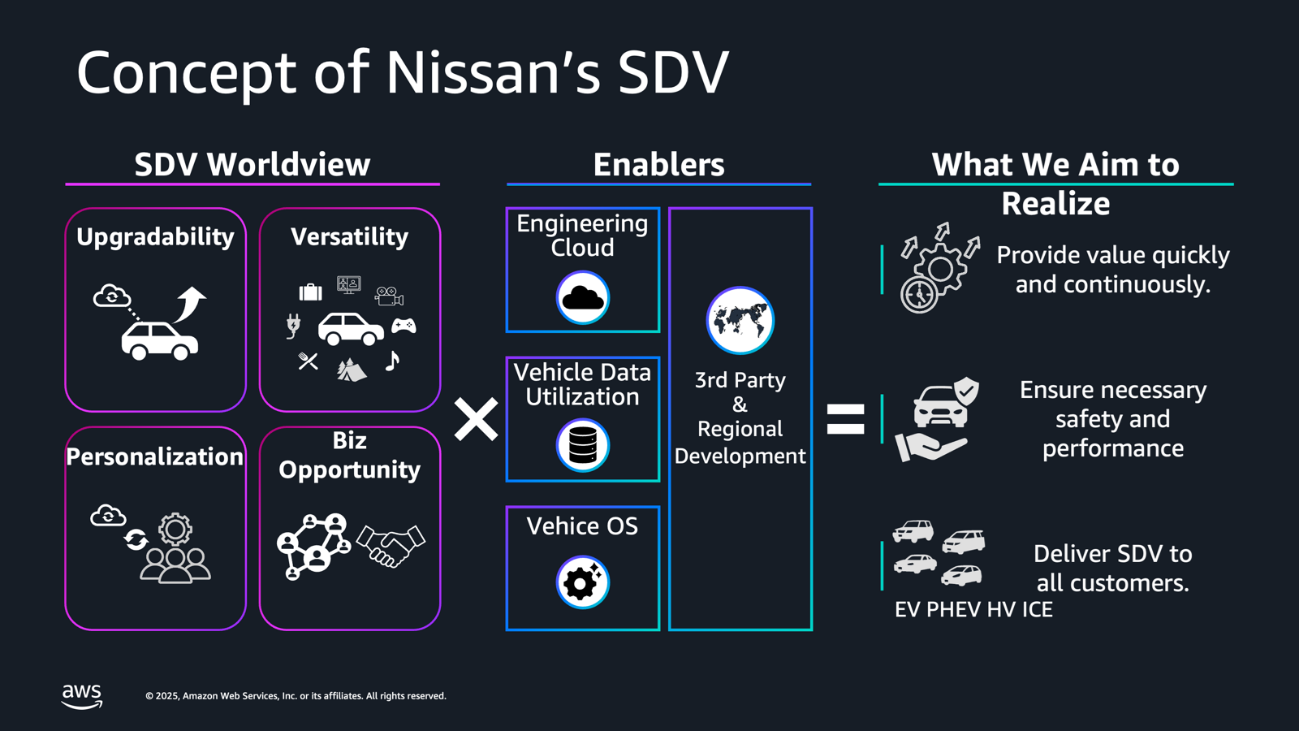
Diagram titled 'Concept of Nissan's SDV' showing a three-part framework on a dark background. The left section labeled 'SDV Worldview' contains four pink-outlined boxes: 'Upgradability' with car and cloud icons, 'Versatility' with icons for vehicles and entertainment features, 'Personalization' with cloud and user icons, and 'Biz Opportunity' with network and handshake icons. A multiplication symbol connects to the center section labeled 'Enablers' with four blue-outlined boxes: 'Engineering Cloud' with cloud icon, 'Vehicle Data Utilization' with database icon, 'Vehicle OS' with gear icon, and '3rd Party & Regional Development' with world map icon. An equals sign connects to the right section 'What We Aim to Realize' in teal, showing three goals with icons: 'Provide value quickly and continuously' with clock and gears, 'Ensure necessary safety and performance' with car and protective hand, and 'Deliver SDV to all customers' with four vehicle types labeled EV, PHEV, HV, and ICE. AWS logo appears in bottom left with copyright 2025 Amazon Web Services.

Figure 1

Building the Nissan SDV Platform on AWS

To advance these priorities, Nissan began developing the Nissan Scalable Open Software Platform in 2023 (see Figure 2, below). Built on AWS, the Nissan platform consists of three layers:

  • Nissan Scalable Open SDK (Open SDK): a development environment for vehicle software
  • Nissan Scalable Open Data (Open Data): a data platform for collecting and using vehicle data
  • Nissan Scalable Open OS (Open OS): a vehicle OS designed to support digital twins

The Engineering Cloud (Open SDK and Open Data), built on AWS, provides a comprehensive development environment that supports software development, machine learning training, test-case execution, and data processing. Development teams in regions such as North America, Europe, and Japan, as well as third-party developers, use this common foundation to respond to regional needs quickly while sharing development outputs across teams. This contributes to restructuring Nissan’s global development framework.
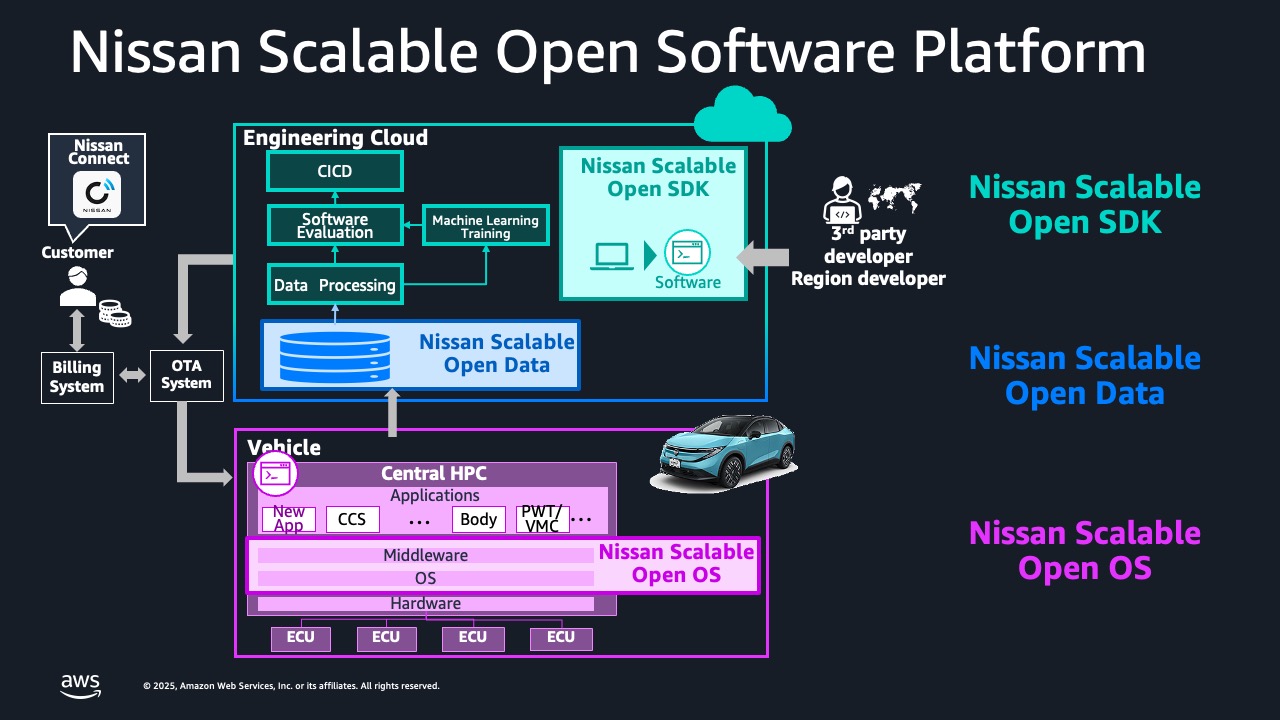
Technical architecture diagram titled 'Nissan Scalable Open Software Platform' on a dark navy blue background. The left side shows input systems including the Nissan Intelligent Mobility logo with circular emblem, a camera icon, and two stacked boxes labeled Billing System and OTA System connected by bidirectional arrows. The top center features an Engineering Cloud section in teal containing GCC with Continuous Integration, Machine Learning Framework, and Data Processing components, connected below to Nissan Scalable Open Data with database icons. Adjacent is the Nissan Scalable Open SDK box showing computer and mobile device icons, with developer and factory building icons labeled Developer and Region Developer. The center contains a large pink Vehicle section showing Central HPC architecture with four layers: Application Core containing ADAS, CCS, Body, and IVN components; Middleware layer; Nissan Scalable OS layer; and Hardware layer with four ECU boxes. A small blue electric vehicle illustration with wireless signals appears on the right. The right side displays three vertical labels in blue and magenta: Nissan Scalable Open SDK, Nissan Scalable Open Data, and Nissan Scalable Open OS. AWS logo and copyright 2025 Amazon Web Services appear at the bottom.

Figure 2

Nissan uses services from AWS’s portfolio of more than 240 Services to meet Nissan’s platform’s functional and performance requirements. AWS Professional Services supports the acceleration of this development. Below, we highlight three key capabilities enabled through collaborating with AWS:

  1. Improved development efficiency through continuous integration (CI) process automation
  2. Unified global development environments
  3. Next-generation container management for SDV development

1. Improving Development Efficiency through CI Process Automation

Nissan previously ran its in-vehicle software CI pipeline on on-premises servers, which slowed testing. To resolve this, Nissan migrated its CI environment to AWS and built a new pipeline using AWS CodePipeline, AWS Step Functions and AWS Lambda (“Lambda”)(see Figure 3, below).

The result is a Software-in-the-Loop (SIL) pipeline that supports both model-based and code-based development. By using Lambda for parallel processing, Nissan reduced test execution time by 75 percent compared to its previous system. Automation across integration testing, including execution, evaluation, result graph generation, and improved developer productivity.
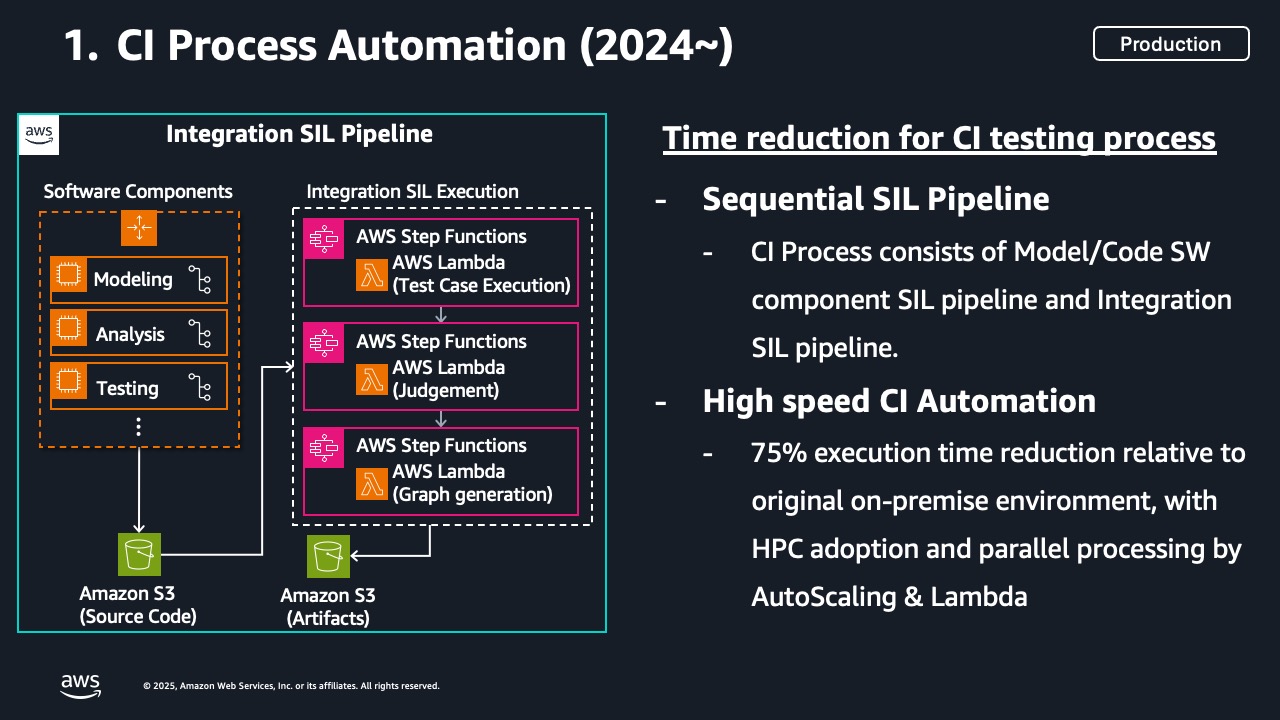
Slide titled '1. CI Process Automation (2024~)' with a Production label in the top right corner on a dark background. The left side shows an Integration SIL Pipeline diagram on a dark teal background divided into two sections. The Software Components section on the left contains three orange boxes stacked vertically labeled Modeling, Analysis, and Testing with small icons. The Integration SIL Execution section on the right shows a workflow starting with 'SIL Step Iteration' containing 'SIL Iteration SIL Test Case Execution', followed by an orange AWS Lambda box for Test Case Execution, then two purple AWS Step Functions boxes for AWS Lambda Invocation and AWS Lambda SIL Orchestration. Green arrows connect components through Amazon S3 Source Code and Amazon S3 Artifacts storage icons. The right side of the slide displays white text explaining 'Time reduction for CI testing process' with three sections: Sequential SIL Pipeline describing the CI process structure with Model/Code SW components and integration SIL pipeline; High speed CI Automation highlighting HPC adoption and parallel processing by Auto Scaling and Lambda; and a key metric showing 75% execution time reduction relative to original on-premise environment. AWS logo and copyright 2025 Amazon Web Services appear at bottom left.

Figure 3

2. Unifying the Development Environment Globally

To accelerate global SDV development, Nissan needed a shared development environment for more than 5,000 developers worldwide. Teams require access to both common and region-specific environments with fast deployment capabilities. To support this, Nissan and AWS built the Workbench Portal on AWS. Using a Backstage-based interface, the portal provides a unified environment for teams in every region (see Figure 4, below).

By combining AWS CodeBuild and Amazon Elastic Container Registry (“Amazon ECR”), Nissan’s Workbench Portal speeds up container image builds and deployments, reducing environment deployment time to about one minute. Docker-in-Docker capabilities improve management of complex toolchains. The system supports flexible deployment of shared and region-specific environments, designed for future use by more than 5,000 developers.
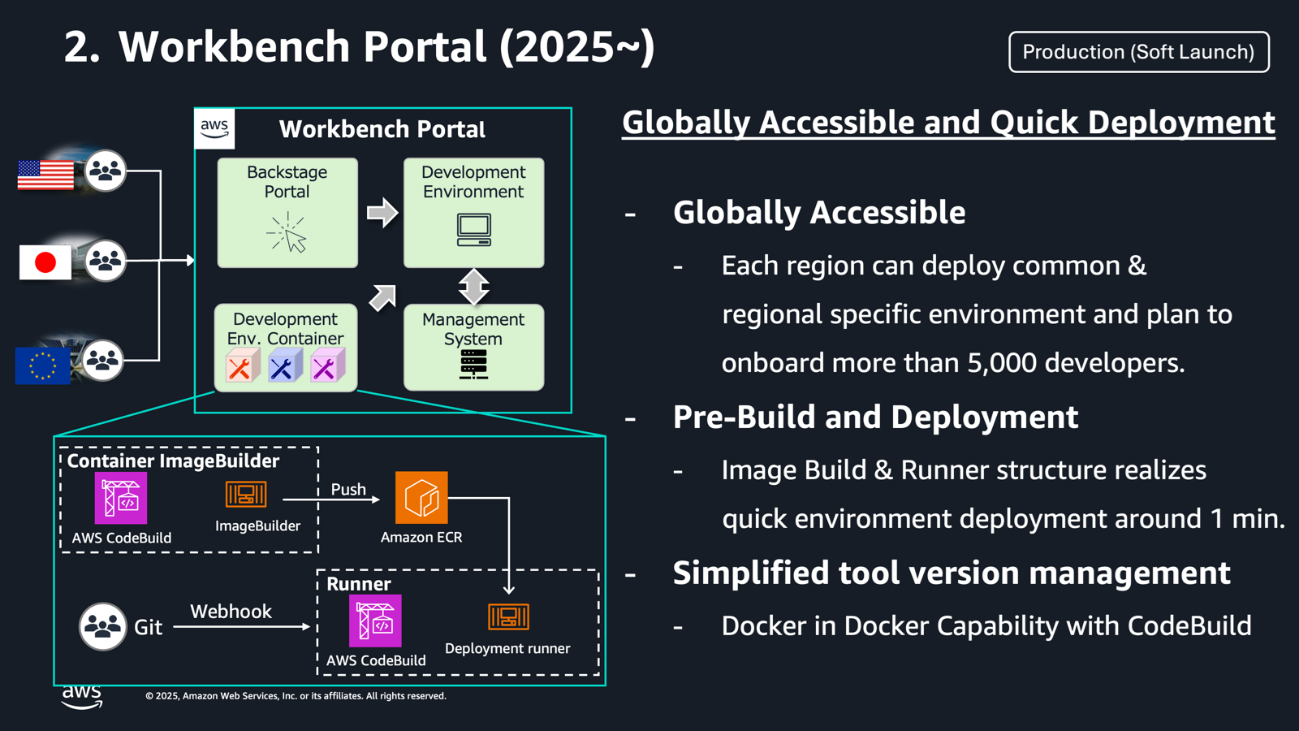
Slide titled '2. Workbench Portal (2025~)' with a 'Production (Soft Launch)' label in the top right corner on a dark background. The left side shows a Workbench Portal architecture diagram in a teal-bordered box. At the top are three regional flags (USA, Japan, and EU) each connected to user group icons, all flowing into the central portal. The portal contains four light green interconnected boxes: Backstage Portal with compass icon, Development Environment with laptop icon, Development Env. Container with three colored component icons (red, blue, magenta), and Management System with server icon. White arrows show connections between these components. Below is a Container ImageBuilder workflow section showing AWS CodeBuild and ImageBuilder components pushing to Amazon ECR (orange container icon), and a Runner section showing Git with Webhook triggering AWS CodeBuild, which connects to a Deployment runner (orange container icon). The right side displays white text explaining 'Globally Accessible and Quick Deployment' with three main sections: 'Globally Accessible' noting each region can deploy common and region-specific environments to onboard more than 5,000 developers; 'Pre-Build and Deployment' highlighting Image Build & Runner structure for quick environment deployment in approximately 1 minute; and 'Simplified tool version management' describing Docker in Docker Capability with CodeBuild. AWS logo and copyright 2025 Amazon Web Services appear at bottom left.

Figure 4

3. Revolutionizing Development Infrastructure with Next-Generation Container Management

A key challenge in SDV development is integrating physical ECUs, virtual ECUs, and development environments. Nissan is advancing efforts to adopt a microservices architecture for production ECUs, enabling more frequent and flexible application updates (see Figure 5, below).Using Podman, Nissan achieves consistent container management from Linux environments using AWS Graviton instances on Amazon EC2. This supports secure, efficient resource utilization across development environments and physical ECUs, even in resource-constrained scenarios. The architecture is also designed for future integration with digital twin environments to support AI-driven vehicle development.
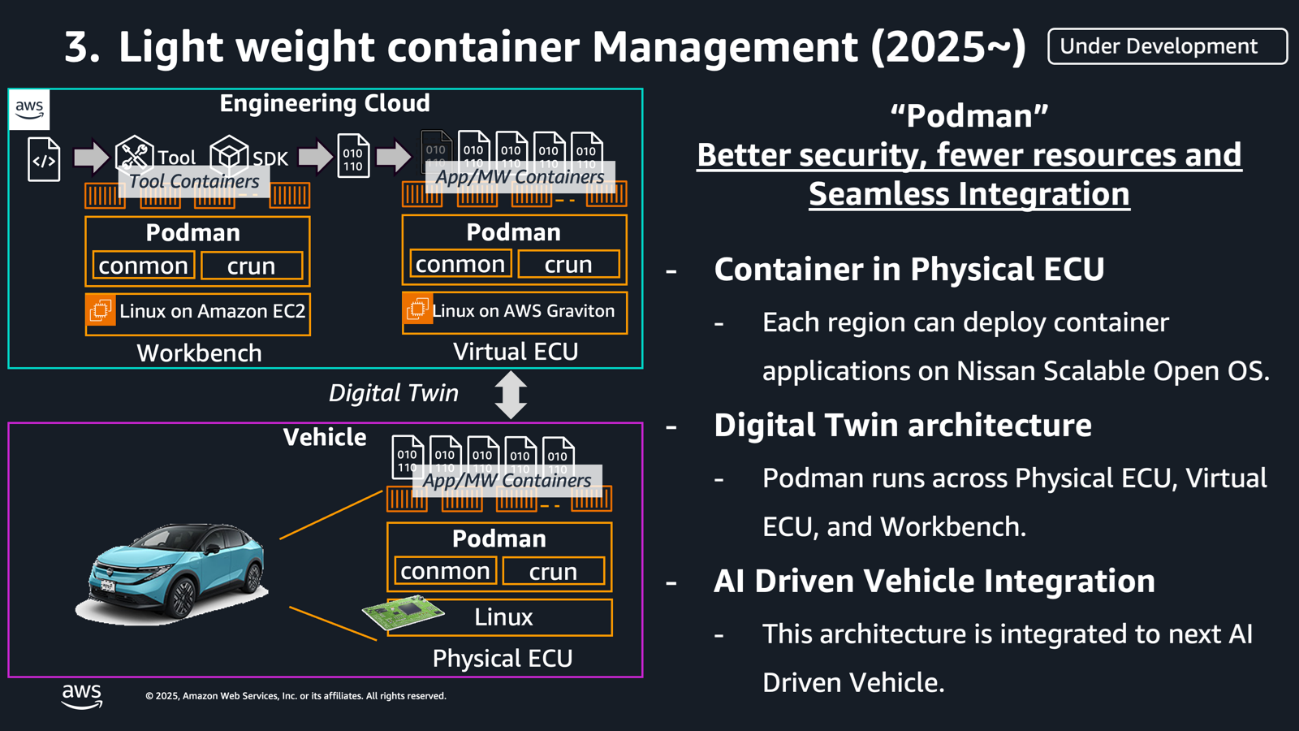
Slide titled '3. Light Weight container Management (2025~)' with an 'Under Development' label in the top right corner on a dark background. The left side shows a technical architecture diagram divided into two main sections connected by a bidirectional 'Digital Twin' arrow. The top section labeled 'Engineering Cloud' in a teal-bordered box displays a workflow starting with Tool Containers containing toolbox and SDK icons, flowing to App/MW Containers shown as five container boxes labeled with binary code. Below is an orange-bordered Podman container with 'common' and 'crun' components, sitting on 'Linux on Amazon EC2' labeled as 'Workbench'. The middle section shows a 'Virtual ECU' with similar Podman structure containing App/MW Containers, common and crun sections, running on 'Linux on AWS Graviton'. The bottom section labeled 'Vehicle' in a purple-bordered box shows a light blue Nissan electric crossover SUV on the left, with orange arrows pointing to a Physical ECU structure containing App/MW Containers, Podman with common and crun sections, and a green circuit board icon representing Linux hardware. The right side displays white text with a heading 'Podman: Better security, fewer resources and Seamless Integration' followed by four main sections: 'Container in Physical ECU' noting each region can deploy container applications on Nissan Scalable Open OS; 'Digital Twin architecture' explaining Podman runs across Physical ECU, Virtual ECU, and Workbench; and 'AI Driven Vehicle Integration' stating this architecture is integrated to next AI Driven Vehicle. AWS logo and copyright 2025 Amazon Web Services appear at bottom left.

Figure 5

Through these initiatives, the Nissan Scalable Open Software Platform supports development across applications, electric powertrains and body control systems. Integration with over-the-air (OTA) updates and billing systems enables continuous delivery (CD) and new business opportunities.

Further Evolution through AI Utilization

Nissan will continue to expand its use of AI to support SDV development. The next-generation ProPILOT aims to deliver safe, reliable driving support that can navigate complex environments, including urban roads. Nissan demonstrated its prototype in September 2025 and plans to launch in Japan by fiscal year 2027. To support these capabilities, Nissan will continue to enhance the Engineering Cloud and the SDV platform built through collaborating with AWS (see Figure 6, below).
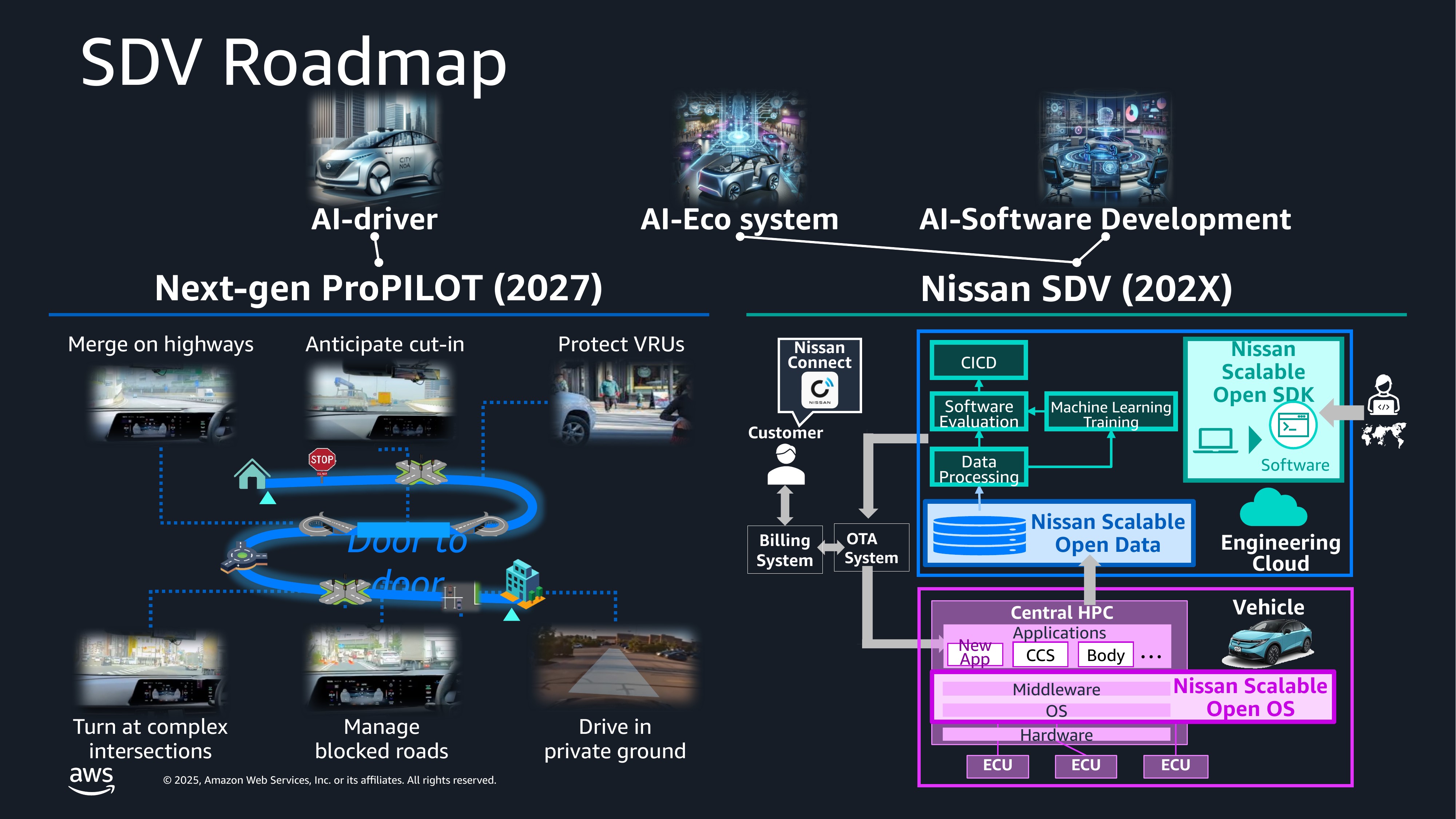
Slide titled 'SDV Roadmap' on a dark background showing Nissan's software-defined vehicle development strategy. The top section displays three future AI capability pillars with small vehicle images: 'AI-driver' showing autonomous driving, 'AI-Eco system' showing energy management, and 'AI-Software Development' showing development tools. Below are two main sections. The left section labeled 'Next-gen ProPILOT (2027)' shows six autonomous driving capabilities with small photographs: 'Merge and cut-in' with highway merging scenario, 'Anticipate cut-in' with vehicle detection, 'Protect VRUs' (Vulnerable Road Users) showing pedestrian protection, 'Turn at complex intersections' with urban intersection view, 'Manage blocked roads' with road obstruction scenario, and 'Drive in private ground' showing parking lot navigation. A blue sports car illustration appears in the center with teal connecting arrows. The right section labeled 'Nissan SDV (202X)' displays a technical architecture diagram showing the Nissan Scalable Open platform with multiple layers: top section in teal shows 'Reset/Central Computing', 'Data Management', and 'Data Organization' connected to 'OTA' (Over-The-Air) and 'Nissan Scalable Open Data' with database icons; middle section in purple shows 'Nissan Scalable Open OS' platform; bottom section shows 'Vehicle' components including 'AI', 'CSS', and 'Body ECU' boxes, plus 'Engineering' components and 'Central IPC' (Intelligent Processing Center) with multiple 'ECU' boxes at the hardware level. A small teal electric vehicle icon with wireless signals appears on the right. AWS logo and copyright 2025 Amazon Web Services appear at bottom left.

Figure 6

Summary

The Nissan Scalable Open Software Platform, developed by Nissan with support from AWS, is expected to become a key source of competitiveness for Nissan in the future automotive industry.

AWS will continue to collaborating with Nissan in Nissan’s efforts to provide value quickly and continuously, ensure required safety and performance, and deliver SDVs to all customers, from EVs and HEVs to internal combustion engine vehicles. This case study demonstrates how a global manufacturer can evolve toward a software-driven development model.

Customer Comment

By Kazuma Sugimoto, General Manager, Nissan Motor Corporation, Software Development Department, Software Defined Vehicle Engineering Division:

“Nissan has been collaborating with AWS to implement cloud-based CI/CD for in-vehicle software development in actual projects since 2024, steadily improving development efficiency. We are delighted to announce the Nissan Scalable Open Software Platform.

Software development for Software-Defined Vehicles is an extremely important strategy for Nissan to rapidly and continuously deliver innovative value to customers and lead the transformation of the automotive industry. The Nissan platform is the key technology that enables this strategy. We are confident that AWS cloud capabilities and expertise will strongly support our efforts to streamline our global development framework and realize next-generation mobility using AI. Through this SDV Platform, Nissan will create the mobility of the future and provide customers with new experiences.”

Hitoshi Hasegawa

Hitoshi Hasegawa

Hitoshi Hasegawa is a Senior Solutions Architect at AWS Japan, focusing on the automotive industry. He previously worked at a system integrator on core systems for automotive and financial clients. He helps automotive customers use data and AI to drive innovation.