Artificial Intelligence
Category: Amazon SageMaker

Introducing Amazon SageMaker Components for Kubeflow Pipelines
Today we’re announcing Amazon SageMaker Components for Kubeflow Pipelines. This post shows how to build your first Kubeflow pipeline with Amazon SageMaker components using the Kubeflow Pipelines SDK. Kubeflow is a popular open-source machine learning (ML) toolkit for Kubernetes users who want to build custom ML pipelines. Kubeflow Pipelines is an add-on to Kubeflow that lets […]

Implementing hyperparameter optimization with Optuna on Amazon SageMaker
Preferred Networks (PFN) released the first major version of their open-source hyperparameter optimization (HPO) framework Optuna in January 2020, which has an eager API. This post introduces a method for HPO using Optuna and its reference architecture in Amazon SageMaker. Amazon SageMaker supports various frameworks and interfaces such as TensorFlow, Apache MXNet, PyTorch, scikit-learn, Horovod, Keras, […]
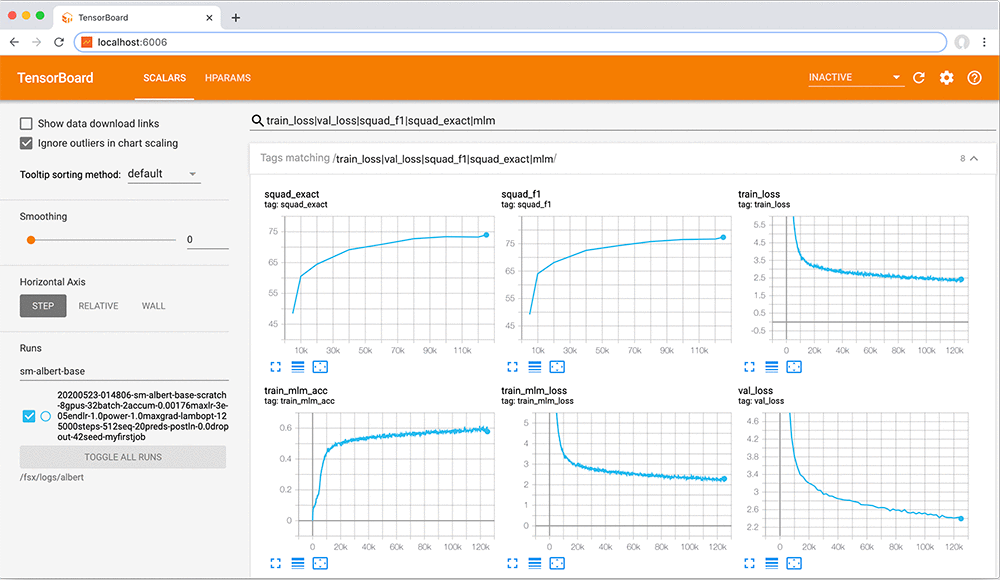
Train ALBERT for natural language processing with TensorFlow on Amazon SageMaker
At re:Invent 2019, AWS shared the fastest training times on the cloud for two popular machine learning (ML) models: BERT (natural language processing) and Mask-RCNN (object detection). To train BERT in 1 hour, we efficiently scaled out to 2,048 NVIDIA V100 GPUs by improving the underlying infrastructure, network, and ML framework. Today, we’re open-sourcing the optimized training code for […]
Creating a complete TensorFlow 2 workflow in Amazon SageMaker
Managing the complete lifecycle of a deep learning project can be challenging, especially if you use multiple separate tools and services. For example, you may use different tools for data preprocessing, prototyping training and inference code, full-scale model training and tuning, model deployments, and workflow automation to orchestrate all of the above for production. Friction […]

Gain customer insights using Amazon Aurora machine learning
In recent years, AWS customers have been running machine learning (ML) on an increasing variety of datasets and data sources. Because a large percentage of organizational data is stored in relational databases such as Amazon Aurora, there’s a common need to make this relational data available for training ML models, and to use ML models […]

Visualizing Amazon SageMaker machine learning predictions with Amazon QuickSight
AWS is excited to announce the general availability of Amazon SageMaker integration in QuickSight. You can now integrate your own Amazon SageMaker ML models with QuickSight to analyze the augmented data and use it directly in your business intelligence dashboards. As a business analyst, data engineer, or data scientist, you can perform ML inference in […]

Learn how to select ML instances on the fly in Amazon SageMaker Studio
Amazon Web Services (AWS) is happy to announce the general availability of Notebooks within Amazon SageMaker Studio. Amazon SageMaker Studio supports on-the-fly selection of machine learning (ML) instance types, optimized and pre-packaged Amazon SageMaker Images, and sharing of Jupyter notebooks. You can switch a notebook from using a kernel on one instance type to another, […]

ML Explainability with Amazon SageMaker Debugger
Machine Learning (ML) impacts industries around the globe, from financial services industry (FSI) and manufacturing to autonomous vehicles and space exploration. ML is no longer just an aspirational technology exclusive to academic and research institutions; it has evolved into a mainstream technology that has the potential to benefit organizations of all sizes. However, a lack […]

Scaling your AI-powered Battlesnake with distributed reinforcement learning in Amazon SageMaker
Battlesnake is an AI competition in which you build AI-powered snakes. Battlesnake’s rules are similar to the traditional snakes game. Your goal is to be the last surviving snake when competing against other snakes. Developers of all levels build snakes using techniques ranging from unique heuristic-based strategies to state-of-the-art deep reinforcement learning (RL) algorithms. You […]
Announcing availability of Inf1 instances in Amazon SageMaker for high performance and cost-effective machine learning inference
Amazon SageMaker is a fully managed service that provides every developer and data scientist with the ability to build, train, and deploy machine learning (ML) models quickly. Tens of thousands of customers, including Intuit, Voodoo, ADP, Cerner, Dow Jones, and Thompson Reuters, use Amazon SageMaker to remove the heavy lifting from each step of the […]