Artificial Intelligence
Category: Amazon SageMaker
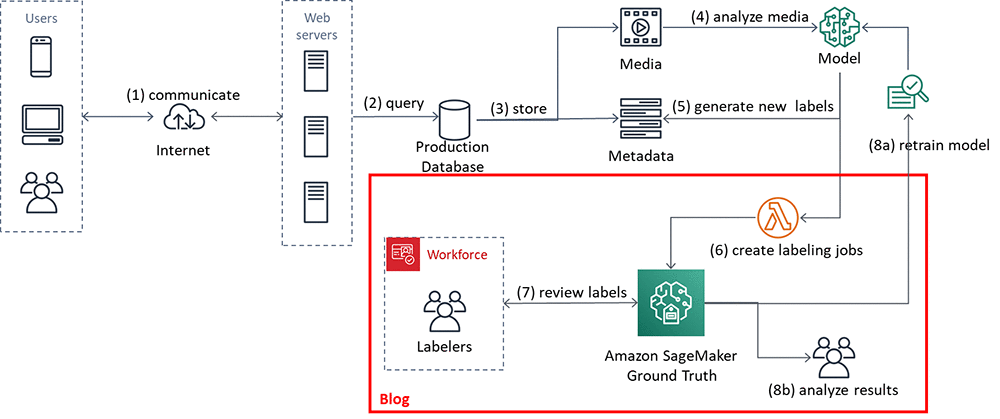
Easily perform bulk label quality assurance using Amazon SageMaker Ground Truth
In this blog post we’re going to walk you through an example situation where you’ve just built a machine learning system that labels your data at volume and you want to perform manual quality assurance (QA) on some of the labels. How can you do so without overwhelming your limited resources? We’ll show you how, […]

Use two additional data labeling services for your Amazon SageMaker Ground Truth labeling jobs
We’re excited to announce the availability of two more data labeling services that you can use for your Amazon SageMaker Ground Truth labeling jobs: Data Labeling Services by iMerit’s US-based workforce Data Labeling Services by Startek, Inc. These new listings on the AWS Marketplace supplement the existing iMerit India-based workforce listing to provide you a […]

Preprocess input data before making predictions using Amazon SageMaker AI inference pipelines and Scikit-learn
May 2025: This post was reviewed and updated for accuracy. Amazon SageMaker AI enables developers and data scientists to build, train, tune, and deploy machine learning (ML) models at scale. You can deploy trained ML models for real-time or batch predictions on unseen data, a process known as inference. However, in most cases, the raw […]
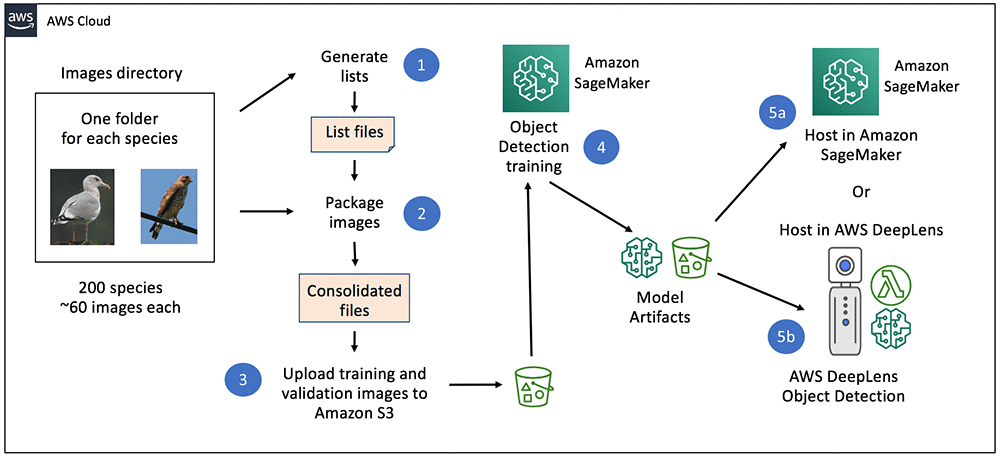
Identifying bird species on the edge using the Amazon SageMaker built-in Object Detection algorithm and AWS DeepLens
April 2023 Update: Starting January 31, 2024, you will no longer be able to access AWS DeepLens through the AWS management console, manage DeepLens devices, or access any projects you have created. To learn more, refer to these frequently asked questions about AWS DeepLens end of life. Custom object detection has become an important enabler for […]

Creating hierarchical label taxonomies using Amazon SageMaker Ground Truth
At re:Invent 2018 we launched Amazon SageMaker Ground Truth, which can Build Highly Accurate Datasets and Reduce Labeling Costs by up to 70% using machine learning. Amazon SageMaker Ground Truth offers easy access to public and private human labelers and provides them with built-in workflows and interfaces for common labeling tasks. Additionally, Amazon SageMaker Ground […]

Using TensorFlow eager execution with Amazon SageMaker script mode
In this blog post, I’ll discuss how to use Amazon SageMaker script mode to train models with TensorFlow’s eager execution mode. Eager execution is the future of TensorFlow; although it is available now as an option in recent versions of TensorFlow 1.x, it will become the default mode of TensorFlow 2. I’ll provide a brief […]

Annotate data for less with Amazon SageMaker Ground Truth and automated data labeling
With Amazon SageMaker Ground Truth, you can easily and inexpensively build more accurately labeled machine learning datasets. To decrease labeling costs, use Ground Truth machine learning to choose “difficult” images that require human annotation and “easy” images that can be automatically labeled with machine learning. This post explains how automated data labeling works and how […]
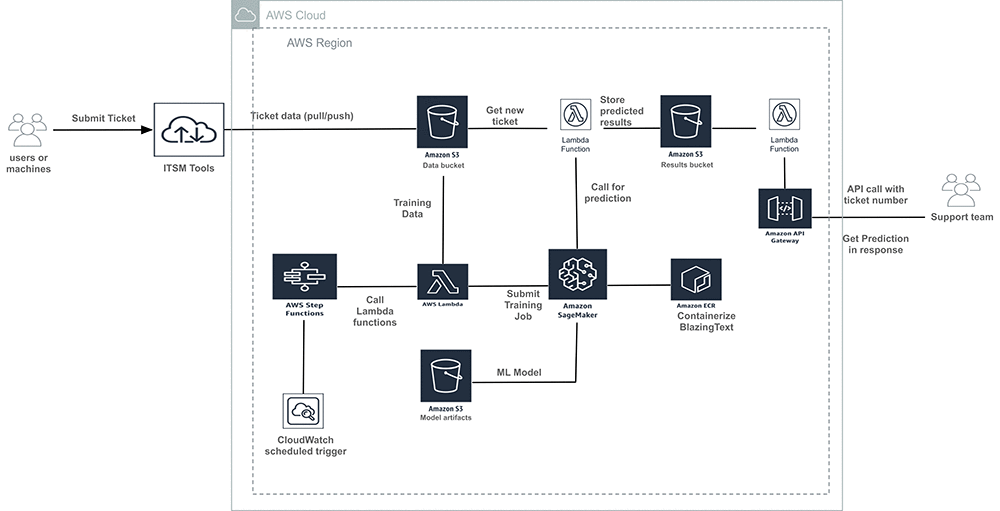
DXC Technology automates triage of support tickets using AWS machine learning
DXC Technology is a global IT service leader providing end-to-end services on Digital Transformation to businesses and governments. They also provide service management to their clients on-premises and in the cloud. The incident tickets raised as part of the process need to be resolved quickly to meet their service level agreements (SLA). DXC has goals […]
Deploy trained Keras or TensorFlow models using Amazon SageMaker
This post was reviewed and updated May 2022, to enforce model results reproducibility, add reproducibility checks, and to add a batch transform example for model predictions. Previously, this post was updated March 2021 to include SageMaker Neo compilation. Updated the compatibility for model trained using Keras 2.2.x with h5py 2.10.0 and TensorFlow 1.15.3. Amazon SageMaker […]
Thoughts on Recent Research Paper and Associated Article on Amazon Rekognition
A research paper and associated article published yesterday made claims about the accuracy of Amazon Rekognition. We welcome feedback, and indeed get feedback from folks all the time, but this research paper and article are misleading and draw false conclusions. This blog post shares details which we hope will help clarify several misperceptions and inaccuracies. […]