Artificial Intelligence
Category: Amazon SageMaker

Lowering total cost of ownership for machine learning and increasing productivity with Amazon SageMaker
You have many choices for building, training, and deploying machine learning (ML) models. Weighing the financial considerations of different cloud solutions requires detailed analysis. You must consider the infrastructure, operational, and security costs for each step of the ML workflow, as well as the size and expertise of your data science teams. The Total Cost […]

Flagging suspicious healthcare claims with Amazon SageMaker
The National Health Care Anti-Fraud Association (NHCAA) estimates that healthcare fraud costs the nation approximately $68 billion annually—3% of the nation’s $2.26 trillion in healthcare spending. This is a conservative estimate; other estimates range as high as 10% of annual healthcare expenditure, or $230 billion. Healthcare fraud inevitably results in higher premiums and out-of-pocket expenses […]

Identifying worker labeling efficiency using Amazon SageMaker Ground Truth
A critical success factor in machine learning (ML) is the cleanliness and accuracy of training datesets. Training with mislabeled or inaccurate data can lead to a poorly performing model. But how can you easily determine if the labeling team is accurately labeling data? One way is to manually sift through the results one worker at […]

Millennium Management: Secure machine learning using Amazon SageMaker
This is a guest post from Millennium Management. In their own words, “Millennium Management is a global investment management firm, established in 1989, with over 2,900 employees and $39.2 billion in assets under management as of August 2, 2019.” Millennium Management is comprised of a large number of specialized trading teams across the United States, […]

Maximizing NLP model performance with automatic model tuning in Amazon SageMaker
The field of Natural Language Processing (NLP) has had many remarkable breakthroughs in the past two years. Advanced deep learning models are raising the state-of-the-art performance standards for NLP tasks. To benefit from newly published NLP models, the best approach is to apply a pre-trained language model to a new dataset and fine-tune it for […]
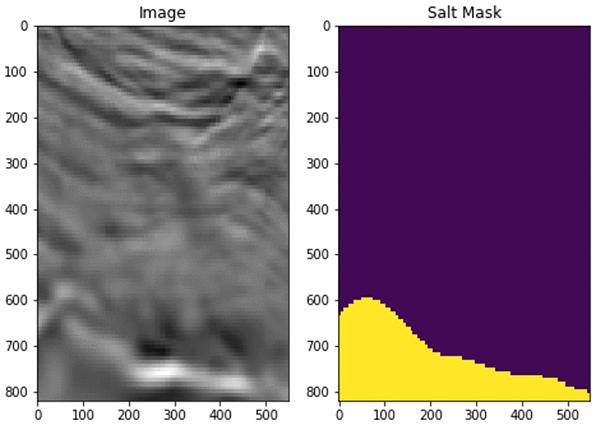
Interpreting 3D seismic data automatically using Amazon SageMaker
Interpreting 3D seismic data correctly helps identify geological features that may hold or trap oil and gas deposits. Amazon SageMaker and Apache MXNet on AWS can automate horizon picking using deep learning techniques. In this post, I use these services to build and train a custom deep-learning model for the interpretation of geological features on […]
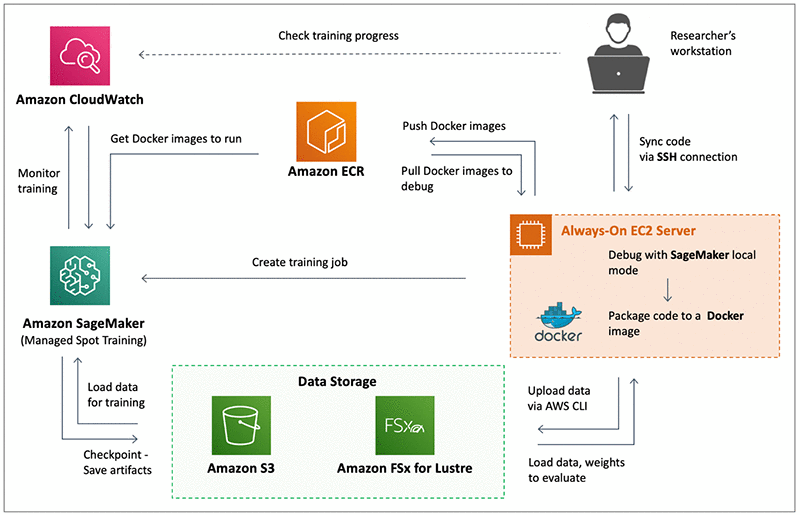
Cinnamon AI saves 70% on ML model training costs with Amazon SageMaker Managed Spot Training
Developers are constantly training and re-training machine learning (ML) models so they can continuously improve model predictions. Depending on the dataset size, model training jobs can take anywhere from a few minutes to multiple hours or days. ML development can be a complex, expensive, and iterative process. Being compute intensive, keeping compute costs low for […]
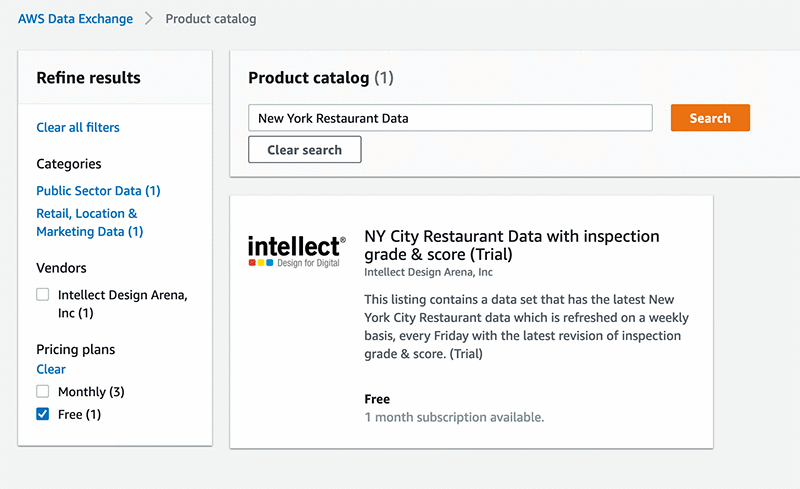
Building machine learning workflows with AWS Data Exchange and Amazon SageMaker
Thanks to cloud services such as Amazon SageMaker and AWS Data Exchange, machine learning (ML) is now easier than ever. This post explains how to build a model that predicts restaurant grades of NYC restaurants using AWS Data Exchange and Amazon SageMaker. We use a dataset of 23,372 restaurant inspection grades and scores from AWS […]

Running distributed TensorFlow training with Amazon SageMaker
TensorFlow is an open-source machine learning (ML) library widely used to develop heavy-weight deep neural networks (DNNs) that require distributed training using multiple GPUs across multiple hosts. Amazon SageMaker is a managed service that simplifies the ML workflow, starting with labeling data using active learning, hyperparameter tuning, distributed training of models, monitoring of training progression, […]
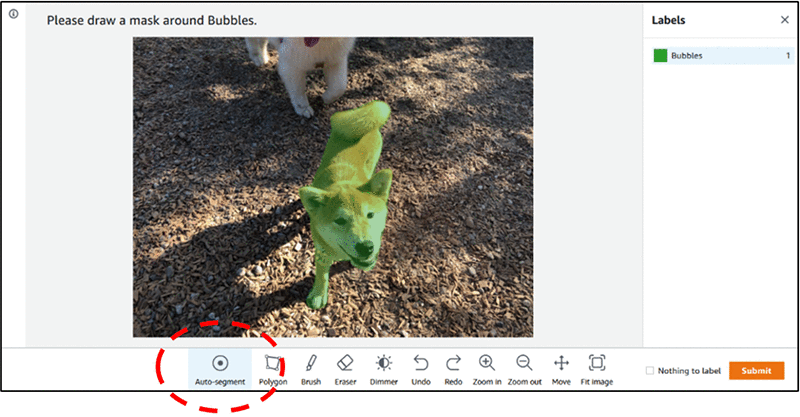
Auto-segmenting objects when performing semantic segmentation labeling with Amazon SageMaker Ground Truth
Amazon SageMaker Ground Truth helps you build highly accurate training datasets for machine learning (ML) quickly. Ground Truth offers easy access to third-party and your own human labelers and provides them with built-in workflows and interfaces for common labeling tasks. Additionally, Ground Truth can lower your labeling costs by up to 70% using automatic labeling, […]