Artificial Intelligence
Category: Amazon SageMaker

AWS launches open source Neo-AI project to accelerate ML deployments on edge devices
At re:Invent 2018, we announced Amazon SageMaker Neo, a new machine learning feature that you can use to train a machine learning model once and then run it anywhere in the cloud and at the edge. Today, we are releasing the code as the open source Neo-AI project under the Apache Software License. This release […]

Ensure consistency in data processing code between training and inference in Amazon SageMaker
In this blog post, we’ll show you how to deploy an inference pipeline consisting of pre-processing using SparkML, inferences using XGBoost, and post-processing using SparkML. For this particular example, we are using the Car Evaluation Data Set from UCI’s Machine Learning Repository and training an XGBoost model to predict the condition of a car (i.e. unacceptable, acceptable, good, or very good).

Automated and continuous deployment of Amazon SageMaker models with AWS Step Functions
Amazon SageMaker is a complete machine learning (ML) workflow service for developing, training, and deploying models, lowering the cost of building solutions, and increasing the productivity of data science teams. Amazon SageMaker comes with many predefined algorithms. You can also create your own algorithms by supplying Docker images, a training image to train your model […]
Amazon SageMaker adds Scikit-Learn support
Amazon SageMaker now comes pre-configured with the Scikit-Learn machine learning library in a Docker container. Scikit-Learn is popular choice for data scientists and developers because it provides efficient tools for data analysis and high quality implementations of popular machine learning algorithms through a consistent Python interface and well documented APIs. Scikit-Learn executes quickly and can […]
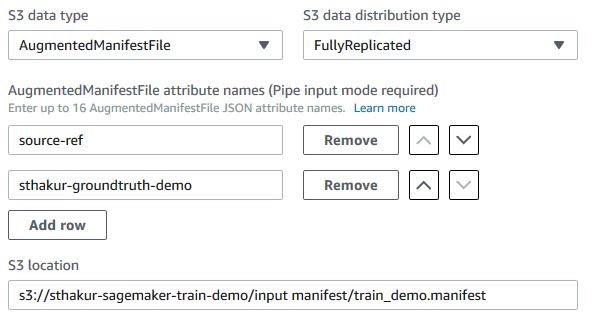
Easily train models using datasets labeled by Amazon SageMaker Ground Truth
Data scientists and developers can now easily train machine learning models on datasets labeled by Amazon SageMaker Ground Truth. Amazon SageMaker Training now accepts the labeled datasets produced in augmented manifest format as input through both AWS Management Console and Amazon SageMaker Python SDK APIs. Last month during AWS re:Invent, we launched Amazon SageMaker Ground […]

Amazon SageMaker Automatic Model Tuning now supports early stopping of training jobs
In June 2018, we launched Amazon SageMaker Automatic Model Tuning, a feature that automatically finds well-performing hyperparameters to train a machine learning model with. Unlike model parameters learned during training, hyperparameters are set before the learning process begins. A typical example of the use of hyperparameters is the learning rate of stochastic gradient procedures. Using […]
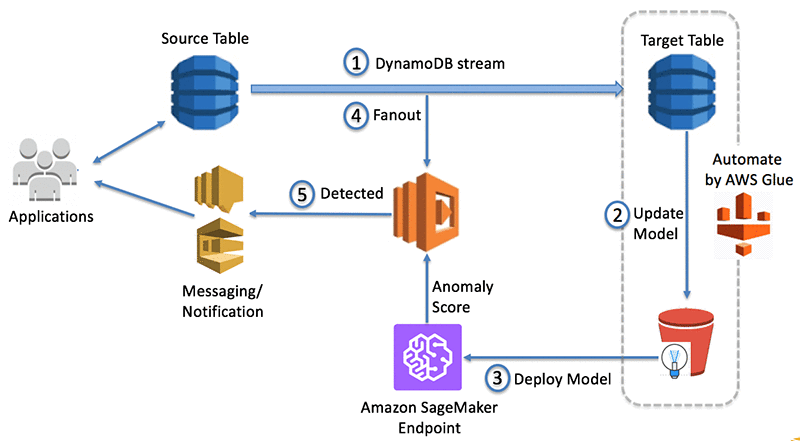
Anomaly detection on Amazon DynamoDB Streams using the Amazon SageMaker Random Cut Forest algorithm
Have you considered introducing anomaly detection technology to your business? Anomaly detection is a technique used to identify rare items, events, or observations which raise suspicion by differing significantly from the majority of the data you are analyzing. The applications of anomaly detection are wide-ranging including the detection of abnormal purchases or cyber intrusions in […]
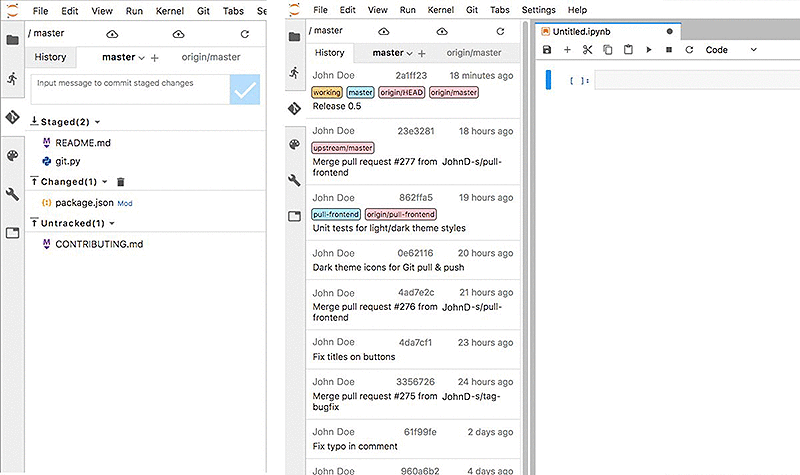
Amazon SageMaker notebooks now support Git integration for increased persistence, collaboration, and reproducibility
It’s now possible to associate GitHub, AWS CodeCommit, and any self-hosted Git repository with Amazon SageMaker notebook instances to easily and securely collaborate and ensure version-control with Jupyter Notebooks. In this blog post, I’ll elaborate on the benefits of using Git-based version-control systems and how to set up your notebook instances to work with Git repositories. Data […]

Semantic Segmentation algorithm is now available in Amazon SageMaker
Amazon SageMaker is a managed and infinitely scalable machine learning (ML) platform. With this platform, it is easy to build, train, and deploy machine learning models. Amazon SageMaker already has two popular built-in computer vision algorithms for image classification and object detection. The Amazon SageMaker image classification algorithm learns to categorize images into a set of […]
New Features For Amazon SageMaker: Workflows, Algorithms, and Accreditation
We’ve seen a ton of progress in machine learning during the past 12 months, with customers using Amazon SageMaker – a fully-managed service which has put ML into the hands of tens of thousands of developers and data scientists – to find fraud, predict pitches, and tune engines. We’ve added nearly 100 new features and […]