AWS for M&E Blog
Inside NFL IQ: The Analytics Engine Behind the NFL Offseason
The biggest decisions in the National Football League (NFL) don’t always happen under stadium lights. More often, they’re made weeks later — when scouts are replaying drills frame by frame, analysts are running probability models late into the night, and front offices are weighing roster needs against contract markets and draft boards. By the time a name is called on draft night, the data story behind that pick has already been building for months.
For years, that decision layer lived almost entirely behind closed doors. The NFL Next Gen Stats team and Amazon Web Services (AWS) set out to open it — not with commentary, but with computation.
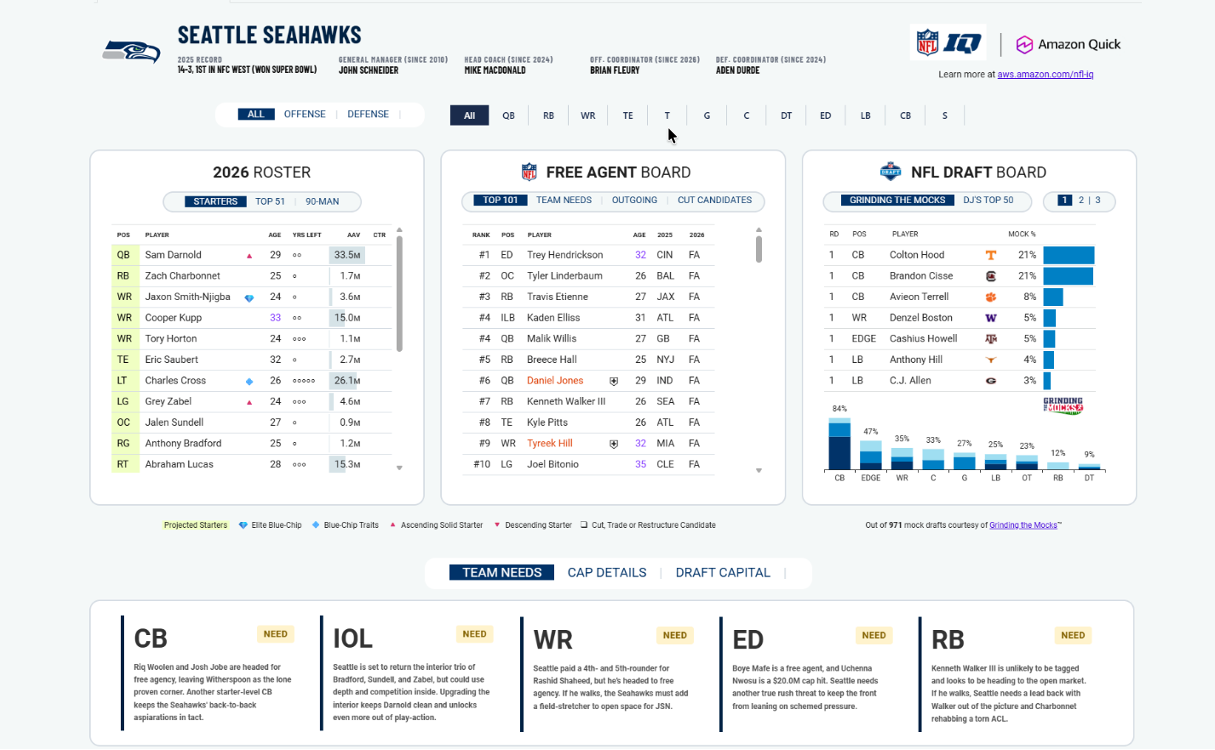
They built NFL IQ, a living offseason intelligence platform that lets fans explore how roster construction really works, how free agency reshapes team needs, how prospect signals change draft probabilities, how consensus projections move, and how every new transaction sends ripple effects across the league. Running on AWS and powered by Amazon Quick, the platform transforms offseason chaos into an interactive analytical experience that updates continuously as the market moves.
The ambition wasn’t to simplify the offseason. It was to let fans navigate it the way decision makers do.
“NFL IQ is really about enhancing the fan experience and deepening the fan connection between the team, front office and the roster itself,” said Mike Band of NFL Next Gen Stats Research & Analytics. “The goal is to put them in the war room — to see what teams are actually looking at when they make roster decisions.”
Transforming the Offseason into a Unified Roster-Building System
From the outside, the offseason looks like a sequence of events — workouts, signings, projections, and selections. Inside football operations, it behaves like a system. Each input changes the math.
A veteran signing reduces positional urgency. Reduced urgency shifts draft probability. Draft probability alters trade value. Prospect measurables affect fit scores. Everything connects.
NFL IQ was designed to model those connections directly. Instead of freezing moments, it recalculates context. When roster data changes, team need indicators change. When team needs change, draft likelihood curves shift. When consensus projections move, targeting clusters update.
The platform treats the offseason as a living model, not a timeline.
“Rather than just looking at prospects, we’re taking a more holistic, 360-view of how a team turns over and tries to improve their roster,” said Keegan Abdoo, Senior Manager at Next Gen Stats. “Free agency is just as important in determining who a team becomes as the draft — and now fans can see that interaction instead of guessing at it.”
What emerges is not a prediction machine but a decision map — one that shows how teams balance uncertainty, probability, and need.
How Amazon Quick Scaled NFL Research Tools for Millions of Fans
What makes NFL IQ feel fast and deep at the same time is the analytics engine underneath it. The platform is built on Amazon Quick, the same cloud BI environment the Next Gen Stats research team already uses to explore tracking data, test metrics, and generate broadcast insights throughout the season.
That continuity matters. It means the fan platform is not a simplified export — it’s an extension of the research workflow itself.
“Quick is the engine that powers our research,” Band explained. “It lets our analysts filter data, find patterns, test ideas — and surface insights fast. That same speed is what lets this platform stay fresh.”
Because Quick supports rapid dashboard authoring and high-performance querying at scale, analysts can move from idea to live visualization quickly — often within the same working session. Instead of long product cycles, the build process becomes iterative and researcher driven.
“Because it’s so intuitive, the barrier to entry is low,” Band said. “An analyst can say, ‘I want to see this stat or this view,’ and we can get it built and published fast. That changes how ambitious you can be with what you show fans.”
It also changes how rich the experience can be. Visual layers, probability charts, and interactive team views aren’t static exports; they’re native analytical surfaces rendered at fan scale.
Separating Draft Signal from Draft Noise
Draft season is overloaded with opinion. Hundreds of mock drafts compete for attention, often contradicting each other. Teams leak selectively. Analysts speculate confidently. The result is volume without clarity.
NFL IQ approaches the problem differently: don’t pick a voice — model the market.
Through its collaboration with Grinding the Mocks, a popular NFL Draft analytics project, the platform aggregates thousands of mock draft projections and converts them into probability distributions that evolve over time. Instead of asking who a team will pick, the platform shows who they are most likely to pick — and how that likelihood is shifting.
“Grinding the Mocks was built on a simple premise: the NFL Draft community collectively knows more than any single analyst. We’ve spent years turning that collective intelligence into structured, AI-driven data that aggregates mock drafts at a scale no individual analyst can match. This includes surfacing patterns, consensus shifts, and prospect momentum that reveal how the league is actually thinking, “said Benjamin Robinson, CEO and Founder of Grinding the Mocks.
“There’s a ton of noise in draft coverage,” Abdoo said. “When you synthesize across the whole ecosystem instead of relying on one source, you start to see real signal.”
Those probability surfaces reveal momentum, convergence, volatility, and positional clustering — patterns that single mock drafts can’t show. Fans can watch how a prospect rises after a workout, how consensus tightens around a pick range, or how team behavior shifts expectation bands.
“Any one mock draft is going to be wrong,” Band noted. “But when you look at the crowd signal together, it becomes directionally right — and that’s where it becomes useful.”
The result is draft intelligence that behaves more like a forecast model than a rumor feed.
Built to Move at the Speed of Football
One of the defining technical choices behind NFL IQ was responsiveness. The offseason doesn’t update politely — news breaks in bursts. Signings appear through trusted reporters before official logs update. Values emerge in fragments.
NFL IQ was engineered to move with that reality. When credible information lands, roster models update and downstream analytics recompute, from team needs to availability boards, probability curves, and fit indicators.
“We designed this to evolve every day,” Band said. “The offseason is dynamic. The dashboard should be too.”
That responsiveness turns revisiting the platform into a habit, not a one-time visit. Each return reveals a slightly different analytical landscape — new signals, new implications, new probabilities.
Start Exploring Inside NFL IQ
NFL IQ works because it doesn’t just answer questions — it invites exploration. It gives fans a way to test assumptions, trace implications, and understand why decisions make sense — or don’t — through data. It transforms offseason conversation from rumor to reasoning.
The hidden analytical game is now visible. And once you see how the decisions connect, it’s hard to look away.