AWS Messaging Blog
Global SMS strategy for gaming: Lessons from migrating 2FA across 100+ countries
When a player in Turkey, Brazil, or India tries to log in, they expect a verification code on their phone within seconds. If it doesn’t arrive, that’s a lost session, a support ticket, or worse, a player who doesn’t come back. For gaming studios operating across 100+ countries, delivering those SMS messages reliably is a complex operational challenge involving country-specific regulations, carrier registrations, and routing rules that can change overnight.
This post shares practical lessons from a real-world migration of a global gaming SMS platform from Amazon Simple Notification Service (Amazon SNS) to AWS End User Messaging. You’ll learn how to use resource sharing to avoid months of re-registration, how to build a country inventory that survives regulatory changes, and how to avoid the operational pitfalls that surface only when you migrate production traffic across accounts. Although the examples here are drawn from gaming, the operational challenges are universal. Any organization delivering SMS at international scale will face the same complexities, whether your users are players, customers, or patients.
Why gaming studios migrate SMS accounts
Before diving into the how, it’s worth understanding the why. Gaming studios commonly need to move SMS workloads between AWS accounts for several reasons:
- Security and scope isolation — Separating messaging infrastructure from game servers and backend services into a dedicated account reduces the impact of a security incident in either environment.
- Organizational changes — Studio acquisitions, team restructuring, or moving from a shared corporate account to a studio-owned account.
- Service evolution — Migrating from Amazon SNS (which supports SMS as one of many pub/sub capabilities) to AWS End User Messaging (purpose-built for SMS/MMS/voice with features like phone pools, protect configurations, and event destinations)
- Compliance boundaries — Isolating messaging resources to meet data residency or audit requirements.
Whatever the reason, the challenge is the same: you have a working global SMS setup with phone numbers, Sender IDs, short codes, and carrier registrations spread across dozens of countries, and you need to move it without disrupting millions of players’ 2FA flows.
Resource sharing: A faster migration path
The traditional approach would be to re-register every origination identity (that is, phone numbers, Sender IDs, short codes, see Choosing an origination identity) in the consuming account from scratch. For a global gaming platform, this is impractical:
- Sender ID registrations can take days to weeks. See Estimated registration times for current timelines.
- Short code provisioning can take 10–12 weeks in some markets.
- China message template registrations require AWS Support involvement and can take 15+ days.
- 10DLC campaigns (US) require brand and campaign registration through The Campaign Registry.
Multiply these timelines across every country where you operate, and a “clean” re-registration migration could take months.
AWS Resource Access Manager (RAM) offers a better path. Instead of re-registering, you share your existing origination identities from the sharing account to the consuming account, which can immediately begin sending. For the step-by-step setup including CLI commands, AWS Identity and Access Management (IAM) policies, and architecture diagrams, see A Complete Guide to Resource Sharing for AWS End User Messaging. This post focuses on the operational challenges that surface at global scale.
Know your country landscape before you start
The single most important preparation step is building a complete inventory of your SMS footprint, country by country. AWS publishes a comprehensive reference table listing supported countries, origination identity types, and registration requirements.
For a ready-made planning template, download the Global SMS Planning Sheet from How to Manage Global Sending of SMS with AWS End User Messaging. Your inventory should go beyond what’s published: document exact registered values (case matters), fallback behavior, carrier/aggregator, and why you chose each approach.
This inventory becomes invaluable for future account transitions, incident response, and onboarding new team members.
Plan for regulatory change, not just today’s rules
The global SMS regulatory landscape is not static. It’s tightening. Countries that previously had relaxed requirements are increasingly introducing mandatory Sender ID registration, content filtering, and message format restrictions. A migration is the ideal time to future-proof your setup, not just replicate what worked yesterday.
For help navigating the registration process for specific countries, see Registration support.
Example: Turkey’s URL blocking regulation (April 2026)
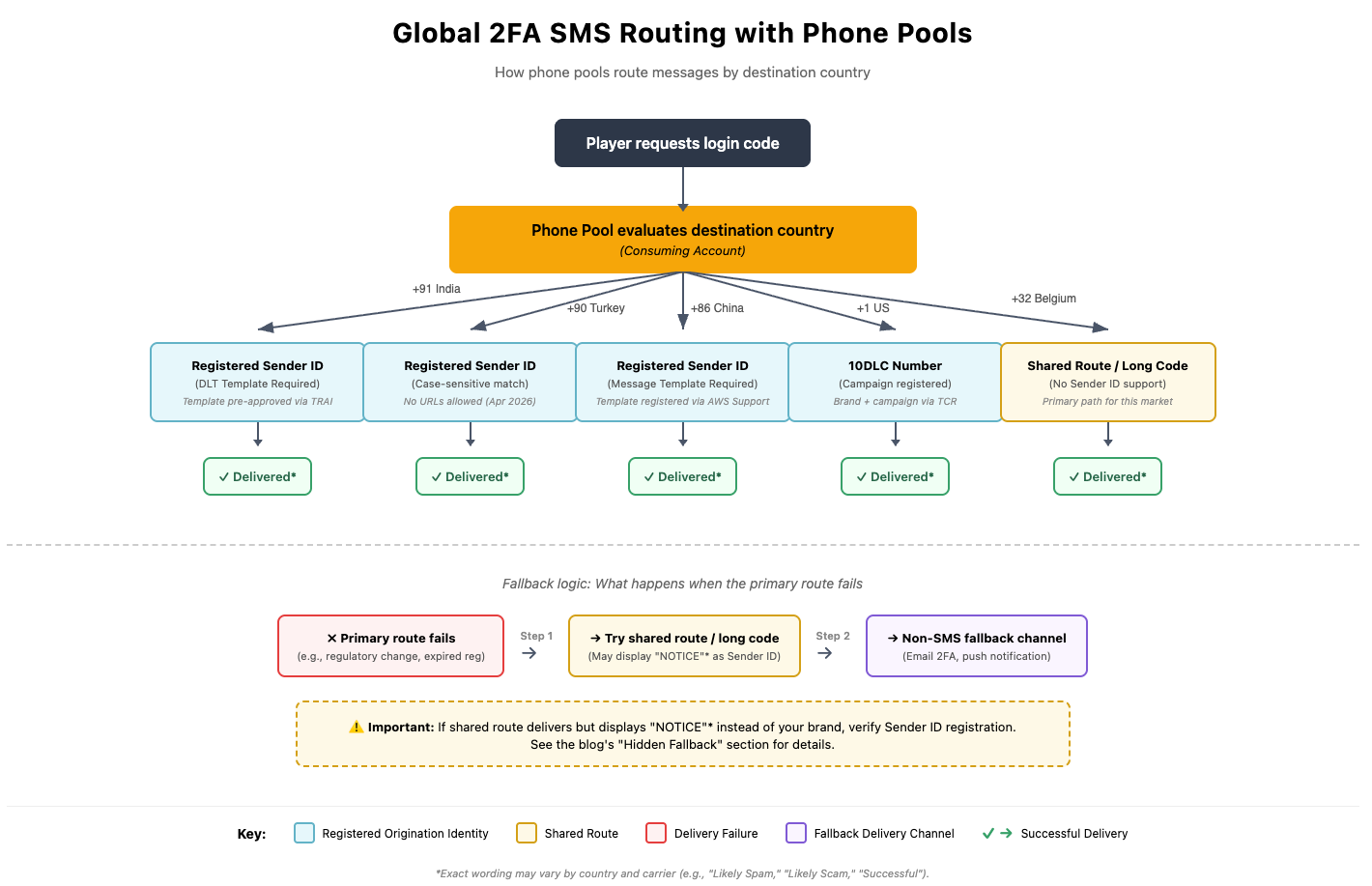
In April 2026, Turkey’s Information and Communications Technologies Authority (BTK) began enforcing a regulation that blocks all international A2P SMS messages containing URLs, hyperlinks, or shortened links. For gaming studios that include account recovery links, promotional URLs, or support links in their SMS messages, this type of regulatory change can mean immediate delivery failure to an entire market.
This type of regulatory shift is becoming more common:
- Optional to mandatory Sender ID registration. Australia is mandating Sender ID registration with ACMA by mid-2026. AWS now supports Australia sender ID registration directly through the EUM console.
- Content template registration. India requires DLT registration through TRAI, and China requires message template pre-registration through AWS Support.
- Content filtering and URL restrictions. Carriers in multiple markets are implementing automated filtering that rejects messages containing URLs or specific patterns, even from registered senders. Your country inventory shouldn’t just document what works today. It should also track regulatory change dates, upcoming requirements, content restrictions, and your fallback plan for each market. For each country, ask: “If the rules change tomorrow, how quickly can we adapt?” If the answer is weeks, that country should have a fallback channel (email, push notification) ready to activate immediately.
Lessons learned: What can go wrong at scale
Even with careful planning, migrating global SMS infrastructure surfaces unexpected issues. The following sections cover the most common pitfalls we encountered.
Sender ID case sensitivity
As documented by AWS, Sender ID values are case-sensitive at the carrier and aggregator level. In countries with mandatory registration (Turkey, UK, India, Australia), carriers might perform exact-match validation. If your application sends STUDIONAME but the carrier has StudioName on file, the message can be rejected.
The AWS End User Messaging console displays all Sender IDs in uppercase regardless of registration casing, which is something to watch out for. Always verify casing against the Registrations section of the console, which preserves the original value. Countries can also begin enforcing stricter matching overnight as regulations tighten, turning previously-working messages into failures.
What to watch for:
- Test delivery to countries with mandatory Sender ID registration before rolling out any casing changes globally.
- Check the country capabilities table for countries marked “Registration required.”
Phone pool quotas for global operations
Phone pools are the recommended way to manage origination identities (that is, phone numbers, Sender IDs, short codes, see Choosing an origination identity) at scale with AWS End User Messaging. A pool automatically selects the appropriate identity based on the destination country code, handling failover between identities for the same country.
You can find the default quota for origination identities per phone pool in Quotas for AWS End User Messaging SMS. You can request increases through the Service Quotas console, or contact AWS Support for larger increases.
Plan ahead: Inventory your origination identities before creating your pool, and request the quota increase before you start associating resources. Hitting the quota mid-migration creates unnecessary delays.
Batch your RAM sharing operations
When sharing a large number of origination identities through RAM (50+), the RAM API creates resource-based policies on each shared resource. The order of operations matters: add the consuming account (principal) to the resource share first, then add resources incrementally. If you create a resource share with hundreds of resources and then add the consuming account afterward, RAM attempts to set resource-based policies on all resources simultaneously. This is the most common trigger for throttling at scale. In severe cases, this throttling can result in resources with empty or corrupted resource policies, making them inaccessible to the consuming account until manually remediated.
Best practice:
- Add the consuming account (principal) to the resource share before adding any resources. Batch resource associations in groups of 10 or fewer.
- After each batch, verify that all resources have reached
ASSOCIATEDstatus. - From the consuming account, confirm that shared resources are visible using the
describe-*CLI commands with the--owner SHAREDflag. - Retain AWS CloudTrail logs for troubleshooting if any associations don’t complete as expected.
- If you suspect corrupted policies, verify the resource policies on affected resources and re-associate them individually.
Not everything transfers through RAM
RAM sharing covers the “what you send with”: phone numbers, Sender IDs, pools, and opt-out lists. But several critical components are account-specific and must be recreated in the consuming account:
- Configuration Sets.
- Event Destinations.
- Message Template Registrations (China).
- Protect Configurations.
- Account-level settings (sandbox/production status, spend limits).
Note on Protect Configurations: Protect Configurations apply at three levels: account default, configuration set, and per-message. A common mistake when setting up a consuming account is checking only the account-level default and missing a restriction at the configuration set level, resulting in unexpectedly blocked destination countries. When recreating your configuration in the consuming account, verify protect settings at all three levels.
Production mode requirement: Both the sharing account and the consuming account must be in Production mode. If the consuming account is still in the SMS sandbox, it can only send messages to verified destination phone numbers, which means shared production-ready resources cannot be used for real-world traffic. Verify production status in the consuming account before beginning your migration.
One tip worth highlighting: The registration process for certain countries’ message templates (notably China) is handled through AWS Support cases. After the registration is approved, retain a copy of the approved template details, the case correspondence, and the registration parameters. Support case history might not be accessible indefinitely. If you need to re-register in a new account later, having your own records of what was approved and the exact template content saves significant time.
Countries without Sender ID support
Not every country supports Sender IDs. If your phone pool is configured with Sender IDs and a message is routed to a country that doesn’t support them (for example, Belgium or Puerto Rico), the delivery will fail, and the error might not clearly indicate that the issue is Sender ID incompatibility.
Build an exclusion list: For countries that don’t support Sender IDs you have two options:
- Route those messages through a different origination identity (long code or short code) if available.
- Exclude those countries from Sender ID routing and allow them to fall back to shared routes.
The country capabilities table is your definitive reference for which countries support which origination identity types.
The “hidden fallback” discovery
A common surprise during migration is that your existing setup might have been silently falling back to shared routes in countries where you assumed you had branded Sender ID delivery. When SMS is sent through Amazon SNS with automatic origination identity selection, the service quietly falls back to shared routes (often displaying “NOTICE” as the Sender ID) if no registered identity is available for the destination country.
This fallback is invisible in normal operations. Messages still deliver, and unless you’re checking the Sender ID displayed on the recipient’s device, there’s no visible indication. But when you migrate to a phone pool with explicit Sender ID routing, these gaps become visible as delivery failures.
Before migrating, audit your actual delivery patterns, not just your configuration. Check delivery reports for countries where you expect branded Sender ID delivery and verify that the Sender ID displayed matches your brand, not “NOTICE” or a generic shared route.
Operational recommendations
The following practices help you avoid disruptions during migration and maintain reliable delivery afterward.
Have a fallback channel ready during migration
Before you begin migrating traffic, ensure you have an alternative authentication channel (typically email-based 2FA) ready to activate on short notice per-country. When an issue is detected, disable SMS for that country and fall back to email while you investigate, rather than leaving players locked out.
Build your country registry
Maintain a living document that tracks what you have (identity type, registration status, exact casing, account location), what you chose and why, what gaps exist (countries relying on shared routes), and registration details (approval dates, case references, template content). This registry is your migration playbook.
Set up delivery monitoring from day one
In the consuming account, configure Configuration Sets with Event Destinations before sending your first message. Consider using the Message Feedback API to track actual OTP conversion, not just carrier delivery. See Track OTP Success with AWS End User Messaging SMS Feedback for implementation details.
Test country by country, not just “it works”
Before scaling traffic, test delivery to representative countries from each category: mandatory Sender ID registration, no Sender ID support, optional Sender IDs, message template registration, and carrier-specific content restrictions. A successful test to the US doesn’t validate your Turkey configuration.
Conclusion
Global SMS for gaming works reliably until something needs to change. Migrations, account restructuring, and service upgrades expose the complexity that was previously hidden behind automatic fallbacks and “it just works” behavior.
In this post, we covered how to use RAM sharing to avoid months of re-registration, how to build a country inventory that accounts for regulatory change, and how to navigate the operational pitfalls of migrating production SMS traffic across accounts. The key takeaways:
- Use RAM sharing to avoid months of re-registration. See A Complete Guide to Resource Sharing for AWS End User Messaging for the step-by-step setup.
- Know your country landscape before you start. The country capabilities table is your starting point, but build your own registry with registration details, exact Sender ID values, and decision rationale.
- Respect the details. Case sensitivity, phone pool quotas, RAM batching limits, non-shareable resources, and record retention can each independently block your migration.
- Monitor from day one and plan for regulatory change. Set up delivery tracking before sending production traffic, and track what’s changing in each market.
What matters to players is that their verification code arrives in seconds, every time, regardless of location. The operational discipline described in this post helps make that happen and keeps it working through whatever infrastructure changes come next. Although this post is framed around gaming, the lessons apply broadly. Whether your users are players, shoppers, or account holders, reliable global SMS delivery requires the same operational rigor.
References
- A Complete Guide to Resource Sharing for AWS End User Messaging — AWS Messaging Blog
- Supported countries and regions for SMS messaging — AWS Documentation
- How to Manage Global Sending of SMS with AWS End User Messaging — AWS Messaging Blog
- AWS End User Messaging SMS User Guide — AWS Documentation
- Track OTP Success with AWS End User Messaging SMS Feedback — AWS Messaging Blog