Migration & Modernization
How RiskSpan modernized its platform on AWS and cut processing time by 10x
This post is co-written with Praveen Vairavan and Anirudh Parmar from RiskSpan.
RiskSpan, a financial analytics company, migrated to AWS but faced architectural design ceilings that horizontal scaling alone couldn’t solve. As a recognized market leader, they felt the need to modernize their RiskSpan platform, which delivers cloud-native models for residential whole loans, MSRs, and asset-backed finance. They saw this as an inflection point to transform their business and the experience of their customers.
Guided by the AWS Cloud Adoption Framework (AWS CAF), the team treated cloud transformation as a compounding investment across six perspectives: Business, People, Governance, Platform, Security, and Operations.This post details that journey: platform modernization cut processing times 10x and earned them RiskTech100 2026 and RiskTech100 2027 recognition, as their team builds toward a cloud operating model for the agentic AI era.
Platform Perspective – Account Architecture and Foundation
The platform migrated to AWS, but cloud adoption and transforming business outcomes using the cloud are not the same thing: the underlying architecture remained a monolith at its core. Elasticity at the edge did not resolve bottlenecks deeper in the stack. The team scaled horizontally at the compute and API layers, with Application Load Balancer (ALB) handling load distribution and Auto Scaling absorbing demand spikes. As compute and API layers scaled out, they funneled demand into a tightly coupled backend. A production event involving bandwidth saturation on a compute-intensive node made that ceiling painfully clear. A single-account AWS structure forced development, staging, and production together, creating environment conflicts, governance gaps, and hard questions from institutional clients about workload isolation.
The platform teams moved to a multi-account AWS architecture on a landing zone built with AWS Control Tower, with AWS Organizations and Service Control Policies (SCPs) enforcing guardrails automatically across every account. Each environment now sits in its own isolated account, with dedicated accounts for logging, security tooling, and shared services. On compute, the platform was rearchitected around Amazon Elastic Kubernetes Service (EKS), decomposing the monolith by domain. The analytics engine, data ingestion, model API, and UI were each deployed as containers that scale, fail, and update independently. Infrastructure as Code (IaC) replaced manual provisioning. This new platform allowed scaling deeper into the stack, including the analytics pipeline, data processing, and model execution tiers, making true end-to-end horizontal scale-out achievable for the first time. Workload isolation meant a large Mortgage-Backed Security (MBS) portfolio analysis from one client no longer degraded performance for other tenants. Account provisioning that once took days now completes in under an hour through code. This standardized platform reduced client resource support needs by 46%, and engineering teams reclaimed time previously lost to environment conflicts.
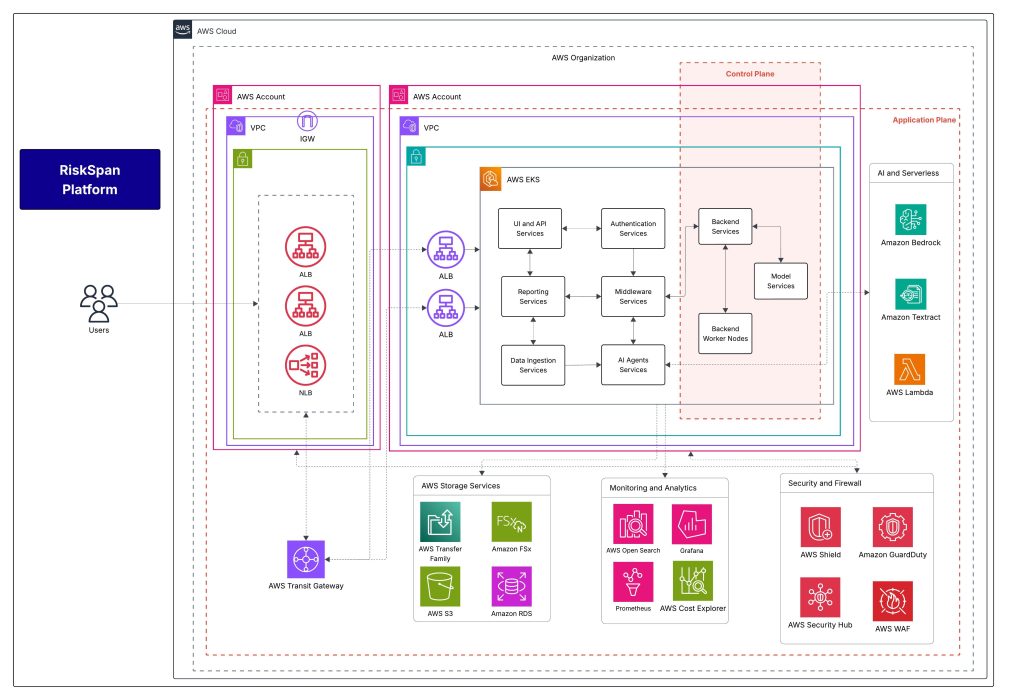
Figure 1: RiskSpan Platform with AWS guardrails
Takeaway
Platform governance debt accumulates silently. The gap between ‘on the cloud’ and ‘cloud-native’ is where it hides. Diagnosis of where elasticity ends was the prerequisite for everything that followed.
Security and Governance Perspective – “Always-On” Audit Evidence
When you serve institutional clients in financial services, security is not a checkbox, it is a condition of doing business. For RiskSpan, security and governance were inseparable, and you couldn’t modernize one without the other. As their client base grew and contracts became more sophisticated, the depth of security assessments grew with them. The security posture was built incrementally over years: tools were added reactively, AWS WAF configurations had drifted, and permission sprawl accumulated across instance profiles. It was no longer adequate to meet the growing business needs and created a periodic scramble to pass compliance assessments. The engineering and business leadership made a bold decision to rebuild rather than patch, embedding security and governance into the platform itself. They knew that in the long term, this would improve the client experience and reduce friction.
The team implemented IAM Roles for Service Accounts (IRSA) and replaced broad instance-level IAM profiles, giving each containerized workload precisely scoped permissions. AWS WAF rules, network security, and governance policies were remediated and codified as platform standards, allowing new services to inherit correct posture automatically. Governance required the same rigor at the data layer. RiskSpan’s clients use Snowflake via AWS Marketplace for data sharing and analytics. It became the natural choice for a unified, governed data layer with role-based access. Container image versioning, immutable infrastructure definitions, and Snowflake query tagging meant that every workload, data access, and deployment event left a traceable record. As a result, compliance and audit evidence pipelines shifted from a “high-lift” periodic scramble to an “always-on” capability.
As a result, client security reviews that previously created friction now move faster. During sales cycles, the security value proposition was now backed by documentation and evidence rather than verbal assurances, which helped earn trust and win business with sophisticated institutional clients. PII and data governance controls were enforced at the platform level instead of relying on developer discipline. Thinking ahead, they added an AI governance framework for data isolation, audit trails, and security. The framework is aligned to ISO 42001, requiring a full inventory of AI workloads across the organization and enforcing guardrails to ensure no workload operates outside the governance boundary. Instead of searching for answers, the team has built them into the platform.
Takeaway
Is your security posture keeping pace with your architecture, or just keeping up appearances? By embedding security, codifying policies, and enforcing governance such as PII controls, role-based access, and security assessments, RiskSpan proved governance and agility aren’t in tension on a modern platform. That perceived tradeoff is an artifact of legacy architecture.
Operations Perspective – Product and Development Agility
The Engineering team’s biggest constraint in meeting their customers’ demands was not talent or product vision: it was the delivery infrastructure. Over several years of feature delivery, the platform had grown organically into a tightly coupled architecture where every new deployment carried inherent risk. QA was entirely manual, and release cycles ran at three-week intervals. A disproportionate share of engineering time and energy went toward maintaining stability rather than building new capability.
The team had to design the migration of workloads to Amazon EKS while managing the platform that served live enterprise clients throughout. Services were containerized and migrated incrementally, with ALB routing bridging legacy and modernized components. The adoption of EKS based containerization provided flexibility and agility as services were decoupled and automation became the new norm for QA.
Once services were containerized and independently deployable, new capabilities could be built and shipped as discrete workstreams. These included the Edge AI module, the MBS agent, and loan tape ingestion automation. Independent deployment pipelines per service replaced the prior single, high-stakes release process. IaC eliminated configuration drift during testing and made environment parity repeatable. Container-native rollback meant that if issues surfaced during testing, the team could revert a single service in minutes without touching the rest of the platform. The release cadence remained the same, but feature throughput per cycle more than doubled without increasing risk. Manual QA was reduced by 40% as automated testing through AWS CodePipeline, Jenkins, and GitOps replaced much of the regression workload. Long-sought capabilities began moving faster through the pipeline. AI Agent features across multiple modules, originally planned for three quarters, shipped in just two months.
Takeaway
Before optimizing your teams’ output, check whether your delivery infrastructure can keep up with what they’re building. RiskSpan found that incremental migration, decoupled services, automated quality gates, and offloading orchestration on managed infrastructure unlocked product velocity. Measure the outcome of modernization not in infrastructure metrics, but in how quickly stalled initiatives begin moving through the pipeline.
People Perspective – Evolution of Roles and Functions
RiskSpan’s engineering team traditionally spent a disproportionate share of its energy just keeping the system running, managing deployments, firefighting events, and coordinating releases across internationally distributed teams. The scope to innovate and build new capabilities was limited, release cycles felt burdensome, and the team had little room for experimentation.
Once the modernization initiative rolled out, the team’s day to day gradually shifted to building repeatable and standardized capabilities for the platform instead of maintaining stability. As services became independently deployable, cross-team autonomy grew: international engineering teams distributed across continents could run separate sprint cadences and deployment tracks under shared platform standards. EKS deployment with AWS-managed node groups and AWS Fargate for burst workloads shifted operational complexity to AWS, letting the team focus on product delivery. Coordination across product, development, and engineering teams improved, reducing the time and operational overhead of sprint planning and releases.
Over time, this stability in deployment, automation, and platform governance opened the door to experimentation with AI/ML workloads. A data scientist or engineer could test a new model or pipeline variant without any risk of touching production client workloads. Engineering teams felt empowered to build new customer self-service capabilities such as the MBS agent, AI-driven collateral analysis, and private credit document extraction, energizing them and improving operations. Finally, with the platform now standardized and governed, engineering leaders could evaluate new capabilities, such as a data vendor integration, a model execution tier, or a client-facing feature, purely on product KPIs. The team also felt energized about investing in their skills: 20 engineers earned certifications including AWS Solutions Architect, AWS Developer, Certified Kubernetes Administrator (CKA), and HashiCorp Terraform.
Takeaway
The issue is not talent or ambition; it is that the architecture demands constant operational attention, leaving little room for experimentation or new capability building. When engineers shifted from keeping the system running to experimenting and building what’s next, they developed initiative, ownership, and creative energy.
Business Perspective – Readiness for Agentic Marketplace Leadership
As RiskSpan onboarded larger institutional clients with greater data volumes and more demanding SLAs, the patchwork of elastic and inelastic layers became harder to manage and scale. Analytical workloads processing millions of loans and pools once took up to 10 hours on monolithic infrastructure. They now complete in under an hour on parallelized compute. This directly translates to faster analytical turnaround and the ability to serve clients with data volumes and SLA requirements that the previous architecture could not support. Snowflake query tagging and cost attribution give per-client, per-workload visibility into infrastructure costs, providing actionable input for ongoing financial operations. The foundational work across infrastructure, security, operations, and product delivery laid the ground to move fast on the market opportunity created by AI/ML solutions.
RiskSpan launched an MBS data agent on Amazon Bedrock in 2025. With the MBS data agent, Agency MBS professionals can query complex structured finance data conversationally. Answers that previously required manual model runs now come in seconds. An internal AI support agent assists RiskSpan Platform support workflows. With it, the team can access institutional knowledge directly in real time. Originally planned for end of 2026, the Unified AI Agent (MBS, collateral, and smart mapping agents) shipped mid-Q2 and reached beta clients in early July, halving the delivery time. The containerized, independently deployable architecture meant the team could build and ship the agent as a discrete workstream without waiting on monolithic release cycles.
The modernization initiative directly influenced business and customer engagement, as seen in its partnership with London Stock Exchange Group (LSEG). The partnership requires running structured finance analytics at scale, with strict SLAs and turnaround demands that the pre-modernization platform could not have met. Bernadette Kogler, CEO of RiskSpan, said: “Our collaboration provides great value to clients. LSEG brings world-class evaluated pricing, reference and derived data strategy, and global market distribution. RiskSpan enhances those capabilities with structured finance analytics and modeling, scalable data engineering, and rigorous validation and workflow tooling. Together, we are raising the standard for how structured products are priced, validated, and delivered to the market.”
Takeaway
Architectures built through incremental scaling reach a ceiling. The business case for modernization is not infrastructure cost reduction alone. It is the optionality to serve larger clients, adopt emerging technologies, and compound product velocity over time. The foundational work across infrastructure, security, and operations is what makes AI workloads deployable, isolatable, and governable.
Conclusion
RiskSpan’s modernization journey illustrates a pattern that applies broadly: transformation is not a single initiative; it is a compounding investment across infrastructure, security, delivery, people, and business adoption. Each layer builds onto the last. The platform they rebuilt is not just faster; it’s the reason they can innovate and build what comes next.
The RiskSpan Platform provides cloud-native analytics for structured finance. Learn more about RiskSpan’s RiskSpan Platform hosted on the AWS Marketplace. To explore the services behind this modernization, visit the product pages for Amazon EKS, AWS Control Tower, and Amazon Bedrock. To learn more about the AWS Cloud Adoption Framework guidance for building cloud adoption strategies across six perspectives (Business, People, Governance, Platform, Security, Operations), visit the AWS documentation.