AWS Physical AI Blog
Flexible Manufacturing with AWS and SoftServe: How Simulation-First Robotics Reaches Production Faster
Introduction
Manufacturers need automation that adapts to changing products without costly rework. At Hannover Messe 2026, SoftServe and AWS demonstrated a simulation-first approach to flexible robotic manufacturing, powered by AWS cloud services for AI orchestration, IoT communication, and quality inspection that ran continuously for five days with a near-100 percent pick success rate during live public operations.
Where Robotics Programs Stall and Why Simulation-First Matters
Most production lines excel at repeatability. That remains important, but many manufacturers now need flexibility as well. They must manage shorter runs, more variants, and more customized outputs without treating each change as a new engineering project.
Adaptive automation addresses that need. Instead of tying logic to a single product, it treats the cell as a set of repeatable capabilities. When those capabilities can be coordinated flexibly, the same line handles a wider range of requests with less rework.
For manufacturers, that can mean:
- Faster response to changing demand
- Less downtime during changeovers
- Lower engineering effort for product variation
- Better use of existing automation investments
Many companies already have robots, machine vision, or industrial software in place. What they often lack is a practical way to connect those elements into a system that adjusts when business needs change.
SoftServe’s approach to simulation-first physical AI, built natively on AWS, helps close that gap. It combines AI-based decision-making, cloud services, robotics, and simulation so manufacturers can move from fixed automation toward more adaptable operations.
End-to-End Automation with Agentic AI at Hannover Messe
At Hannover Messe 2026, SoftServe and AWS demonstrated this approach in a live production cell on the AWS booth. The cell had been designed and validated weeks earlier in NVIDIA Isaac Sim, before any physical hardware was on site.
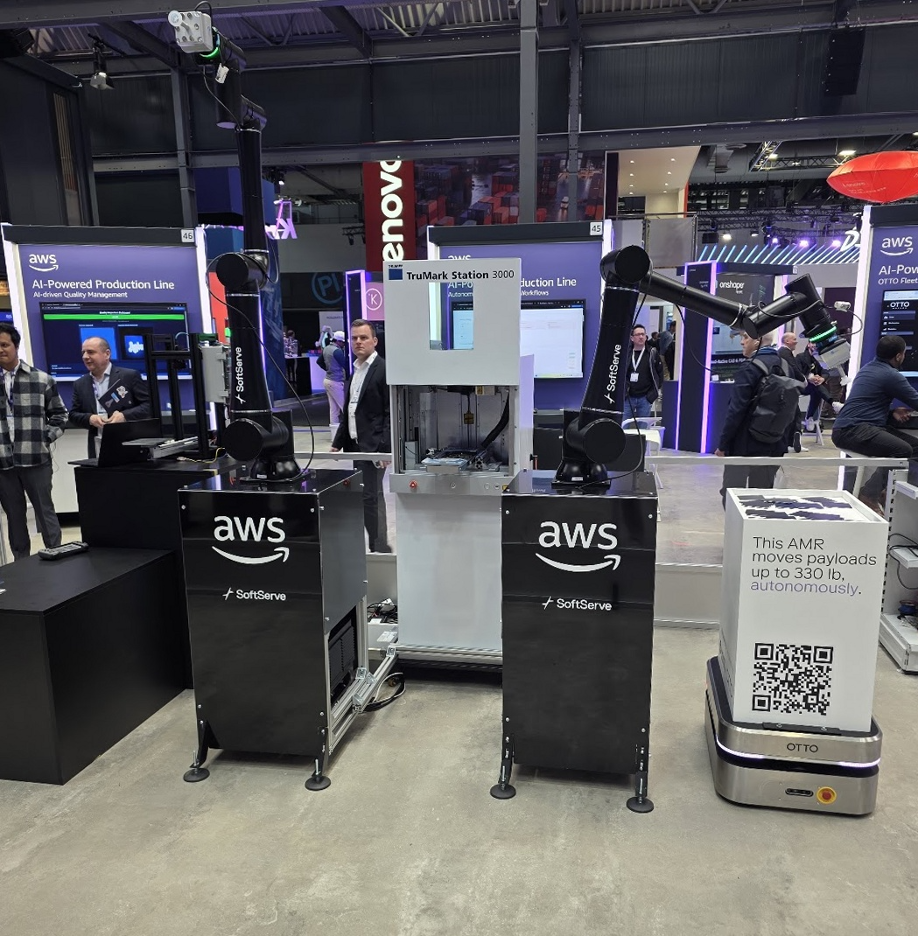
Image 1: Hannover Messe 2026
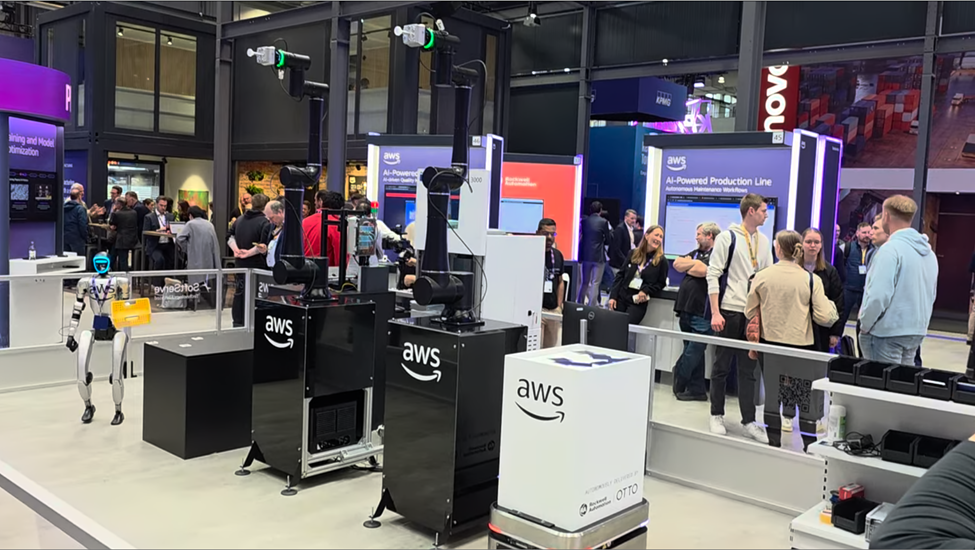
Image 2: Hannover Messe 2026 demo kiosk
The experience began at a kiosk. A visitor entered a few words, selected a style, and submitted a request for a custom table top drink coaster. The system then coordinated the full production process:
- A mobile robot brought a blank coaster to the production area.
- A robotic arm loaded it into an industrial laser engraver.
- The engraver marked the design selected by the user.
- A second robotic arm moved the coaster to a quality inspection station.
- An AI-based vision system checked the finished result.
- After inspection, the second arm placed the coaster into a basket.
- A humanoid robot carried the finished item back to the visitor.
This was not a static display or a lab-only proof of concept. It was a functioning cell that ran repeatedly in public across the full five days of the event.
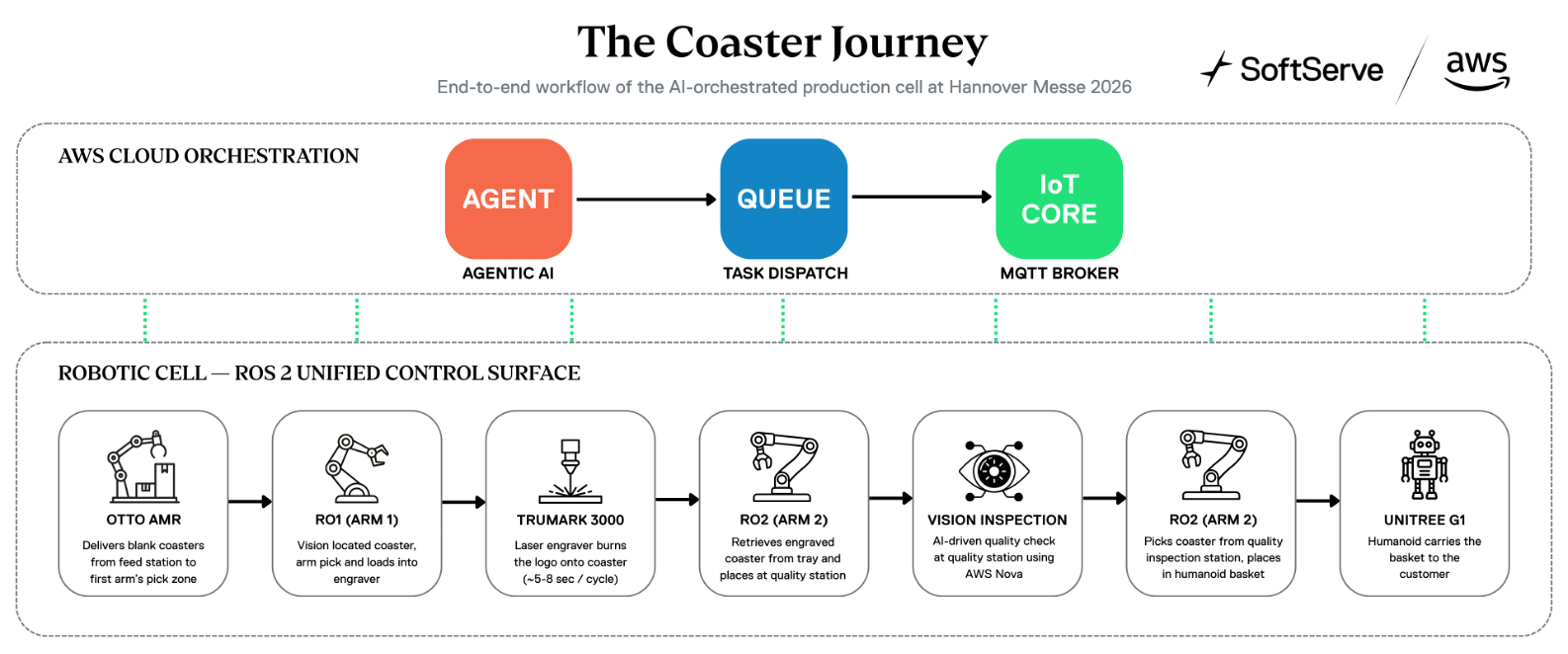
Figure 1: Production cell at Hannover Messe 2026 showing the robotic workflow from kiosk order to finished coaster delivery.
The significance was not the coaster itself. It was the operating model behind it. The system did not require engineers to hard-code a separate workflow for each new design. Thus, the request changed while the underlying action set remained consistent. That is the shift manufacturers care about: whether the same setup can respond to changing inputs without major rework.
The AWS Architecture Behind the Cell
That flexibility was built on a robust set of AWS services working together across cloud and edge:
Generative AI for custom design. When a visitor submitted a request at the kiosk, Amazon Bedrock invoked Amazon Nova Canvas to generate a custom coaster design from the text prompt and prompt-engineering containing the design requirements through prompt wrapping. Nova Canvas generates a 1024×1024 PNG. A Lambda function then applies binary thresholding to produce a 1-bit bitmap, crops to a circular mask matching the 90mm coaster diameter, and converts to the engraver’s native format (e.g., BMP or SVG via potrace). Total image generation time and post-processing latency is around ~3-4 seconds without requiring manual design effort
Agentic orchestration for workflow coordination. Amazon Bedrock Agents provided the reasoning layer that broke each production request into discrete steps and dispatched them in the correct sequence. The agent determined which robot to activate, when to trigger the engraver, and when to initiate inspection, adapting the sequence as needed without hard-coded logic.
Job queuing and task dispatch. Amazon Simple Queue Service (Amazon SQS) managed the queue of incoming production requests, ensuring reliable ordering and delivery of tasks even during peak visitor periods. AWS Step Functions orchestrated the multi-step workflow state machine, coordinating handoffs between each stage of production.
IoT messaging for robot communication. AWS IoT Core served as the MQTT message broker connecting all physical devices – mobile robots, robotic arms, the laser engraver, and the inspection station to the cloud orchestration layer. Each device published state updates and subscribed to command topics, enabling bidirectional communication with low latency.
AI-powered quality inspection. After engraving, a camera connected to a vision system captured an image of the finished coaster. An Amazon Nova Language Model (VLM), accessed through Bedrock, analyzed the image against the original design requirements to verify engraving quality and provided automated pass/fail determination without human intervention.
Edge computing for local reliability. AWS IoT Greengrass ran on a local gateway that served as the MQTT relay between AWS IoT Core and the cell’s devices over the local network. Greengrass components handled protocol translation between the cloud MQTT namespace and the robots’ native interfaces. The edge device provides local processing power for time-critical commands and maintained operation continuity during any momentary connectivity variations.
Observability and monitoring. Amazon CloudWatch collected metrics, logs, and traces across the entire system, from cloud orchestration latency to individual robot pick-and-place cycle times, giving operators real-time visibility into cell performance.
Security and Identity. AWS Identity and Access Management (IAM) enforced least-privilege access across all services and devices, while IoT Core’s mutual TLS authentication secured device-to-cloud communication.
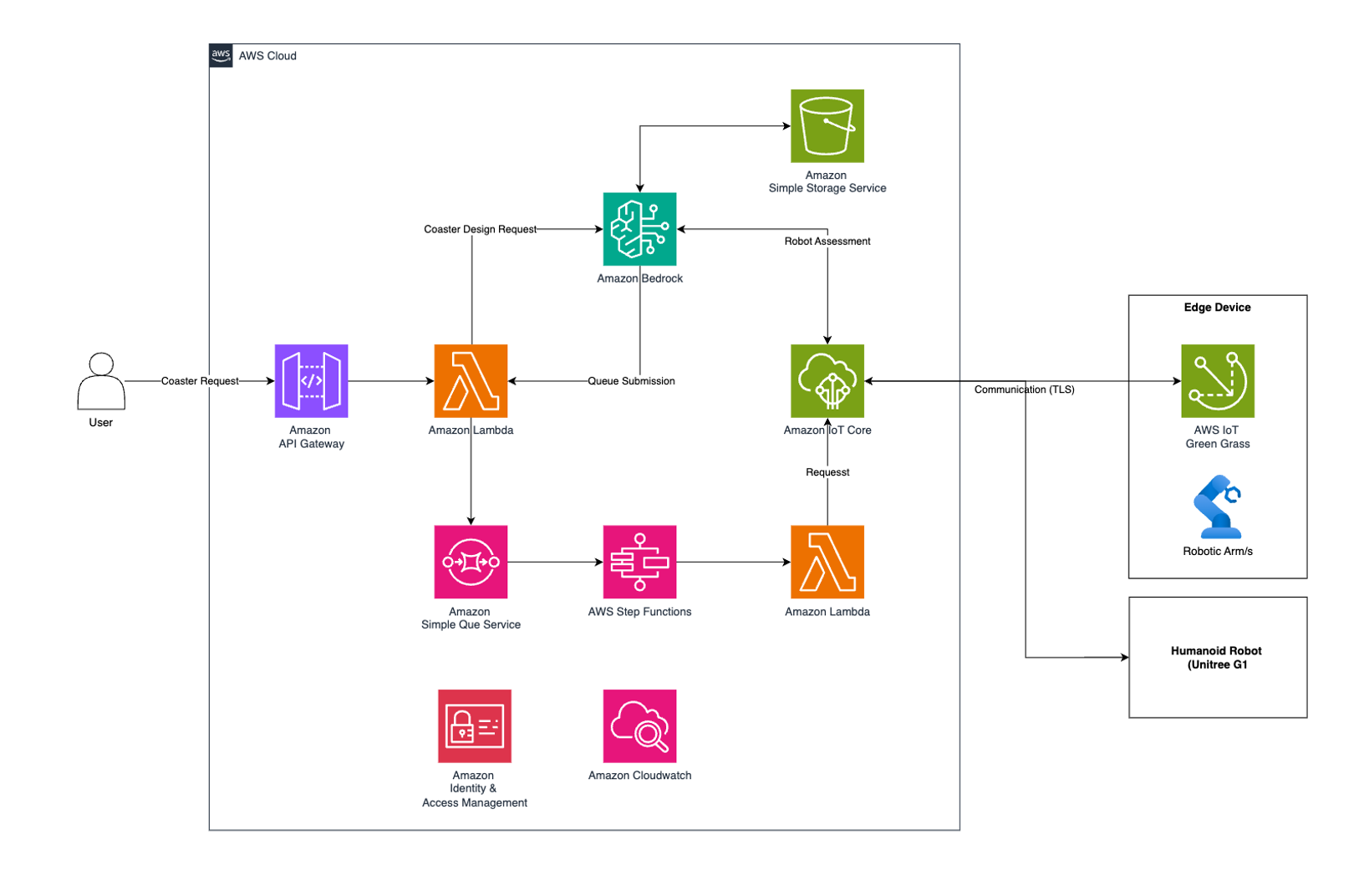
Figure 2: AWS Architecture – Flexible Manufacturing
Demonstration Results
During the five-day demonstration, the team observed the following:
- End-to-end cycle time of approximately 45 to 50 seconds per coaster
- Engraving step completion in approximately 5 to 8 seconds per part
- Continuous operation across all five days of the event
- Pick success rate near 100 percent
These results demonstrated that the system brought several machines and software layers into one continuous workflow reliably in a live trade-show setting.
Turning Simulation-First Design into Production with AWS
The Hannover Messe cell was one workflow, but the simulation-first pattern applies more broadly. Many manufacturing teams need to:
- Support more product variation while minimizing complexity
- Introduce new product options faster
- Reduce the time and cost tied to integration changes
- Validate changes before implementing them on the line
- Connect AI initiatives to operational outcomes
Key elements of the approach include:
Simulation before deployment. SoftServe uses NVIDIA Isaac Sim to validate workflows before physical commissioning. Teams run parallel simulations on Amazon Elastic Compute Cloud (Amazon EC2) GPU instances, store training data and digital-twin assets in Amazon Simple Storage Service (Amazon S3), and version scenarios for regression testing. This approach reduces deployment risk and shortens implementation cycles.
Cloud-based coordination. In the Hannover Messe architecture, cloud orchestration handled decision logic while the cell executed defined actions on the floor. Amazon Bedrock Agents, AWS IoT Core, Step Functions, and Amazon SQS coordinated work across connected machines and applications, a pattern that scales from one cell to multiple production lines.
AI-driven design and inspection. The demonstration used AI both at the customer input stage and at the quality stage. Amazon Bedrock provides access to foundation models for content generation, VLM for vision-based inspection, and decision support, all through a unified API that simplifies integration.
Operational visibility and security. Production systems require observability, control, and governance. CloudWatch monitors performance, IAM secures communications, and AWS CloudTrail provides an audit trail of all API activity for compliance and troubleshooting.
SoftServe brings experience in robotics, industrial automation, AI, and digital engineering. AWS provides cloud services that connect, coordinate, and scale these systems. Together, this gives manufacturers a practical route from pilot to production deployment.
Moving From Development to Deployment
Autonomous manufacturing advances through practical deployments, not abstractions. The SoftServe and AWS collaboration at Hannover Messe demonstrated the most credible path forward: a production cell that accepted changing customer requests, executed jobs across connected systems, inspected results, and completed workflows with strong reliability in a live setting.
For manufacturers, the takeaway is clear. More flexible automation becomes achievable when AI, cloud services, simulation, and robotics work together. That creates a practical opportunity to move beyond fixed automation and build operations that adapt as your business needs evolve.
Get Started
- Learn how SoftServe leverages physical AI for flexible and effective robotic automation.
- Explore the Guidance for Physical AI for Robotics on AWS for reference architectures and implementation patterns.
- Read how AWS accelerates Physical AI with simulation and real-world learning.
- Contact SoftServe to discuss your flexible manufacturing use case on AWS.