AWS Security Blog
Category: Security, Identity, & Compliance

How to use AWS Certificate Manager with AWS CloudFormation
December 11, 2024: This post has been updated with AWS CloudFormation templates to issue AWS Certificate Manager (ACM) public certificates, as well as AWS private certificates (using ACM). In July 2020, Amazon Web Services (AWS) introduced the ability to automate issuing and validating public and private certificates using AWS CloudFormation. To make this easier, AWS […]

Learn and use 13 AWS security tools to implement SEC recommended protection of stored customer data in the cloud
Most businesses collect, process, and store sensitive customer data that needs to be secured to earn customer trust and protect customers against abuses. Regulated businesses must prove they meet guidelines established by regulatory bodies. As an example, in the capital markets, broker-dealers and investment advisors must demonstrate they address the guidelines proposed by the Office […]
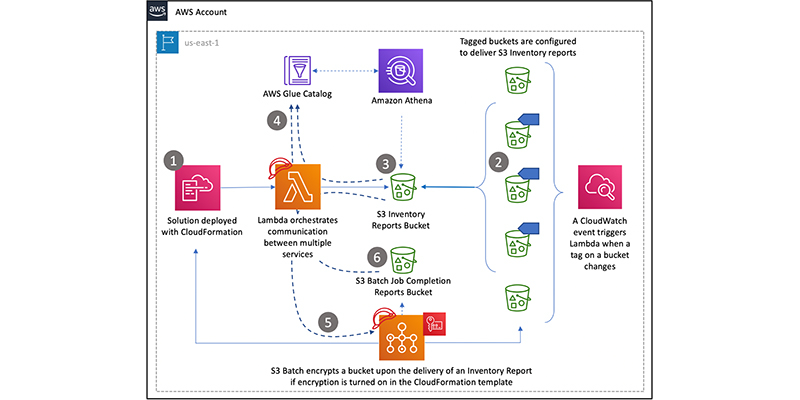
How to retroactively encrypt existing objects in Amazon S3 using S3 Inventory, Amazon Athena, and S3 Batch Operations
February 5, 2026: Amazon S3 now supports the UpdateObjectEncryption API so you can atomically update the server-side encryption type of existing encrypted objects from server-side encryption with S3 managed encryption (SSE-S3) to server-side encryption with AWS Key Management Service (AWS KMS) encryption keys (SSE-KMS). Read the documentation. November 1, 2021: AWS KMS is replacing the […]

Identify, arrange, and manage secrets easily using enhanced search in AWS Secrets Manager
AWS Secrets Manager now enables you to search secrets based on attributes such as secret name, description, tag keys, and tag values. With this launch, you can easily identify, arrange, and manage your secrets into logical groups that can then be used by specific applications, departments, or employees. For example, you can use the Secrets […]

How to use resource-based policies in the AWS Secrets Manager console to securely access secrets across AWS accounts
AWS Secrets Manager now enables you to create and manage your resource-based policies using the Secrets Manager console. With this launch, we are also improving your security posture by both identifying and preventing creation of resource policies that grant overly broad access to your secrets across your Amazon Web Services (AWS) accounts. To achieve this, […]

Code signing using AWS Certificate Manager Private CA and AWS Key Management Service asymmetric keys
August 31, 2021: AWS KMS is replacing the term customer master key (CMK) with AWS KMS key and KMS key. The concept has not changed. To prevent breaking changes, AWS KMS is keeping some variations of this term. More info. In this post, we show you how to combine the asymmetric signing feature of the […]

How to build a CI/CD pipeline for container vulnerability scanning with Trivy and AWS Security Hub
In this post, I’ll show you how to build a continuous integration and continuous delivery (CI/CD) pipeline using AWS Developer Tools, as well as Aqua Security‘s open source container vulnerability scanner, Trivy. You’ll build two Docker images, one with vulnerabilities and one without, to learn the capabilities of Trivy and how to send all vulnerability […]

What is a cyber range and how do you build one on AWS?
In this post, we provide advice on how you can build a current cyber range using AWS services. Conducting security incident simulations is a valuable exercise for organizations. As described in the AWS Security Incident Response Guide, security incident response simulations (SIRS) are useful tools to improve how an organization handles security events. These simulations […]

Tighten S3 permissions for your IAM users and roles using access history of S3 actions
September 28, 2023: IAM is incrementally adding support for actions from more services. For a list of services that report action last accessed information, see IAM action last accessed information services and actions. Customers tell us that when their teams and projects are just getting started, administrators may grant broad access to inspire innovation and […]

How to perform automated incident response in a multi-account environment
How quickly you respond to security incidents is key to minimizing their impacts. Automating incident response helps you scale your capabilities, rapidly reduce the scope of compromised resources, and reduce repetitive work by security teams. But when you use automation, you also must manage exceptions to standard response procedures. In this post, I provide a […]