AWS Spatial Computing Blog
Atinary’s AI & Self-Driving Labs® on AWS accelerate R&D for dsm-firmenich, Takeda, and MIT
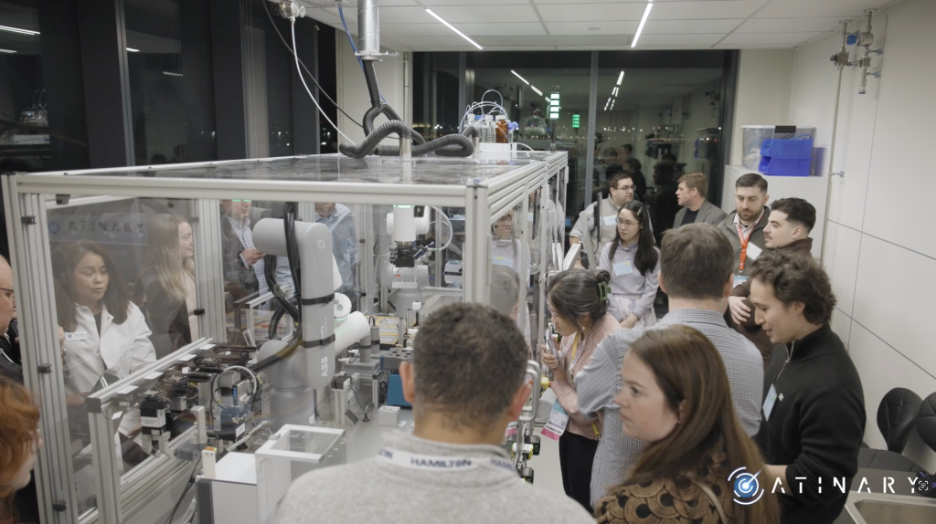
Self-Driving Labs® are no longer a vision
Developing a new drug takes an average of 10-15 years and costs over $2 billion. For patients waiting on life-saving treatments, every month of R&D delay matters. The bottleneck isn’t a lack of scientific talent, it’s the sheer scale of experimentation required. A single drug optimization campaign might require testing thousands or even millions of chemical combinations, taking hours of manual lab work, data recording, and analysis. A PhD student might spend five years generating the same volume of data that a Self-Driving Lab produces in a single week. Scientists manually design each experiment, wait for results, record data in spreadsheets, analyze it, and then decide what to try next. This cycle repeats hundreds or thousands of times. It’s slow, expensive, and fundamentally limited by human bandwidth.
Recognizing this, Atinary developed Self-Driving Labs®. Their solution, SDLabs®, is an agentic AI platform that augments scientists with AI and robotics to execute continuous discovery loops. Their code-free platform has evolved alongside the rapid advancements of AI and automations to address the fundamental bottlenecks in R&D, closing the loop between experimental design and execution.
Atinary and AWS recently celebrated the launch of SDLabs® 2.0 and the opening of Atinary’s new Self-Driving Lab at a joint event in Zurich, showcasing how the convergence of science, AI, and cloud computing is transforming R&D for global leaders including dsm-firmenich, Takeda Pharmaceuticals, and MIT.
SDLabs® is hosted entirely on AWS Cloud, using Amazon Elastic Container Service (Amazon ECS) with both Amazon Elastic Compute Cloud (Amazon EC2) and AWS Fargate compute options, Amazon Bedrock for its conversational AI interface, and Amazon Aurora PostgreSQL for secure data storage – providing scientists with enterprise-grade infrastructure.
“SDLabs® generate more experimental data in one week than a PhD student produces in 5 years”

Figure 1: Atinary and AWS joint event to celebrate the launch of Atinary’s agentic platform SDLabs® 2.0 and the Atinary Self-Driving Labs® opening, Zurich, February 25, 2026
What is Atinary SDLabs® 2.0?
SDLabs® 2.0 is Atinary’s latest version of their AI platform, used by scientists to automate laboratory workflows. This new version makes it easier for scientists to run laboratory experiments using AI, with improved algorithms, interface, and agentic workflows, and the possibility to integrate with any robotic platform. Scientists interact with SDLabs® to design and optimize their experiments, and learn from each result, dramatically reducing the number of experiments needed to find the optimal outcome.
How It Works
At its core, SDLabs® is built on top of an optimization algorithm that is able to efficiently navigate millions, or even billions of possible experimental combinations. The model learns and becomes smarter with each experiment. Unlike traditional trial-and-error approaches, these machine learning optimizers learn from each experiment to strategically recommend the next best parameters to test, dramatically reducing iterations needed to reach optimal results.
The platform operates on an iterative Design-Make-Test-Analyze+Learn (DMTA+L) loop where AI algorithms design experiments, scientists or robotic systems execute them, real-time data processing extracts insights, and machine learning models provide optimized recommendations. In the case of Atinary’s Self-Driving Lab in Boston, this closed-loop process can run 24/7 and generate more experimental data in one week than a PhD student produces in 5 years.
Key Capabilities
SDLabs® 2.0 is agentic and hardware agnostic. The platform can be used in laboratory environments with or without robotic integrations. SDLabs® can connect with virtually any robotic platform or laboratory automation system, including equipment from ABB Robotics, Agilent, Bruker, Chemspeed, Mettler-Toledo, and other robotic platforms.
The platform features an intuitive, code-free interface with new LLM features where scientists interact conversationally to conduct literature searches, extract key information for the experimental design, provide expert context, and receive recommendations. Scientists start generating results within 2 hours of accessing the platform, no coding required. Proprietary machine learning suites handle multi-parameter, multi-objective, and constrained challenges simultaneously, with real-time analytics providing transparency into how algorithms navigate experimental spaces.
Built for regulated industries, SDLabs® 2.0 is SOC-2, AWS FTR, and GDPR compliant, with 100% customer IP ownership and possibilities to integrate with existing LIMS and ELNs.
These capabilities translate into real-world impact. Here’s how three industry leaders are using SDLabs® to transform their R&D workflows:
dsm-firmenich + Atinary: 97% cost reduction in Hydroformylation
In a collaboration between Atinary and dsm-firmenich, the teams have redefined the economics of hydroformylation, a multiton chemical transformation used in the fragrance and pharmaceutical industries. Hydroformylation is a key chemical process used to produce fragrances and pharmaceutical ingredients at industrial scale. Optimizing it traditionally requires testing millions of combinations of catalysts, temperatures, and pressures. By leveraging the SDLabs® platform to navigate a staggering 2.9 billion possible combinations, the teams identified optimal reaction conditions in just 88 experiments.
The impact on the bottom line was transformative:
- 97% Lower Costs: Reduced the cost contribution of Rhodium, one of the world’s rarest precious metals, from €127/kg to €4/kg.
- 30x More Efficient: Reduced catalyst loading by up to 30x without sacrificing selectivity or conversion.
- Double the Throughput: Cut reaction times by 50%, effectively doubling laboratory capacity
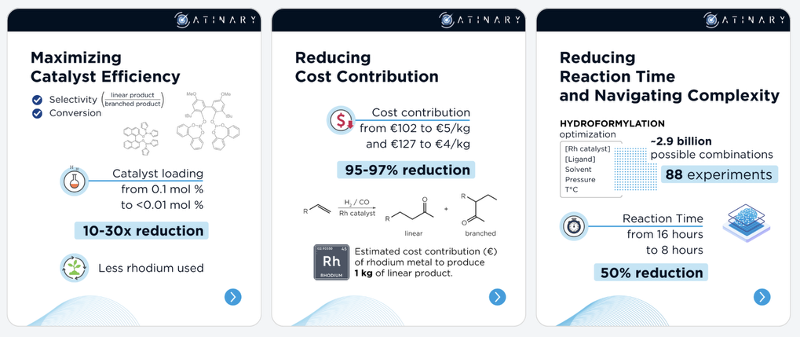
Figure 2: dsm-firmenich benefits from utilizing the SDLabs® platform
Explore more about this use case | Read the publication
Takeda + Atinary: 90% increased yield in Pharma
Atinary has been working closely with Takeda Pharmaceutical to integrate the SDLabs® platform into Takeda’s drug discovery workflows. In addition to accelerating process optimization, the goal is to create a connected ecosystem where hardware and software work together to reduce the manual overhead typically found in analytical data processing.
By integrating AI-guided optimization, Takeda’s scientists have achieved unprecedented breakthroughs:
- Rapid Optimization: Accelerated timelines from months to weeks and increased yields to 90% in just 3 iterations
- Proven Versatility: Seamlessly optimized complex Buchwald-Hartwig reactions
- Operational Velocity: Maximized resource utilization to deliver life-saving treatments to patients faster
“The optimization was done with our Self-Driving approach in about 1 week, in comparison to the 1-2 months that would have taken the manual external approach.” — Dr. Adrian Ramirez Galilea, Associate Director, Automation & HTE
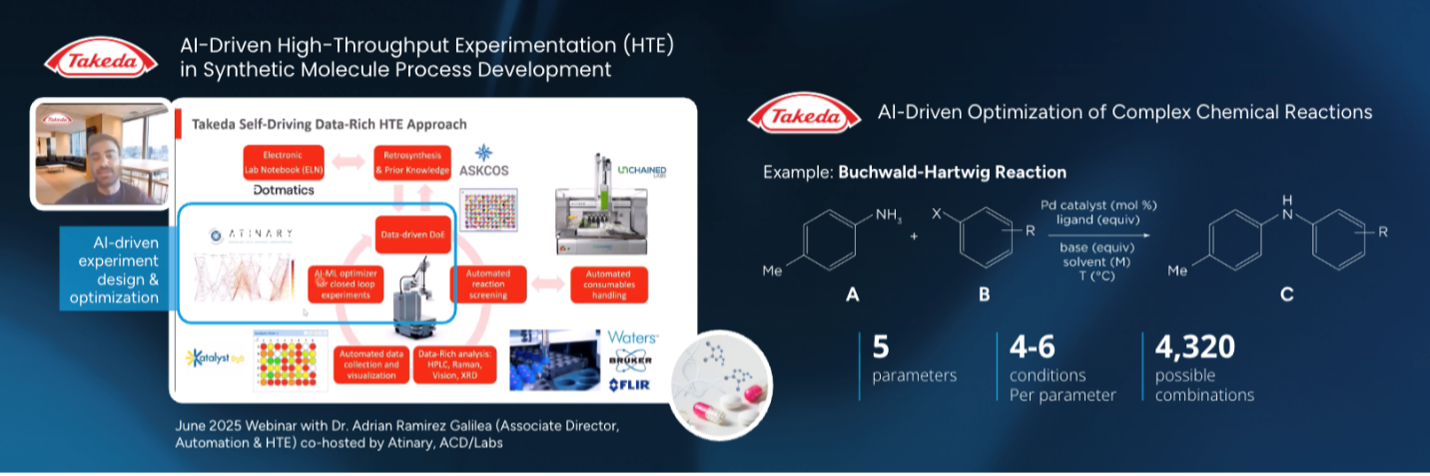
Figure 3: Takeda benefits from utilizing the SDLabs® platform. Troc deprotection is a critical step in synthesizing complex drug molecules, and Buchwald-Hartwig reactions are a widely used method for creating carbon-nitrogen bonds in pharmaceutical compounds.
Read more about this collaboration
MIT + Atinary: Solving the Impossible in Solar Cell Research
In a collaboration between Atinary and the Buonassisi Lab at MIT, the team needed to simultaneously optimize five different variables in their solar cell design – a problem with an enormous number of possible combinations in a complex five-dimensional (5D) search space. Facing a strict four-week deadline, the teams needed a way to optimize experimental campaigns without the overhead of traditional, high-volume trial-and-error.
By leveraging Atinary’s SDLabs®, the Buonassisi team bypassed the complexity and delivered a breakthrough:
- From Thousands to Dozens: Completed the entire experimental campaign in just 25 iterations
- Zero-Code Innovation: Used agentic, code-free Bayesian optimization to remove technical barriers for scientists
- Rapid Discovery: Disentangled complex environmental variables to meet a deadline that was previously out of reach

Figure 4: Professor Tonio Buonassisi presenting joint Atinary-MIT research at the Zurich event
Explore more about this use case | Read the publication
Powering Self-Driving Labs with AWS
When Atinary set out to build SDLabs® 2.0, they needed cloud infrastructure that could handle the computational demands of AI-driven scientific discovery while meeting the stringent compliance requirements of pharmaceutical and chemical manufacturing. AWS provides the foundation to make Self-Driving Labs® a reality.
The Solution Architecture
SDLabs® 2.0 is hosted entirely on AWS Cloud, using Amazon Elastic Container Services (Amazon ECS) with both Amazon EC2 and AWS Fargate compute options.
The platform’s AI-driven onboarding process features a large language model interface where researchers interact conversationally to search, define, and select laboratory workflows. This conversational interface, powered by Amazon Bedrock, dramatically reduces the learning curve. Amazon Aurora PostgreSQL provides secure, scalable data storage for experimental data and results.
AWS’s global infrastructure enables Atinary to support customers worldwide, from their state-of-the-art Self-Driving Lab in Boston to pharmaceutical companies and research institutions across continents. The combination of scalable compute, secure data management, and real-time IoT connectivity creates an environment where R&D can happen at unprecedented speed.
The Atinary Self-Driving Labs® in Boston Seaport
To further catalyze these innovations, Atinary recently announced the opening of its new state-of-the-art Self-Driving Lab in Boston. This facility serves as a flagship for Physical AI, augmenting scientists with AI and robotics, and running experiments in closed-loop Design-Make-Test-Analyze+Learn (DMTA+L) to accelerate scientific discovery and innovation.
The Self-Driving Lab outputs entire experimental data autonomously which feeds back into Atinary’s Agentic Platform SDLabs®. Atinary builds high-quality datasets that are used to train its machine-learning algorithms and foundation models after each iteration to recommend the next best experiments. The ultimate goal is to accelerate R&D, discovery, and economic progress.

Figure 5: The Atinary Self-Driving Lab® facility in Boston Seaport
Learn more about Atinary’s lab opening in Boston
Conclusion
For the patient waiting on a new treatment, the farmer needing a more sustainable material, or the engineer designing the next generation of solar cells, Self-Driving Labs® mean faster answers, lower costs, and discoveries that might never have been found through manual experimentation alone.
AWS together with partners like Atinary are proving that the future of R&D is autonomous, cloud-native, and human-centric. By combining Atinary’s SDLabs® AI platform with AWS’s robust infrastructure and integrating with robotics systems, our teams are removing the barriers to innovation, helping scientists spend less time on manual iterations and more time on the breakthroughs that will define the 21st century.
To learn more about Atinary’s solutions and Self-Driving Labs® technologies, please visit the following resources: