What is Advanced Analytics?
- What is advanced analytics?
- What are the use cases of advanced analytics?
- What are the types of advanced analytics?
- What is the difference between business intelligence (BI) and advanced analytics?
- What technologies are used in advanced analytics?
- What are the essential infrastructure technologies required for advanced analytics?
- How can AWS help with your advanced analytics requirements?
What is advanced analytics?
Advanced analytics is the process of using complex machine learning (ML) and visualization techniques to derive data insights beyond those available through traditional business intelligence. Modern organizations collect vast volumes of data and use advanced analytics to discover hidden patterns and forecast future trends. They use the information to improve business process efficiency and customer satisfaction, and inform future and real-time decision-making. Advanced analytics techniques can derive insights from unstructured data, such as social media images. Advanced analytics can help organizations solve complex problems more efficiently. Advancements in cloud computing and data storage have made advanced analytics more affordable and accessible to all organizations.
What are the use cases of advanced analytics?
Your organization can use advanced analytics to solve complex challenges beyond traditional analytics and reporting. Here are some examples across industries.
Healthcare
Healthcare and life science companies perform advanced analytics on clinical and operational data to decrease care costs and boost their diagnosis accuracy. For example, applying sophisticated techniques to medical images can generate precision diagnoses. Similarly, medical professionals use advanced analytics to turn patient, genomic, transcriptomic, and other -omics data into actionable insights. It accelerates clinical trials, enhances research and innovation, and simplifies clinical multiomics.
Finance
Financial services entities can enhance their operational processes and innovation using data-driven insights from transformative technologies. For example, they can use advanced analytics for these purposes:
-
Optimize critical banking operations
-
Drive transformation and reimagine business models in capital markets
-
Modernize core systems and enhance risk modeling in insurance
The industry can perform data mining to transform experiences for stakeholders, employees, intermediaries, and customers. Advanced analytics enables companies to make better decisions for profitability and customer satisfaction.
Manufacturing
The manufacturing industry uses advanced analytics to improve overall equipment effectiveness (OEE). Diagnostic and predictive analytics improve equipment maintenance and monitoring. The manufacturing sector can also use advanced analytics to:
-
Improve processes by identifying trends and remedying bottlenecks
-
Detect real-time anomalies in equipment
-
Automate inspection, verification, and other time-consuming manufacturing processes
Retail
The retail industry uses advanced analytics technologies to create smart stores, streamline digital commerce, and build intelligent supply chains. They can derive valuable insights from customer behavior and interactions for many purposes:
-
Improve merchandising decisions and develop effective merchandising strategies
-
Boost customer lifetime value by personalizing product recommendations
-
Optimize internal business operations to lower costs and improve margins
-
Democratize access to complex data to innovate and predict future outcomes
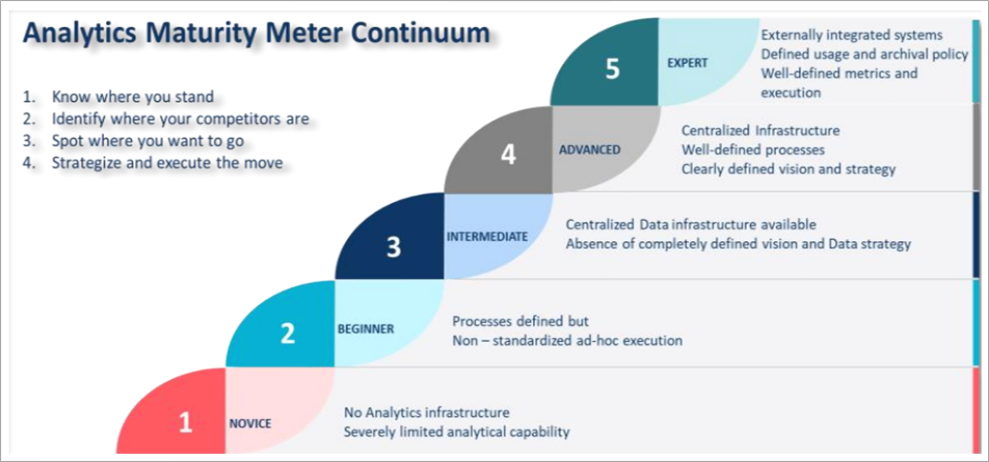
What are the types of advanced analytics?
Advancements in data science have helped develop several distinct focus areas within the field of analytics.
Cluster analytics
Cluster analysis organizes data points into groups based on similarities. It makes no initial assumptions about the relationship between data points, which can help identify patterns and associations during advanced data analytics.
For instance, you can use cluster analysis to create demographic or psychographic categories within customer bases. You can then plot the relationship between one quality and another. You could assess whether there's a relationship between certain demographics and buying habits.
Cohort analytics
Like cluster analysis, cohort analysis divides large datasets into smaller segments. However, it focuses on tracking a segment's behavior over time. Cohort analysis is often used in user behavior and retention studies. You can use it to trace how each cohort responds to different events. This advanced analytics method can improve customer retention, user engagement, product adoption, and customer interactions.
Predictive analytics
Traditional descriptive analytics looks at historical data to identify past trends and patterns. Predictive modeling in advanced analytics uses past data to predict future outcomes. You mainly use predictive analytics in risk-related fields or when trying to identify new opportunities. By performing statistical analyses and seeing potential future scenarios, you can make better strategic decisions. Predictive analytics helps reduce risk and increase operational efficiency.
Prescriptive analytics
Prescriptive analysis recommends actions you can take to affect a desired outcome within a predicted future scenario. For instance, imagine a business scenario where predictive analytics tells you which customers are most likely to churn in the next quarter. You can run additional prescriptive analyses to recommend retention strategies tailored to each at-risk customer segment, such as special discounts, loyalty programs, or personalized communication campaigns.
Digital twins
Digital twins are virtual replicas of physical systems, processes, or entire environments—for example, the production line, machinery, and processes in a manufacturing facility. Organizations use digital twins with real-time data to test how specific changes impact a manufacturing floor or a complex retail supply chain. You can use digital twins for data analysis to evaluate proposed changes, assess risks associated with potential events, and identify bottlenecks before committing real-world resources.
Graph analytics
Graph analysis maps relationships between data points within a broader network. For example, financial institutions map transaction relationships to identify sophisticated fraud.
Complex event processing (CEP)
Complex event processing (CEP) evaluates multiple streams of real-time data to identify meaningful patterns or events as they occur. Rather than waiting to analyze historical data after the fact, CEP systems continuously monitor incoming information from Internet of Things (IoT) sensors and other sources. When the system detects a specific sequence or condition, such as a real-time anomaly in manufacturing equipment, it can automatically trigger a response.
What is the difference between business intelligence (BI) and advanced analytics?
Advanced analytics methods expand on the foundational elements of traditional business intelligence (BI). They differ significantly in their scope and the types of data they handle, and in how quickly they process information.
Traditional BI typically focuses on descriptive analytics, which look at historical data to answer, "What happened?" It relies heavily on structured data, such as that collected in standard relational databases.
Advanced analytics applies predictive and prescriptive models to look forward. It aims to answer, "What will happen next?" and often suggests targeted actions. Analytics tools natively process complex, unstructured, and structured data. They can often ingest live data streams to support immediate, real-time decision-making.
What technologies are used in advanced analytics?
Advanced analytics solutions can combine several technologies.
Statistical methods
Statistical methods such as time-series analyses, regression analyses, decision trees, and Monte Carlo simulations may be present in predictive and prescriptive analytics. These statistical methods may be combined with other strategies or technologies to achieve specific goals.
Machine learning (ML)
Machine learning techniques that support advanced analytics include supervised learning, unsupervised learning, reinforcement learning, and more. For predictive and prescriptive analytics, systems must analyze large volumes of data to generate accurate insights. ML techniques support this by rapidly analyzing millions of data points to facilitate ongoing monitoring and forecast future outcomes.
Read about Machine Learning (ML) »
Artificial intelligence
Advanced analytics uses artificial intelligence (AI) to simulate human observation, pattern recognition, and organization. With AI, you can process more data, work on more complex modeling, and incorporate increasingly abstract algorithms.
AI tools include a range of technologies that work together to support advanced analytics. Deep learning techniques use neural networks with many layers to analyze data such as images, audio, and text. For example, natural language processing (NLP) extracts information from human-generated text, and computer vision interprets images and videos to perform tasks.
What are the essential infrastructure technologies required for advanced analytics?
Here are some elements that can help to run a successful advanced analytics program in your organization.
Internet of Things
Internet of Things (IoT) devices and smart sensors capture continuous, real-world data streams. Analyzing these data streams in real time allows systems to bypass slow batch processing and initiate immediate, automated responses. For example, in manufacturing, IoT streaming advanced analytics helps support instantaneous anomaly detection. If sensors detect irregular vibrations, the system automatically stops the machinery to prevent failure.
Read about Internet of Things (IoT) »
Storage
Today, organizations increasingly adopt data lakehouses to store data in ways accessible to advanced analytics tools. These architectures help reduce data silos by unifying data, rather than forcing teams to move, duplicate, and centralize data before they can analyze it.
They allow advanced analytics and machine learning tools to query structured and unstructured data directly. This architecture can automatically integrate data from diverse sources and provide faster access to the information required for real-time decision-making.
Computing
Advanced analytics tools need a high data processing capacity to function effectively. It can help to use distributed computing so that multiple server nodes can process the data simultaneously. You also might need advanced processing capabilities for your predictive models and other machine learning and artificial intelligence tools. Additionally, leveraging edge computing allows systems to process data locally at the source, reducing latency for real-time applications.
Read about distributed computing »
Visualization
You need data visualization tools to create and present reports on your advanced analytics findings. Without clear visualization, it is challenging to act upon the insights generated. You can gain deeper insights through advanced analytics, but it can be difficult to share them. With visualization technology, you can share those insights with your business users and nontechnical stakeholders.
Read about data visualization »
Security
Access control, encryption, and protection against unauthorized access all help protect sensitive data during advanced analytics. However, modern security also requires effective data governance, which is a verifiable trail documenting how data was transformed. You may also need to navigate data privacy regulations and sovereignty requirements to make sure that their analytics workflows comply with regional data residency laws and still generate useful insights.

How can AWS help with your advanced analytics requirements?
Amazon Web Services (AWS) provides the broadest selection of advanced analytics services. We help businesses of all sizes to reinvent their business with data-driven decision-making. From data movement to streaming analytics, AWS offers purpose-built services that provide the best price performance, scalability, and lowest cost. AWS has hundreds of fully managed services that help at every step of the advanced analytics process. Here are some examples:
-
Amazon EMR is a big data processing service that accelerates analytics workloads with unmatched flexibility and scale.
-
Amazon QuickSight delivers AI-powered BI capabilities within QuickSight, transforming your scattered data into strategic insights for everyone—allowing you to make faster decisions and achieve better business outcomes.
-
Amazon SageMaker is the center for all your data, analytics, and AI.
-
AWS Glue helps you to discover, prepare, and integrate all your data at any scale.
Get started with advanced analytics on AWS by creating a free account today.
Browse all cloud computing concepts
Browse all cloud computing concepts content here:
Did you find what you were looking for today?
Let us know so we can improve the quality of the content on our pages