AWS Partner Network (APN) Blog
Continuous model adaptation with 4MINDS on AWS
By: Haresh Vaishnav, WW GenAI Category Manager – AWS
by: Savannah Meredith, AMER Startup Growth PDM – AWS
by: Eric Yuen, Sr. Partner Solution Architect – AWS
by: Michael Kneip, Sr. Director AI Partnerships – 4MINDS
by: Robert Ray, VP of Solutions Engineering – 4MINDS
 |
| 4MINDS |
 |
In this post, we discuss continuous model adaptation solution from 4MINDS on Amazon Web Services (AWS). You’ll learn how this solution overcomes the limitations of the existing Retrieval Augmented Generation (RAG) approach to fine-tuning the model at enterprise scale.
If you’ve deployed RAG in production, you’ve seen it work. When you connect a foundation model (FM) to your enterprise data, teams are getting answers grounded in real documents. The initial results achieved from this implementation show significant improvement.
Then somewhere between pilot and enterprise-wide rollout, something shifts. It’s not a failure, more like a plateau. The model handles direct lookups well, but it struggles when reasoning across multiple knowledge domains. Retrieval results become noisier as your knowledge base grows, and despite processing thousands of queries, the model itself doesn’t get any better at understanding your business. Left unaddressed, this plateau becomes an obstacle to achieving meaningful results. Production timelines slip. Stakeholder confidence erodes. What began as a promising AI initiative risks joining the many enterprise AI projects that never make it past pilot. The 4MINDS solution adopts continuous model adaptation, allowing the model to learn and improve from the user interaction and additional knowledge base.
Understanding the RAG ceiling
RAG solves the critical problem of providing general-purpose model access to proprietary information without the cost and complexity of fine-tuning. For use cases like document Q&A, policy lookup, and customer-facing search, RAG might be the appropriate approach. However, RAG has an inherent architectural limitation. Because RAG-based architecture is stateless, every query starts from zero, which means that using RAG doesn’t help models learn your business. The model generates a response from retrieved context but doesn’t retain the knowledge provided through RAG. The next query on the same topic goes through the same retrieval-and-forget cycle. At enterprise scale, this design creates several challenges. This stateless architecture approach results in the nonlinear degradation of retrieval quality as the number of documents fed to the model during RAG increases. A RAG system with 10,000 documents retrieves with high precision. At 10 million documents, results fail to achieve the precise context. They’re similar semantically but not precisely relevant. The model then reasons over imperfect inputs, compounding error with each hop. Meanwhile, context windows force invisible trade-offs. Today’s larger context windows help, but a model can only reason over limited data effectively due to resource constraint and cognitive bottleneck. The retrieval system must decide what to include and what to leave out, and those decisions happen silently without the user’s knowledge. A confident-sounding answer can be grounded in an incomplete picture.As a result, domain reasoning remains shallow. A model that retrieves information about your industry’s terminology can repeat it correctly. However, it won’t learn how concepts relate to each other, how your organization handles exceptions, or what good judgment looks like in context. That requires something beyond retrieval. It requires the model to learn. These challenges are the result of architecture limitations where the model remains static and knowledge resides outside it.
Knowledge built into the model with 4MINDS
4MINDS, an AWS Advanced Technology Partner, has introduced a new architectural pattern called continuous model adaptation. With this pattern, enterprise knowledge isn’t retrieved at query time but is learned and built directly into model parameters. This approach addresses the RAG limitations by changing what the model fundamentally knows rather than what it can look up. Instead of maintaining a separate knowledge system that feeds context to a static model, 4MINDS can improve its understanding of your business continuously as explained in the next paragraph. This alleviates downtime and removes the traditional costs of fine-tuning. This unique architectural choice brings additional value to traditional fine-tuning approach. 4MINDS represents the knowledge in structured fashion. Instead of treating enterprise data as flat text to be chunked and embedded, they organize knowledge hierarchically, capturing facts as well as relationships between concepts, organizational structures, and reasoning patterns specific to your domain. 4MINDS doesn’t require retraining the entire model. They modify a small fraction of parameters (typically less than 5%). In this way, they internalize new knowledge while preserving general capabilities. Teams can fully reverse changes and roll back in minutes if a new adaptation underperforms. The solution learns from every interaction in production during inference. As your business evolves with new products, new regulations and new terminology, they adapt in near real time rather than requiring periodic, expensive retraining cycles. This new architectural paradigm allows AI to improve its understanding of your business over time, without the operational burden that traditional fine-tuning imposes.
4MINDS implementation on AWS
4MINDS implements continuous model adaptation with the solution built on AWS services as shown in the following figure. This integration makes it straightforward for customers to deploy the solution on AWS without having to worry about additional integration. The solution uses Amazon Bedrock or Amazon SageMaker AI for foundation model access, and Amazon Simple Storage Service (Amazon S3) for enterprise data pipelines. For governance, they rely on services you already run. AWS Key Management Service (AWS KMS) handles encryption, AWS PrivateLink provides private connectivity, and AWS Identity and Access Management (AWS IAM) manages access control.
For teams already on AWS, getting started involves adding capability to the infrastructure you already run. You subscribe to the 4MINDS solution through AWS Marketplace. AWS Marketplace supports provisioning and billing through your existing AWS agreement.
Upon deploying the solution, 4MINDS connects to your enterprise data where it already lives. Teams select a foundation model in Amazon Bedrock or Amazon SageMaker AI, and 4MINDS adapts on top of it rather than replacing it. Amazon Bedrock models receive reasoning grounded in your data, and Amazon SageMaker AI models receive rapid, continuously improving fine-tuning in addition to that same grounded reasoning.
From that point, adaptation begins. 4MINDS builds a structured representation of your domain and starts internalizing it into the model, with changes that are fully reversible and an adaptation loop that continues as your business evolves. Most teams go from subscription to a domain-adapted model without requiring new infrastructure project. The following diagram shows the architecture deployed in a software as a service (SaaS) environment.
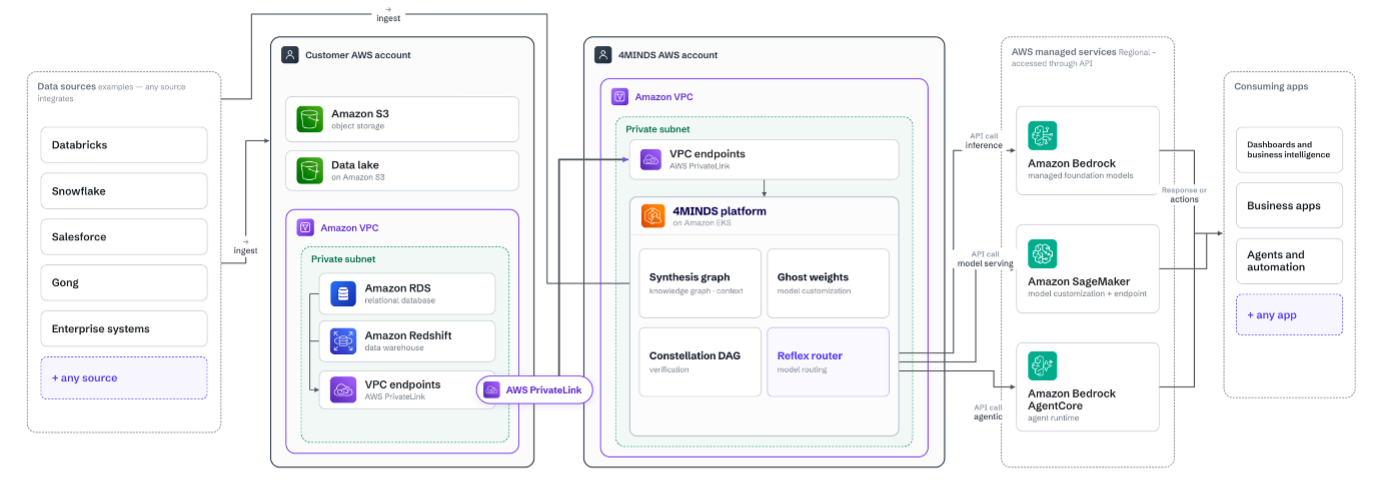
Figure 1: 4MIND intelligence pipeline architecture
Organizations adopting 4MINDS can expect outcomes associated with a more direct, domain-informed approach to enterprise AI. 4MINDS enables models to learn from structured business context resulting in accelerated deployment, improved reliability and relevance of outputs, and reduced operational complexity associated with maintaining extensive retrieval infrastructure. In a typical deployment, 4MINDS targets outcomes such as faster time to production, fewer unsupported or inaccurate responses on business-critical tasks, lower ongoing infrastructure and maintenance requirements, and improved ability to scale AI across enterprise workflows. actual results are dependent on the underlying use case, data readiness, implementation scope or application.
When to consider 4MINDS alongside RAG
RAG performs better at breadth and real-time information access, whereas continuous model adaptation is preferred for depth and domain mastery. Many enterprises will likely use both approaches. The decision comes down to whether your workload needs the model to know something or find it. Start with 4MINDS on workloads where retrieval is visibly struggling, evaluate in parallel, and expand incrementally. Consider 4MINDS when:
- Your AI needs domain reasoning, not just document lookup – If users are asking questions that require synthesizing knowledge across multiple sources, understanding implicit context, or applying business judgment, retrieval alone will hit a ceiling.
- Your knowledge base has crossed a complexity threshold – When retrieval quality degrades because your corpus is too large, too interconnected, or too nuanced for embedding-based search to handle reliably.
- Consistency matters more than recency – For use cases where the model needs to apply stable enterprise knowledge and expertise (such as compliance interpretation, technical standards, or organizational processes), building that knowledge into the model using 4MINDS produces more reliable outputs than retrieving it fresh each time.
- You’re spending more on RAG maintenance than on innovation – When your team’s time is going into chunking, embedding selection, and retrieval tuning, adding continuous adaptation can let the model carry more of that domain knowledge directly.
The bigger picture
Enterprise AI is maturing beyond a single architectural pattern. RAG proved that AI could be grounded in proprietary knowledge without enormous upfront investment. But as organizations push toward production workloads that demand deeper domain understanding, the limitations of retrieval-only architecture become apparent.4MINDS represents the next layer of the enterprise AI stack. In addition to accessing your knowledge, they genuinely understand the context behind it. 4MINDS is built on AWS to make this pattern more accessible, combining continuous adaptation with the security, scale, and services enterprises already trust. For organizations that have already invested in AI on AWS and are ready for what comes next, this is a pattern worth exploring.
Next steps
If the challenges described earlier sound familiar, explore the 4MINDS listing in AWS Marketplace to understand how continuous model adaptation integrates with existing AWS infrastructure. You can also contact your AWS account team and 4MINDS to schedule an exclusive workshop and demo of the solution..

4MINDS – AWS Partner spotlight
4MINDS is an enterprise AI software company focused on the layer between foundation models and production business workflows. Its platform connects structured and unstructured enterprise data into a continuously updated context layer, adapts models to customer-specific terminology and decision patterns, and governs how agents reason, use tools, verify evidence, and take or recommend action.