AWS Partner Network (APN) Blog
How ClickHouse powers real-time AI Agents on Amazon Quick
By: Stanley Chukwuemeke, Senior Partner Solutions Architect – AWS
By: Nakul Mishra, Senior Solutions Architect – AWS
By: Luke Gannon, Principal Product Manager – ClickHouse
 |
| ClickHouse |
 |
Building real-time AI agents requires instant access to analytical data at conversational speed, and integrating ClickHouse with Amazon Quick can deliver the sub-second query performance needed for conversational analytics to customers. When you build AI agents for customer behavior analysis, anomaly detection, or recommendation systems, database queries that take minutes instead of milliseconds degrade the user experience customers expect.
By integrating ClickHouse with Amazon Quick through Model Context Protocol (MCP), you can build AI agents that deliver sub-second query responses across billions of data points, maintaining natural dialogue flow while providing actionable insights instantly. ClickHouse’s millisecond query performance at scale, combined with Amazon Quick enterprise AI capabilities, gives you the tools to build conversational AI agents quickly and improve your interactive experience.
This post walks you through integrating ClickHouse Cloud with Amazon Quick for conversational analytics. We’ll cover the integration benefits, Amazon Quick MCP server architecture, setup steps, authentication configuration, and AI agent creation for real-time data queries.
Solution overview
Amazon Quick comes with a built-in MCP client that you activate through an integration. After it’s configured, it connects to a remote MCP server, automatically discovers the tools and data sources that server exposes, and makes them immediately available to your AI agents and automations with no custom middleware required. This means you can extend Amazon Quick with action execution, real-time data access, and knowledge base creation through a single integration point.
The following figure shows how customers use Amazon Quick to invoke application capabilities, exposed as MCP tools by independent software vendors (ISVs) such as ClickHouse, enterprise systems, or custom solutions through an MCP integration.
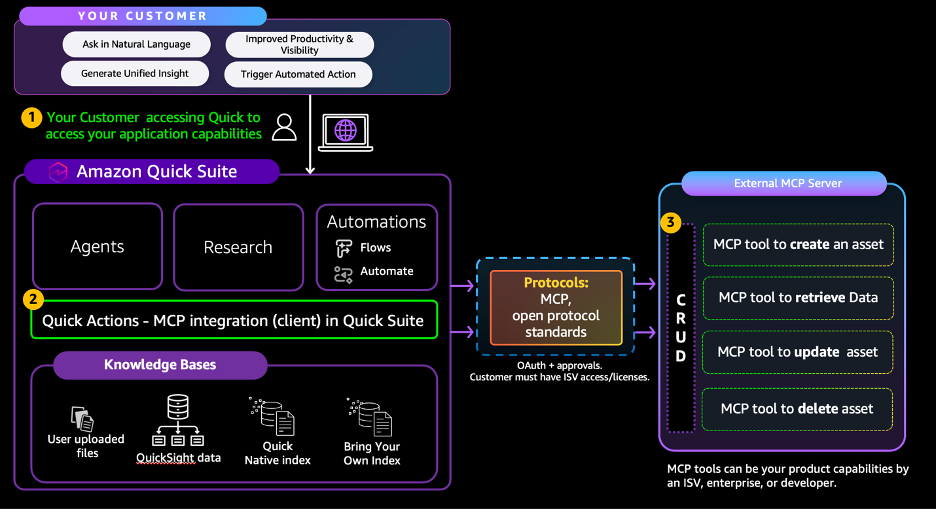
Figure 1: Amazon Quick MCP integration with an external MCP server that exposes application capabilities as MCP tools
Amazon Quick and ClickHouse integration architecture
This integration uses ClickHouse remote MCP server, which acts as the bridge between Amazon Quick AI agent and your ClickHouse Cloud service. Amazon Quick supports integrations with various third-party applications and services, with each integration supporting different combinations of actions and knowledge base creation capabilities. The following figure shows a reference architecture for integrating ClickHouse Cloud on AWS to Amazon Quick using ClickHouse remote MCP server. For more information, refer to Amazon Quick supported integrations.
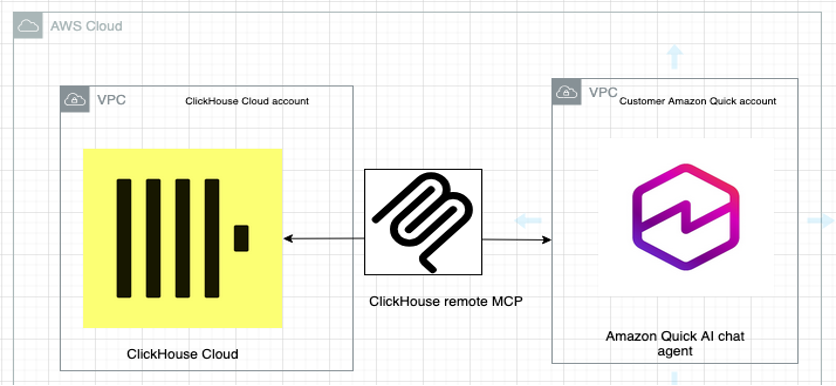
Figure 2: Amazon Quick and ClickHouse integration through ClickHouse remote MCP server
Integration benefits
When AI agents need to make real-time decisions, waiting minutes for database queries fundamentally breaks the conversational experience and limits agent autonomy. ClickHouse columnar storage architecture delivers query results in milliseconds across billions of rows, ensuring AI agents rarely wait on data. With built-in support for streaming inserts and integrations with Amazon Managed Streaming for Apache Kafka (Amazon MSK), Amazon Kinesis, and other event pipelines, ClickHouse ensures that the data your agents reason over is always current. High-volume event and telemetry data that AI agents depend on can quickly become very expensive to store. ClickHouse’s ability to compress data on disk reduces the cost of storing information and the amount of resources needed to query, boosting query performance. ClickHouse speaks standard ANSI SQL with extensions to the language, making it straightforward to connect to existing business intelligence (BI) tools and orchestration layers without specialized adapters. ClickHouse Cloud separates compute from storage, helping organizations to scale query capacity on demand during peak AI workloads without over-provisioning and incurring idle infrastructure costs.
The combination of ClickHouse Cloud and Amazon Quick solves three fundamental business challenges: moving from insight to action in real time, giving nontechnical teams access to complex datasets, and the ability to scale volume without increasing cost.
Amazon Quick AI agents can now query live operational data and act on it. Agents can provide recommendations and trigger workflows or flag anomalies the moment they emerge, rather than after a reporting cycle has completed.
Using Amazon Quick, business users can query complex datasets without writing SQL. Paired with ClickHouse, those natural language queries now run against a database engineered for speed at scale, providing nontechnical teams with accurate, real-time answers without being blocked by data engineering backlogs.
As data volumes grow, most integrations degrade, producing slower queries, higher costs, and more infrastructure to manage. This integration scales with your business. ClickHouse Cloud handles large-scale data while Amazon Quick agents remain responsive, keeping the experience consistent for you regardless of data volume.
Integrating ClickHouse with Amazon Quick
Before you start this integration, check with your security and compliance team to understand your organization’s requirements when integrating tools.
To set up the integration, connect to your ClickHouse Cloud service to retrieve the ClickHouse remote MCP server endpoint.
Currently, the Amazon Quick client MCP can only connect to remote MCP servers that are accessible publicly. Refer to Security and MCP for ClickHouse guidance on exposing their MCP publicly.
To create an MCP integration in Amazon Quick:
- Sign in to the Amazon Quick console with a user that has Author permissions or higher.
- From the integration grid, choose Model Context Protocol (MCP).
- Choose the plus sign ( + ).
- On the Create integration page, enter a Name, Description, and your MCP server endpoint URL. Choose Next, as shown in the following screenshot.
- Choose Create and then Continue. Review the discovered tools and data capabilities from your MCP server.
- When you’re finished, choose Done.
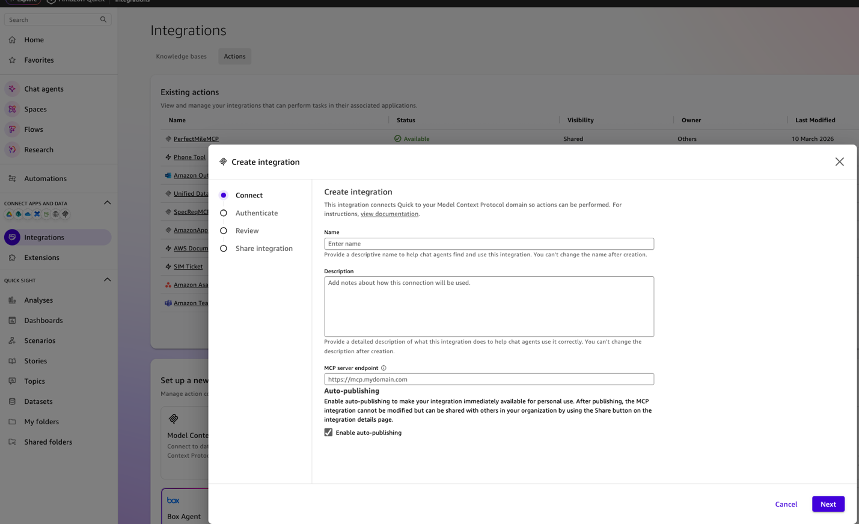
Figure 3: Amazon Quick MCP Integration page
To authenticate to ClickHouse Cloud using OAuth:
- After the integration becomes available, choose Sign in to complete authentication.
- Authenticate using your ClickHouse Cloud credentials.
- If you want other users to use the integration, share it.
The following screenshot shows the ClickHouse sign-in page.
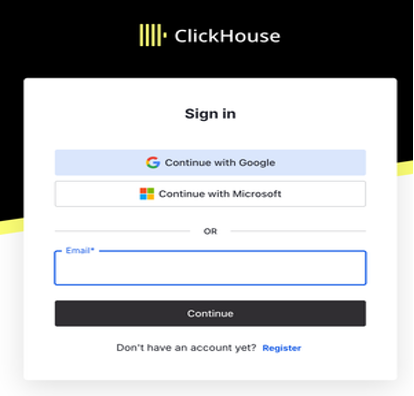
Figure 4: ClickHouse sign-in
After the integration is complete, you create a custom chat agent and add the connector to create a conversational interface that answers specific business questions. Optionally, you can also add this connector to your Amazon Quick space and share it with your team or other parts of your organization either in isolation or across multiple agents. This way, you can scale the integration across multiple agents or combine it with other data sources in the space. Another option is to use this integration with Amazon Quick Flows to automate repetitive tasks and Amazon Quick Research to get a deep understanding of a specific topic by using data in ClickHouse in combination with other sources.
Powering real-time AI Agent with ClickHouse
Through the Amazon Quick AI agent chat interface, business users can query ClickHouse directly using natural language with no SQL knowledge required. Amazon Quick passes the conversation to the ClickHouse MCP server to translate those conversation inputs into SQL actions executed against the ClickHouse database, returning insights at the speed ClickHouse is known for, regardless of data volumes. The ClickHouse MCP server provides a tool called run_select_query that can be used to run a SQL SELECT statement against a ClickHouse database. The MCP server implements all the logic needed to perform that action when the tool is used, for example, for creating a connection or authentication.
For example, in the Amazon Quick AI chat agent, you can ask a question that requires real-time data, such as “What were the top 5 products by revenue yesterday?” The agent should invoke the ClickHouse MCP connector, discover the relevant schema, execute the SQL query, and return a synthesized natural language response with the results.
The following figures show a sample interaction using Amazon Quick AI chat agent.
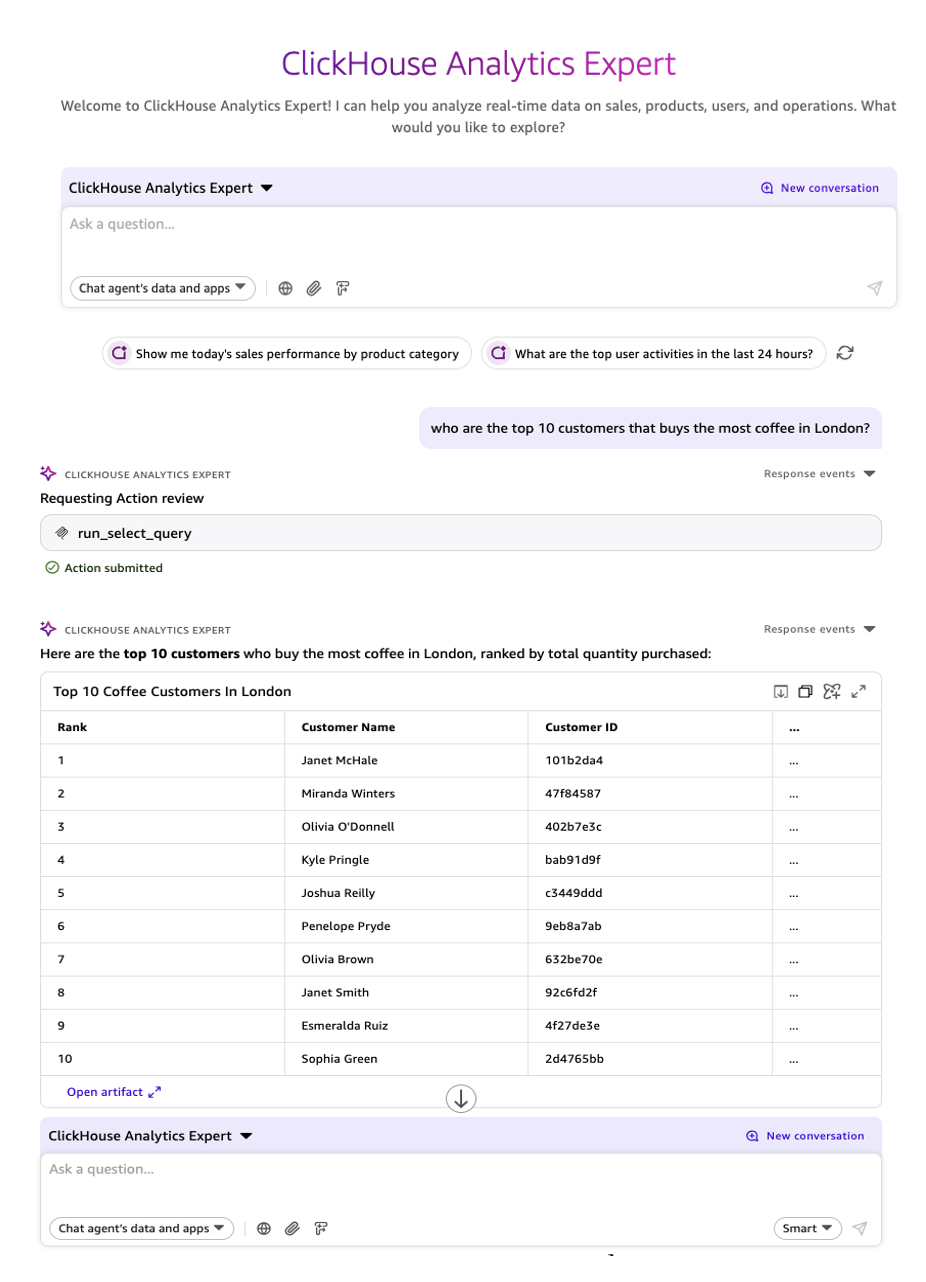
Figure 5: Sample interaction using Amazon Quick AI chat agent
Conclusion
The integration of ClickHouse Cloud with Amazon Quick delivers sub-second query responses for AI-powered analytics. By combining ClickHouse analytical performance with Amazon Quick AI agents’ natural language capabilities, organizations can unlock real-time insights that transform how teams interact with their data. Using this integration, you can query complex datasets conversationally and make data-driven decisions faster. Start building your first real-time AI analytics agent today by exploring this integration setup for your own use cases and experience how the combination of ClickHouse speed and Amazon Quick intelligence can accelerate your analytics, workflow, and research journey.
For next steps, review Model Context Protocol (MCP) integration and Integrate external tools with Amazon Quick Agents using Model Context Protocol (MCP) for detailed implementation required by third-party partners to integrate with Amazon Quick using MCP.
To get started, sign up for ClickHouse Cloud and Amazon Quick to build your first real-time AI analytics agent.

.
ClickHouse – AWS Partner Spotlight
ClickHouse, Inc is an AWS Advanced Technology Partner and AWS Competency Partner that is behind ClickHouse, a fast, open source columnar database built for real-time analytics at scale. Engineered for high performance, ClickHouse Cloud delivers exceptional query speed and concurrency, and it’s purpose-built for AI agents generating frequent, complex queries. Trusted by leading companies like Sony, Tesla, Anthropic, and Lyft, ClickHouse delivers a high-throughput, low-latency platform for instant insights from massive data volumes.