AWS Partner Network (APN) Blog
How DXC Technology upgraded Angular and .NET applications with Amazon Q Developer
By: Charles Christopher, Principal Solutions Architect – DXC Technology
By: Dhiraj Thakur, Senior Solutions Architect – AWS
 |
| DXC Technology |
 |
Many enterprises adopt microservices and micro-frontend architectures to build scalable, cloud-based platforms. A customer of DXC Technology operated a large-scale, distributed enterprise platform supporting multiple business domains with high availability and continuous delivery.
The platform consisted of more than 80 independently deployed backend microservices; multiple Angular-based micro-frontend applications; separate continuous integration and continuous delivery (CI/CD) pipelines per service; integrations with authentication systems, APIs, and third-party services; and mandatory static application security testing (SAST) and dynamic application security testing (DAST) security validation before production deployment.
Although the architecture was modern, the underlying technology stack had aged. Backend services ran on older .NET versions, and frontend applications used earlier Angular releases—both approaching or past end-of-support. As the platform grew, maintaining outdated frameworks introduced operational risk. Each microservice carried its own dependencies, configurations, and version constraints. Upgrading required careful coordination to avoid breaking API contracts, authentication flows, routing, shared components, and integrations.
With multiple teams owning different services, standardized upgrade patterns, synchronized release planning, and rigorous regression validation were essential. Modernization demanded structured execution across architecture, security, testing, and DevOps. However, modernizing such a large distributed system required a well-planned, automated, low-risk approach to maintain business continuity while accelerating transformation. In this post, we explore how DXC used Amazon Q Developer to successfully upgrade to a newer framework.
Business challenges
DXC’s customer faced mounting operational and security risks from their aging stack:
- End-of-life risk – Several Angular and .NET versions were nearing end-of-support, limiting access to security patches and vendor support.
- Security exposure – Regular SAST and DAST scans surfaced vulnerabilities from deprecated libraries and unsupported components.
- Large-scale complexity – Upgrading more than 80 microservices and multiple micro-frontends required coordinated changes across distributed repositories.
- Regression and integration risk – Framework changes could impact API contracts, authentication flows, and service communication, requiring extensive validation.
- Cross-team coordination overhead – Multiple teams with inconsistent upgrade approaches led to extended timelines.
A traditional manual upgrade strategy was unsustainable. The customer needed a standardized, automated approach to accelerate upgrades while preserving stability and business continuity.
Proof of concept and prompt engineering approach
Before initiating the full-scale upgrade across so many microservices, DXC conducted a structured proof of concept (POC) to validate the modernization approach using Amazon Q Developer. The objective of the POC was to:
- Evaluate migration accuracy to the latest supported framework versions
- Identify breaking changes and dependency conflicts
- Measure effort savings compared to manual upgrades
- Assess security improvements
- Validate build and testing stability after migration
During the POC, the team carefully selected a representative set of microservices and one Angular application. Instead of performing direct manual upgrades, developers used Amazon Q Developer with structured prompt engineering techniques.
How prompt engineering was used
The team provided clear and contextual prompts to guide the migration process, such as:
- Specifying the source and target framework versions
- Asking for deprecated API replacements aligned with best practices
- Requesting dependency compatibility checks
- Providing build errors and stack traces for troubleshooting
- Asking for secure coding improvements
When migration-related build failures occurred, developers supplied configuration files and error logs to Amazon Q Developer. The tool analyzed the context and suggested corrected package versions, configuration updates, and refactored code snippets.This iterative interaction significantly reduced troubleshooting time compared to traditional debugging. The POC demonstrated that Amazon Q Developer could standardize the upgrade process, reduce manual effort, and improve consistency across services. Based on measurable time savings and successful validation, the team proceeded with full-scale modernization across the platform.
Solution design
The customer operated many backend microservices and multiple micro-frontend applications built on older framework versions. The goal was to upgrade the entire platform quickly, securely, and with minimal risk. The process followed four steps:
- Developer workstation – Developers worked in Visual Studio and VS Code, connecting legacy applications (Angular 9 or 15, .NET 6 or 7) to Amazon Q Developer directly from their integrated development environments (IDEs).
- AI-driven modernization – Amazon Q Developer automatically upgraded Angular 9 or 15 to Angular 20 and .NET 6 or 7 to .NET 8. It fixed deprecated APIs and resolved broken dependencies and security vulnerabilities.
- CI/CD and security pipeline – After the applications are modernized, they flow through a fully automated CI/CD and security pipeline. The pipeline has the following components:
- AWS CodeCommit – Source code repository
- AWS CodeBuild – Build and unit testing
- AWS CodePipeline – End-to-end pipeline orchestration
- Code assessment – Code quality checks
- SAST tool – Static security scanning
- Amazon Elastic Container Registry (Amazon ECR) – Container image repository
The pipeline has the following components:
- Automated build and test
- Code quality validation
- Security vulnerability scanning
- Container image creation
- Secure artifact storage
By using this design, every change is validated, secure, and production ready.
- Secure cloud deployment – After successful validation, the applications are deployed to AWS. The frontend deployment consists of:
- Uses Amazon Simple Storage Service (Amazon S3) for static web hosting
- Hosts Angular 20 web applications
- Can be integrated with Amazon CloudFront for global content delivery network (CDN)
The backend deployment consists of:
- Amazon Elastic Kubernetes Service (Amazon EKS) for containerized microservices
- Runs .NET 8 microservices
- Supports auto scaling and high availability
The following high-level architecture diagram illustrates the solution design.
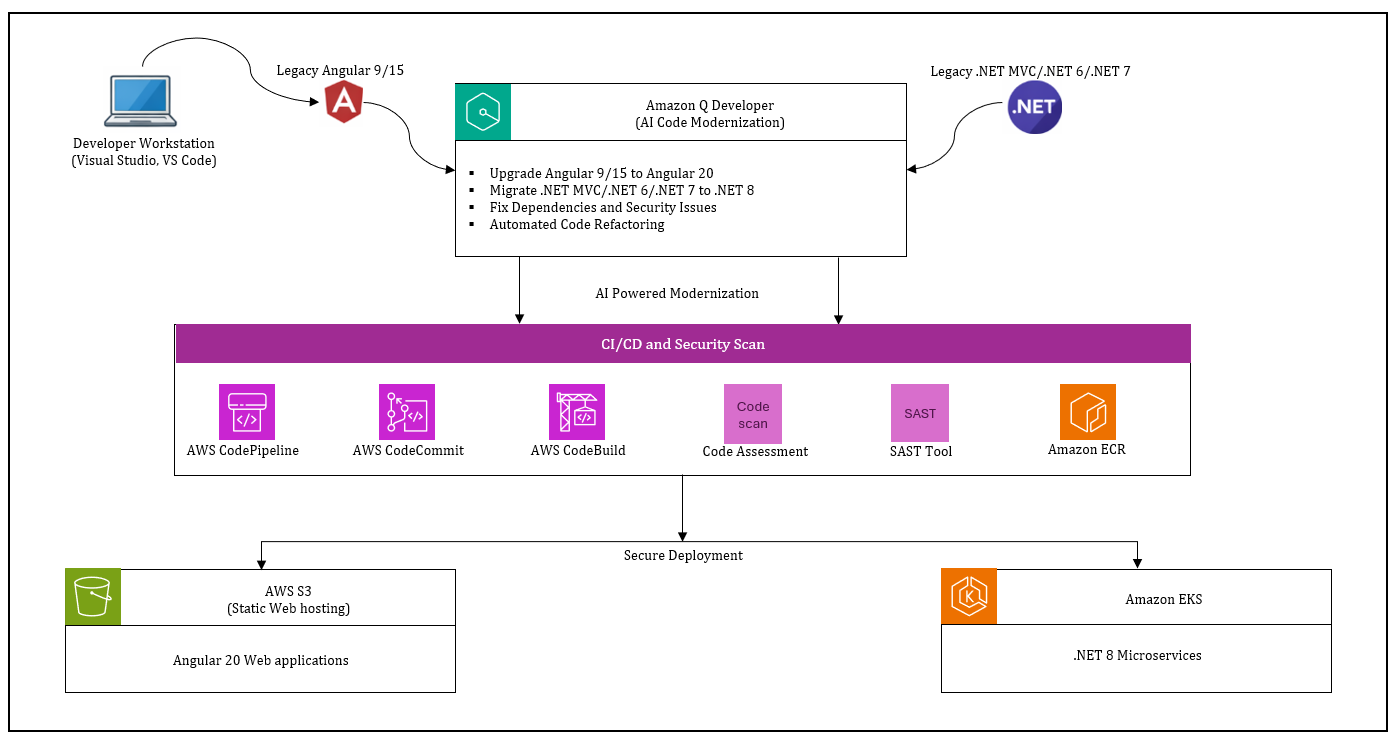
Figure 1: Solution design
Security validation
Before production promotion, DXC implemented multiple security validation layers. Beyond traditional SAST and DAST scans, Amazon Q Developer proactively identified security concerns during development—flagging insecure patterns, deprecated libraries, and recommending secure alternatives for authentication and configuration handling.This early AI-assisted review reduced vulnerabilities before code entered the CI/CD pipeline. Formal SAST and DAST scans then maintained compliance with enterprise security policies. Combining AI-driven review with automated scanning strengthened the platform’s security posture and production readiness.
Testing and validation
After the upgrade, DXC ran automated unit tests within the CI/CD pipeline to validate framework compatibility and functional correctness. Integration testing verified service communication, authentication flows, and API contracts, and regression testing confirmed that existing workflows remained unaffected. Amazon Q Developer helped developers quickly resolve issues from deprecated APIs or configuration changes, reducing stabilization time before deployment.
Customer benefits
By using Amazon Q Developer for application upgrades, the customer was able to modernize both frontend and backend applications faster and with much lower risk. They enjoyed several benefits:
- Faster upgrades across a large platform – The customer was able to upgrade more than 80 microservices and several micro-frontend applications in a structured and consistent way. Tasks that would normally take several months using manual effort were completed much faster in few weeks, helping the team meet security and compliance timelines.
- Less manual work and fewer errors – Upgrading frameworks usually involves a lot of manual changes, such as fixing deprecated APIs, updating dependencies, and resolving build issues. Amazon Q Developer handled most of this work automatically, reducing manual effort and lowering the chance of mistakes across multiple codebases.
- Stronger security and compliance – Moving to supported framework versions helped resolve issues found during SAST and DAST scans. By replacing outdated and vulnerable libraries, the platform became more secure and aligned with security and compliance requirements.
- Lower risk during testing and rollout – The upgrades were applied in a consistent way across services, which reduced unexpected behavior and integration issues. This helped minimize regression risks and reduced the time needed for testing and stabilization.
- Cleaner and easier-to-maintain code – After the upgrades, the applications followed modern framework standards and best practices. This made the code easier to understand, maintain, and extend, simplifying future enhancements and upgrades.
- Better long-term stability – By upgrading to long-term support (LTS) versions, the customer received continued access to security patches, bug fixes, and vendor support. This reduced operational risk and improved platform stability.
- Higher developer productivity – With much of the upgrade work automated, developers were able to focus more on delivering business features instead of spending time on repetitive technical tasks. This improved overall team productivity.
- Cross-team consistency – Amazon Q Developer enforced a common upgrade approach, reducing dependency conflicts during integration.
Productivity metrics
By using Amazon Q Developer for framework modernization, DXC significantly reduced the total upgrade effort compared to a manual approach. On average, manually upgrading a single microservice required approximately 16–24 developer hours, including dependency updates, deprecated API fixes, build issue resolution, security remediation, and testing. For more than 80 microservices, this would have required an estimated 1,600–2,000 total developer hours. With Amazon Q Developer, the average upgrade time per service was reduced to approximately 4–6 hours, bringing the total effort down to roughly 400–600 hours. This resulted in an estimated savings of 1,200–1,400 developer hours, representing a 60–75% reduction in overall upgrade effort while maintaining security and quality standards.
Key learnings
- Structured POC validation reduces large-scale upgrade risk.
- Prompt engineering significantly improves AI modernization accuracy.
- Standardizing upgrade patterns across teams minimizes integration failures.
- AI-assisted troubleshooting reduces debugging time but still requires engineering validation.
- Combining AI modernization with SAST or DAST strengthens production readiness.
- Upgrading to LTS versions provides long-term operational stability.
Conclusion
By combining AWS AI tooling with deep engineering expertise, DXC helped its customer transform a high-risk, long-duration modernization effort into a fast, secure, and scalable success.

DXC – AWS Partner Spotlight
DXC is an enterprise technology and innovation partner that helps global enterprises and public sector organizations run efficiently and modernize their systems. We provide end-to-end solutions across every technology domain, keeping critical systems resilient, compliant, scalable, streamlined and protected with our Business Process Services, Cloud & Infrastructure, Cybersecurity, Enterprise Applications, Infrastructure Protection, Managed Applications, Modernization as a Service and Modern Workplace solutions.