AWS Partner Network (APN) Blog
Mission Cloud accelerates data validation with Amazon Bedrock AgentCore
By: Na Yu, Principal AI Solutions Architect – Mission Cloud
By: Cindy Barrientos, Senior GenAI Engineer – Mission Cloud
By: Ryan Ries, Director at AI Solutions – Mission Cloud
By: Qiong Zhang, Senior Partner Solutions Architect – AWS
By: Jonathan Vota, Senior Partner Solutions Architect – AWS
 |
| Mission |
 |
When a services firm relies on a handful of experts for data validation, every departure takes institutional judgment out the door with it. With experts retiring and tenure shrinking, that knowledge drain is now structural. Expertise has to live in the software layer rather than in headcount, where it compounds instead of churning.
Mission Cloud and Amazon Web Services (AWS) built exactly that for a data migration firm: an AI agent on Amazon Bedrock AgentCore that cut onboarding time for new employees, made expert-level validation independent of who’s staffed, and put smaller engagements within economic reach.
Operational bottlenecks in data validation
A data migration consulting company faced critical operational inefficiencies in its validation processes. The firm’s consultants relied heavily on memorizing complex job configurations and navigating extensive business object templates. This created dependency on a small group of expert practitioners. The validation process often required writing text-to-SQL queries against business databases, but not all team members possessed the technical SQL expertise. These experts were expensive, making it difficult to profitably serve small and midsize clients and putting a hard ceiling on growth.This skill gap slowed the business at every level. Client deliverables stalled as consultants waited for experts to become available, while manual query construction introduced frequent errors. Execution quality varied widely between consultants and engagements, and onboarding new team members stretched to months, placing even more demand on the experts.Frequent process updates and consultant turnover further compounded these challenges. The company needed a solution that could guide consultants through validation workflows. It had to preserve institutional knowledge and support natural language data analysis. The goal was to democratize expertise so the business could serve smaller migrations that were previously too costly.
Solution overview
The goal was to reduce validation cycle time and onboarding duration by replacing manual, expert-dependent processes with guided, AI-assisted workflows that empower consultants to perform at an expert level.The solution is an enterprise chat-based assistant with two specialized agents: a data validation agent that guides consultants through a structured nine-step validation workflow and a text-to-SQL agent that lets nontechnical users query business databases using natural language. A contextual routing layer directs each request to the appropriate agent based on where the consultant is in the application, eliminating the need for intent classification.To deliver this, Mission Cloud took ownership of five key areas:
- Architectural design for multi-agent systems
- Memory and state management for multi-turn conversations and workflow session restoration
- Tooling strategy that balances reusability and development velocity
- Security and access controls meeting enterprise governance requirements
- Observability and monitoring for operational visibility and continuous improvement
Mission Cloud used Amazon Bedrock AgentCore as the serverless and isolated execution environment. Strands Agents served as the agent framework. Together, they provide scalable orchestration, built-in memory management, observability, and enterprise controls. This combination allowed rapid movement from pilot to production. It also maintained the reliability and governance standards required for enterprise deployment.
Solution benefits
The AI agent solution has delivered measurable business impact, based on the customer’s early production data:
- Automated text-to-SQL generation – Consultants can perform SQL-based analysis through natural language at approximately $0.02 per query. Validation execution averages $0.40 per run. Both replace a manual process that previously took days or weeks per cycle.
- Significant reduction in onboarding time – New employees onboard faster, guided by the AI agent through validation workflows and equipped with natural language SQL capabilities.
- Reduced validation cycles – Consultants complete validation tasks in days instead of weeks or months, eliminating wait times for expert availability and reducing manual configuration effort and construction errors.
- Preserved institutional knowledge – Complex validation procedures and business rules are encoded in the agent workflows, protecting against knowledge loss from consultant turnover.
- Enhanced consistency – Standardized, AI-guided workflows help maintain consistent execution quality across consultants and client engagements.
- Scalable cloud infrastructure –The serverless architecture of Amazon Bedrock AgentCore is designed to automatically scale to handle demand spikes without infrastructure management overhead.
The Mission Cloud approach
Mission Cloud delivered the solution in three phases: discovery and planning, implementation, and production deployment.
Discovery, requirements, and architectural planning
Mission Cloud analyzed the customer’s validation workflows and knowledge transfer protocols to pinpoint operational pain points. Given the aggressive 2–3 month production timeline, the team selected Amazon Bedrock AgentCore to perform the work from pilot to production. Core requirements included:
- Text-to-SQL analysis for nontechnical consultants
- Multistep file quality validation
- Uploaded file recommendations for validation
- Conversation management for session monitoring and resumption
Mission Cloud chose contextual routing based on the structured nature of the client’s interface. The application already knew which agent was needed based on the page the user was on, so the user didn’t need to perform an additional large language model (LLM) call to classify intent. This architectural decision eliminated the latency of supervisor decision-making, the complexity of training intent recognition, and the risk of misidentified intent. The team also matched model capability to agent complexity, optimizing cost and performance.
Solution architecture and implementation
Mission Cloud designed and implemented an architecture for production deployment using AWS services. Here’s how the architecture works in practice:
- Authenticate using Amazon Cognito – The consultant logs in through Amazon Cognito, which verifies identity and enforces access control.
- Access the React frontend – The consultant accesses the React frontend on AWS App Runner, initializing a new session.
- Submit a query or request – The consultant submits a request using text input, file upload, or prompt template.
- Request is routed to the right agent – The contextual routing layer routes the request to the appropriate specialized agent in the Amazon Bedrock AgentCore runtime: the data validation agent (nine-step validation workflow) or the text-to-SQL agent (querying business objects in PostgreSQL).
- Conversation context is maintained – Bedrock AgentCore memory preserves context across turns, allowing natural follow-up questions.
- The agent invokes its tools – The agent calls tools, including Amazon Bedrock Knowledge Bases, validation workflows, SQL execution through AWS Lambda, and PostgreSQL data reads.
- Response and action – The agent returns formatted results. The consultant reviews the results, updates parameters, saves queries, or accesses Amazon Quick Sight dashboards for deeper analysis.
The following figure shows the end-to-end architecture, from user authentication through agent orchestration to tool invocation.
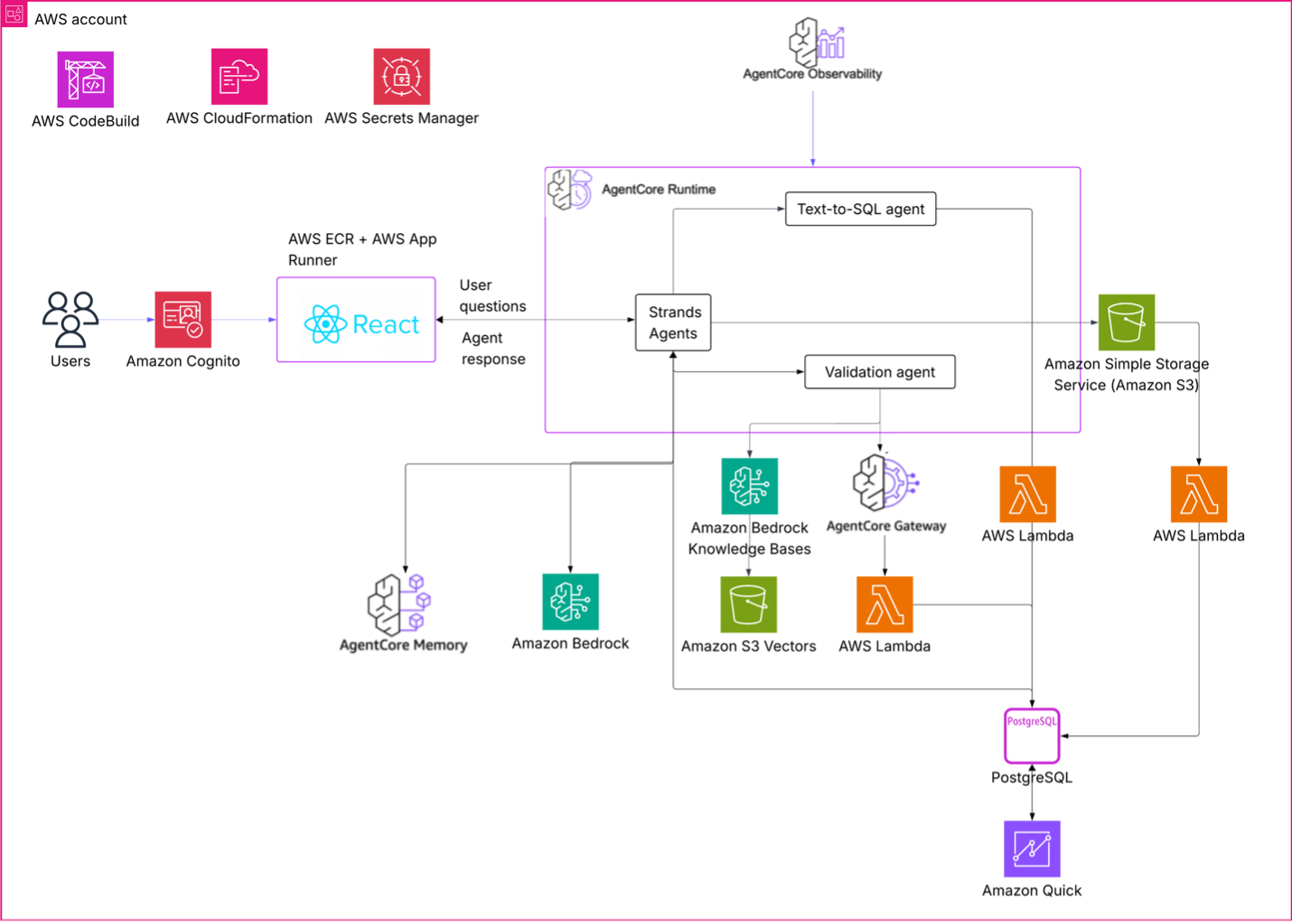
Figure 1: Enterprise AI agent architecture on AWS
Beyond functionality, the solution embeds safety and governance into every layer of the architecture. Amazon Cognito governs identity and access management for users. This means only authenticated users can reach the agent. The agent requires human review at key checkpoints as it guides users through the workflow. Sessions and validations are logged in PostgreSQL for compliance and troubleshooting. The agent’s write access is scoped to session management, maintaining a clear boundary from business-critical data.AWS Partner solutions architects collaborated closely with the Mission Cloud team, providing architectural guidance that refined the solution design and accelerated production delivery.
AWS Partner solutions architects collaborated closely with the Mission Cloud team, providing architectural guidance that refined the solution design and accelerated production delivery.
Production deployment and optimization
Mission Cloud deployed the solution with comprehensive observability, implementing performance monitoring using Amazon Bedrock AgentCore metrics and Amazon CloudWatch, conversation tracing for debugging and quality assurance, cost tracking by agent and model, and user feedback collection for continuous improvement.
Key lessons learned
The experience Mission Cloud had delivering this solution revealed several critical insights for enterprise AI agent development:
- Let context guide architecture – Don’t default to complex supervisor patterns when simpler contextual routing meets your needs. Start simple and evolve as requirements demand.
- Prioritize observability from day one – Production AI agents require comprehensive monitoring, tracing, and feedback mechanisms to identify issues and drive continuous improvement.
Conclusion
Moving from pilot to production with enterprise AI agents requires careful architectural decisions and robust state management. It also demands thoughtful tooling strategies and comprehensive observability. Amazon Bedrock AgentCore provides the foundation for production agentic systems, handling infrastructure complexity and freeing teams to focus on business logic and user experience.Organizations exploring agentic AI should start by setting goals for clear business outcomes, choose architectures appropriate to their complexity, and use AWS services to accelerate delivery while maintaining enterprise reliability and governance standards.
To learn more about how you can build production AI systems on AWS, visit AWS Prescriptive Guidance and Mission Cloud.

Mission Cloud – AWS Partner Spotlight
Mission Cloud, a CDW company, is an AWS Premier Tier Services Partner. The company specializes in enterprise AI strategy, implementation, and managed services. Mission Cloud has delivered more than 450 AI engagements on AWS. The company has earned back-to-back recognition as an AWS Generative AI Partner of the Year finalist, the AWS AI Competency, and launch partner status for Amazon Bedrock. Its capabilities span the entire AI adoption journey, from prioritization and architecture through production delivery and ongoing operations.