AWS Architecture Blog
Recovery strategies to meet data residency requirements
Data residency requirements can affect how government agencies, regulated industries such as financial services, healthcare, and power and utilities, and businesses that make residency commitments plan for the recovery of their critical workloads on AWS. These requirements must be considered and balanced against applicable workload recovery objectives. This post assumes familiarity with AWS Regions, disaster recovery concepts, and AWS encryption services.
Where residency requirements are scoped at the national level, AWS provides multiple Regions within the same country in the United States, Canada, Australia, India, Japan, Germany, and China (operated by Sinnet and NWCD). In some cases, residency requirements can span national borders. For example, AWS offers multiple Regions within the European Union (EU), including the AWS European Sovereign Cloud, giving EU customers options for hosting and recovering workloads across member states where pan-national regulations treat the EU as a unified jurisdiction for data protection. This allows customers to use multi-Region recovery architectures and maintain data residency.
Where residency requirements are scoped to a country or countries served by a single AWS Region, or you need to address failure scenarios not fully mitigated by multiple Regions in the same country, alternate strategies can help you achieve your recovery requirements. In this post, we present three strategies that customers can use in close collaboration with their regulators to achieve bounded recovery while addressing data residency requirements. These strategies range from encryption-based compensating controls on multi-Region replication to fully in-country architectures.
Recovery strategies
We present three strategies for backing up critical business data (source code and data you cannot reproduce from other sources) and launching recovery infrastructure from those backups at a location distinct from your primary Region. Each strategy represents a different set of constraints on where data and administrative operations can reside. You should select the strategy that best matches your requirements and risk appetite, then evaluate the options within that strategy in collaboration with your regulator. The most important factor of success for whichever strategy you choose is your ability to test it end-to-end, continuously, to build and maintain confidence it will work when required.
Strategy 1: Cryptographic boundary
This approach replicates data into another AWS Region in a geopolitically aligned country with compatible data protection frameworks using encryption as a compensating technical control. Customers use AWS Key Management Service (AWS KMS) keys to encrypt the data, so that no one, including AWS operators, can access the data without the customer-controlled data encryption keys. This approach supports replication using features like Amazon Simple Storage Service (Amazon S3) Cross-Region Replication (CRR) or AWS Backup cross-Region copy.
With AWS KMS, you can also use key policies to explicitly deny decryption operations in the recovery Region. This provides you with strong assurance that your data in the recovery Region cannot be decrypted under any circumstances until you modify the key policy. You can work with your regulators to determine when to update these key policies as part of your recovery process.
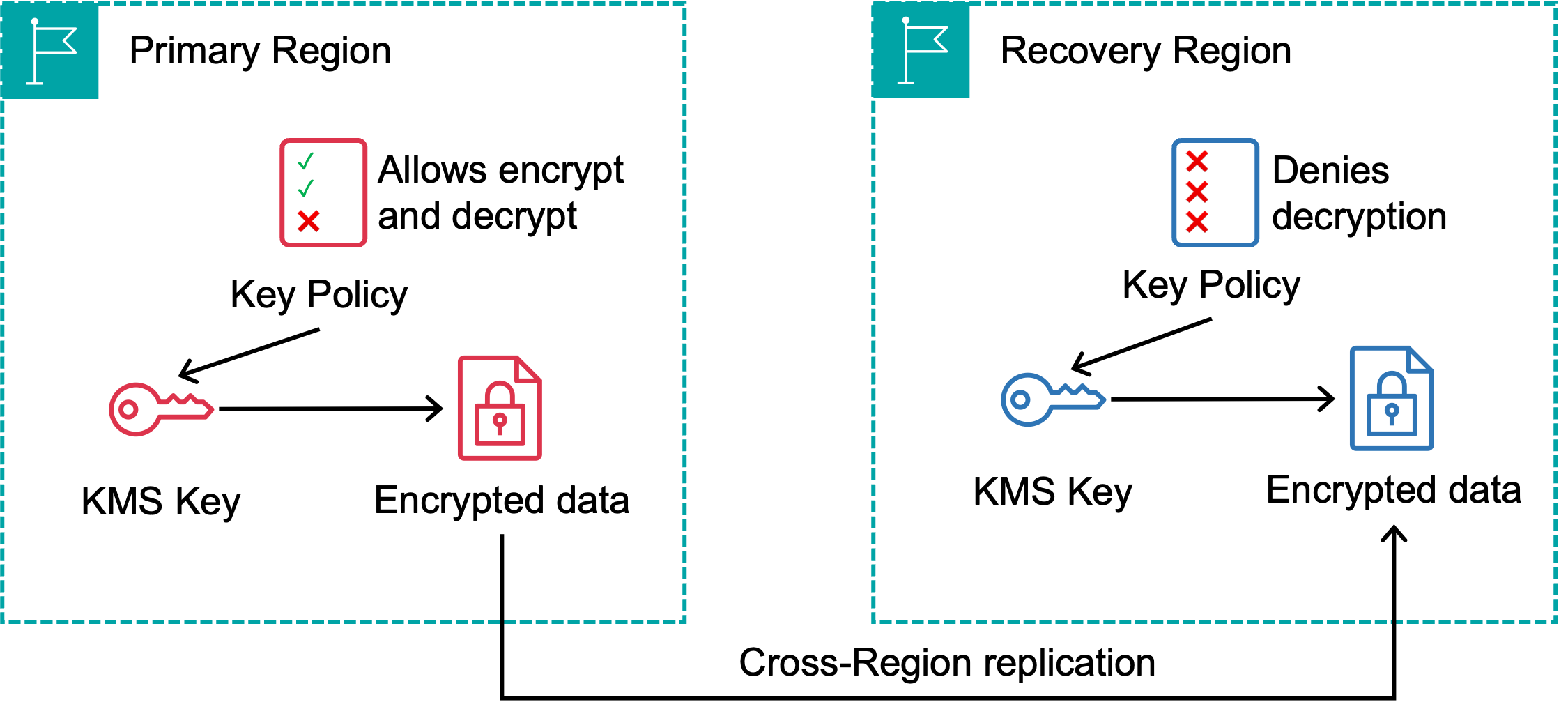
Figure 1 – Server-side encryption architecture using AWS KMS with cross-Region replication.
You can also use this approach with client-side encryption for backups you manage and store in S3. Customers manage their own backup processes and use the AWS Encryption SDK or their own clients with multi-Region AWS KMS keys to encrypt the data. Multi-Region keys allow you to encrypt and decrypt replicated S3 data in multiple Regions using the same key material.
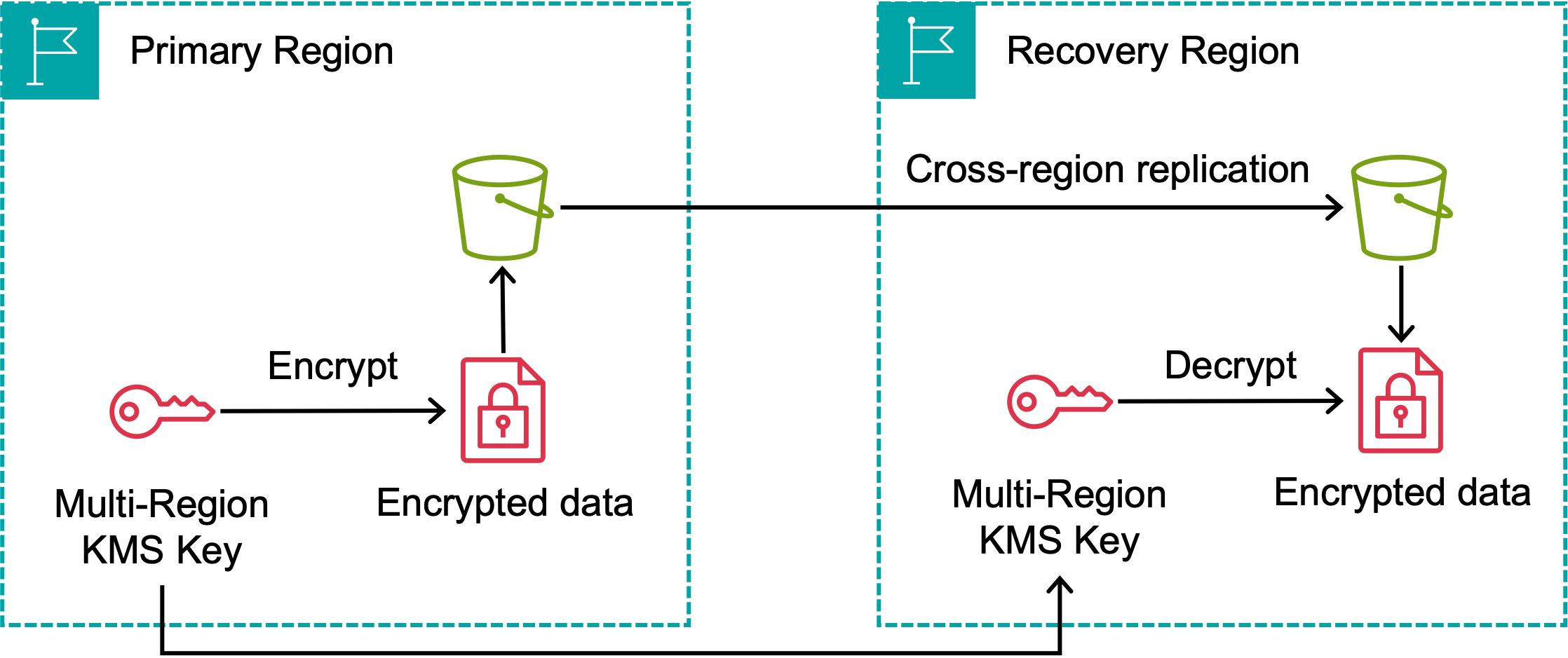
Figure 2 – Client-side encryption approach using multi-Region AWS KMS keys.
You can explore additional strategies for enhancing controls on the key policies to meet your requirements. For example, you can require Multi-Factor Authentication (MFA) to update your key policies. This allows the MFA holder and credential holder to be two distinct parties. They could be two different teams within an organization, or you could consider greater separation by providing the MFA device to a trusted third party such as a regulator. Another option is to implement controls in your identity provider to issue specific IAM session tags that provide conditional access to update the key policy. You should also scope key policy update permissions to a set of named IAM principals using condition keys, so that only explicitly authorized identities can modify decryption access.
Choose this strategy when storing encrypted data in a partner country is acceptable. Key policies prevent unauthorized access, and this approach offers the simplest operational model with the lowest recovery time.
Strategy 2: Data boundary
In this strategy, you store backups or operate a pilot light recovery environment on AWS Outposts in an on-premises site within the source country or other approved location. You replicate data from your primary Region using automated data movement tools such as S3 sync operations, third-party backup solutions, or database-native replication tools like MySQL binlog or Postgres logical replication for Amazon Relational Database Service (Amazon RDS) instances. You maintain full control of where your business data physically resides at all times. You can also use third-party backup solutions to replicate data from your primary Region to on-premises or in-country storage.
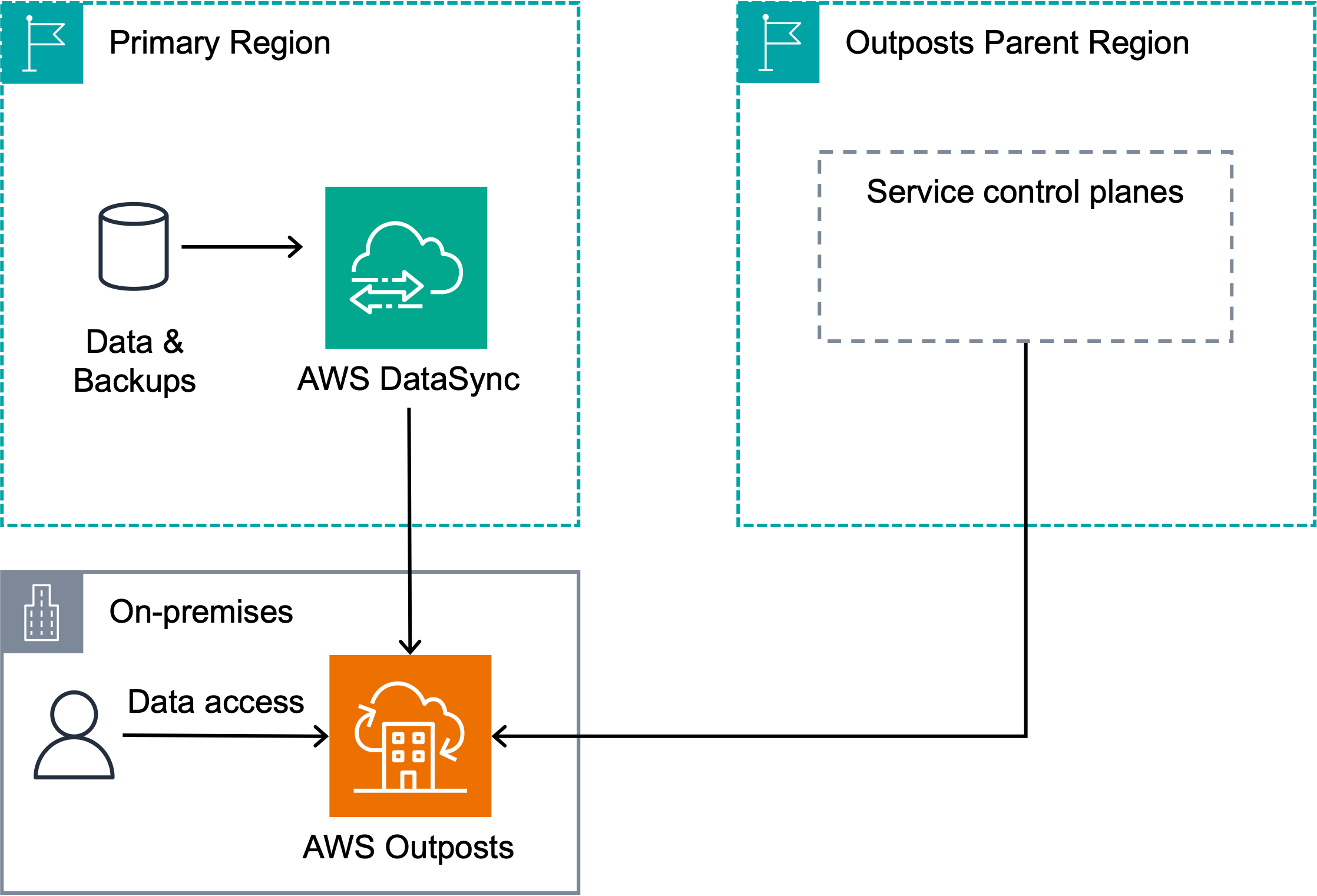
Figure 3 – AWS Outposts recovery architecture with data replicated to on-premises infrastructure.
Data access occurs directly over the local network in your on-premises facility through the data planes of the resources hosted on the Outposts infrastructure. These are resources like Amazon Elastic Compute Cloud (Amazon EC2) instances, Amazon RDS database instances, and S3 buckets. You provision and configure those resources through each service’s control plane, which is hosted in the parent Region you select when you order your Outposts racks.
Choose a parent Region that is different from your primary Region. This prevents simultaneous impact to your primary workloads and your ability to use control plane operations for recovery, such as launching new instances on your Outposts. Note that Outposts are not designed for disconnected operations or environments with limited to no connectivity. Maintain highly available networking connections from your on-premises site back to the parent AWS Region.
During recovery, you can restore your environment directly on the Outposts infrastructure. AWS Outposts support a subset of the available AWS services in a Region, so you need to design your workloads to use the services available. Alternatively, you may obtain regulator agreement to restore your environment from backups stored on your Outposts to an AWS Region in a different country during extreme circumstances.
Select this strategy when you must physically maintain your backups and data in specific locations, want a consistent experience using AWS services and hardware in the cloud and on-premises, and using control planes for your Outposts infrastructure from outside your primary Region is acceptable.
Strategy 3: Strict local autonomy boundary
Some data residency frameworks, such as those in financial services or national security contexts, may require customer data and the control plane systems used to manage that data and recovery environments remain within national borders. Two options achieve this outcome.
Option 1: On-premises infrastructure
In this option, you operate hardware and software in an on-premises location to store backup data. Like the Outposts option, this provides flexibility on where backed-up data is restored: it could be restored to on-premises physical hardware or to an AWS Region in a different country.

Figure 4 – On-premises backup architecture with data copied from Amazon S3 to local storage.
This solution requires you to self-manage backups in S3, then copy them to on-premises storage using tools like AWS DataSync. You need to decide how to manage encryption of your data on-premises. Encrypting and decrypting data on-premises should not depend on the availability of the primary Region.
Option 2: Multi-cloud
In a multi-cloud solution, you can replicate backups from your primary cloud to an environment on another cloud provider and recover your workloads there. You can also use a lifeboat strategy.
A lifeboat strategy involves running a separate set of systems in another cloud provider which meets your residency requirements. These systems are not replicas of the primary platform. They are built and developed natively to provide a subset of critical functionality. This approach avoids architecting to the least common denominator of services across providers. You can take full advantage of all services available on AWS for your primary workload while the stand-in system uses a separate, purpose-built architecture.

Figure 5 – Multi-cloud lifeboat architecture with a purpose-built stand-in system.
Monzo Bank’s stand-in system is a well-documented example of this pattern. Monzo operates its primary banking system on AWS with thousands of microservices. Rather than replicating that entire stack, they built a small set of purpose-built services on a separate cloud provider that supports only the operations most critical to their customer experience: card payments, bank transfers, and balance information. According to Monzo, the stand-in shares no code and no infrastructure with the primary system.
The lifeboat pattern follows several key design principles. The stand-in supports only key functionality, which helps minimize the cost of the solution. Using different software reduces the probability that the same defect or failure mode affects both systems simultaneously. The stand-in accepts eventually consistent data, which avoids strong coupling between the two environments and preserves availability independence. The recovery does not appear transparent to end users. The experience is intentionally degraded to a subset of services, which is an explicit trade-off for maintaining availability.
A multi-cloud lifeboat provides protection against service disruptions of an AWS Region in a single country, but using multi-cloud to keep data in-country may not fully mitigate scenarios where all major cloud providers in a geography face simultaneous disruption.
Testing
You must continuously test your recovery strategy to build and maintain confidence it will succeed during a real event. Testing must be performed end-to-end: validating the integrity and consistency of backups, launching compute and database resources, and running synthetic test traffic through the recovered system. The more frequently you test, the more recovery becomes a standard operational process rather than a one-off monthly or quarterly activity. Your testing must keep up with the rate of change in your environment. If a change breaks your recovery process, you want to know about it and fix the procedures as quickly as possible.
The approach to testing is generally the same as traditional multi-Region recovery testing, but the additional complexities and operational processes of these solutions require an increased level of rigor:
- Strategy 1 (Cryptographic boundary): You need to decide if decrypting data and launching recovery environments with that data is acceptable. Ideally, you run full end-to-end recovery tests during approved test windows. If you cannot, you need to test your recovery procedures using synthetic data that is not subject to data residency requirements. This helps validate your recovery procedures, but it does not prove you can recover your critical business data.
- Strategy 2 (Data boundary): Validate replication lag meets your recovery requirements. Test launching recovery workloads on Outposts infrastructure and confirm that the parent Region control plane can orchestrate recovery while the primary Region is simulated as unavailable.
- Strategy 3 (Strict local autonomy boundary): For on-premises recovery, validate that backups can be restored to your target environment and that workloads function correctly outside of AWS. For multi-cloud lifeboats, test failover activation and verify that the lifeboat has no dependencies on your primary environment.
Summary
In this post, we presented three strategies for implementing disaster recovery solutions that support data residency requirements:
- Strategy 1 (Cryptographic boundary) uses encryption to meet the intent of data residency while using multi-Region AWS infrastructure for recovery. This offers the lowest operational complexity and best recovery performance, if permitted by applicable regulations.
- Strategy 2 (Data boundary) uses AWS Outposts to maintain data in-country in customer-controlled facilities while using an out-of-country control plane for management operations, if permitted by applicable regulations.
- Strategy 3 (Strict local autonomy boundary) keeps both data and control in-country during a recovery event using on-premises infrastructure or a multi-cloud lifeboat strategy. This offers the highest degree of control but with the greatest operational complexity.
The option that works best will be a joint decision between your business, regulators, and your customers. You should consider potential failures proactively and build recovery plans before an event occurs. This framework provides a structured way to evaluate the trade-offs and determine where to invest based on your regulatory environment, risk appetite, and operational capabilities.
Next steps
To learn more about the services and approaches discussed in this post, see the following resources:
- Disaster Recovery of Workloads on AWS
- AWS Key Management Service
- AWS Outposts
- AWS Backup
- AWS DataSync
If you have questions about applying these strategies to your specific workloads and regulatory environment, reach out to your AWS account team to discuss your recovery requirements in detail.