AWS Compute Blog
Category: Uncategorized

Learn how to deploy Falcon 2 11B on Amazon EC2 c7i instances for model Inference
This post is written by Paul Tran, Senior Specialist SA; Asif Mujawar, Specialist SA Leader; Abdullatif AlRashdan, Specialist SA; and Shivagami Gugan, Enterprise Technologist. Technology Innovation Institute (TII) has developed Falcon 2 11B foundation model (FM), a next-generation AI model that can be now deployed on Amazon Elastic Compute Cloud (Amazon EC2) c7i instances, which support […]

Sending and receiving CloudEvents with Amazon EventBridge
Amazon EventBridge helps developers build event-driven architectures (EDA) by connecting loosely coupled publishers and consumers using event routing, filtering, and transformation. CloudEvents is an open-source specification for describing event data in a common way. Developers can publish CloudEvents directly to EventBridge, filter and route them, and use input transformers and API Destinations to send CloudEvents […]
Building a serverless pipeline to deliver reliable messaging
This post is written by Jeff Harman, Senior Prototyping Architect, Vaibhav Shah, Senior Solutions Architect and Erik Olsen, Senior Technical Account Manager. Many industries are required to provide audit trails for decision and transactional systems. AI assisted decision making requires monitoring the full inputs to the decision system in near real time to prevent fraud, […]

Serverless ICYMI Q4 2023
Welcome to the 24th edition of the AWS Serverless ICYMI (in case you missed it) quarterly recap. Every quarter, we share all the most recent product launches, feature enhancements, blog posts, webinars, live streams, and other interesting things that you might have missed! In case you missed our last ICYMI, check out what happened last […]

Introducing AWS Step Functions redrive to recover from failures more easily
Developers use AWS Step Functions, a visual workflow service to build distributed applications, automate IT and business processes, and orchestrate AWS services with minimal code. Step Functions redrive for Standard Workflows allows you to redrive a failed workflow execution from its point of failure, rather than having to restart the entire workflow. This blog post […]
Enhancing Workflow Studio with new features for streamlined authoring
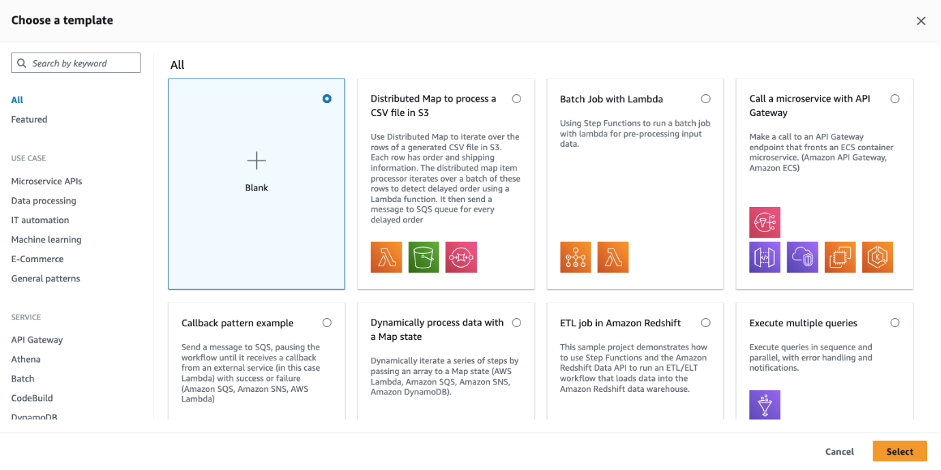
AWS Step Functions is emerging as a foundational tool for building scalable and distributed serverless applications through workflows. In 2021, the Step Functions team launched Workflow Studio, a low-code visual tool for creating Step Functions workflows in the AWS Management Console. This made workflow building accessible even to those with limited coding experience. In response to […]

Python 3.11 runtime now available in AWS Lambda
You can build and deploy functions using Python 3.11 using the AWS Management Console, AWS CLI, AWS SDK, AWS SAM, AWS CDK, or your choice of Infrastructure as Code (IaC). You can also use the Python 3.11 container base image if you prefer to build and deploy your functions using container images.

Deploying an automated Amazon CloudWatch dashboard for AWS Outposts using AWS CDK
This post is written by Enrico Liguori, Networking Solutions Architect, Hybrid Cloud and Sumeeth Siriyur, Sr. Hybrid Cloud Solutions Architect. AWS Outposts is a fully managed service that brings the same AWS infrastructure, services, APIs, and tools to virtually any data center, colocation space, manufacturing floor, or on-premises facility where it might be needed. With Outposts, […]

Secure Connectivity from Public to Private: Introducing EC2 Instance Connect Endpoint
This blog post is written by Ariana Rahgozar, Solutions Architect, and Kenneth Kitts, Sr. Technical Account Manager, AWS. Imagine trying to connect to an Amazon Elastic Compute Cloud (Amazon EC2) instance within your Amazon Virtual Private Cloud (Amazon VPC) over the Internet. Typically, you’d first have to connect to a bastion host with a public […]

Selecting cost effective capacity reservations for your business-critical workloads on Amazon EC2
This blog post is written by Sarath Krishnan, Senior Solutions Architect and Navdeep Singh, Senior Customer Solutions Manager. Amazon CTO Werner Vogels famously said, “everything fails all the time.” Designing your systems for failure is important for ensuring availability, scalability, fault tolerance and business continuity. Resilient systems scale with your business demand changes, prevent data […]