AWS Compute Blog
Category: Uncategorized

Introducing AWS Step Functions redrive to recover from failures more easily
Developers use AWS Step Functions, a visual workflow service to build distributed applications, automate IT and business processes, and orchestrate AWS services with minimal code. Step Functions redrive for Standard Workflows allows you to redrive a failed workflow execution from its point of failure, rather than having to restart the entire workflow. This blog post […]
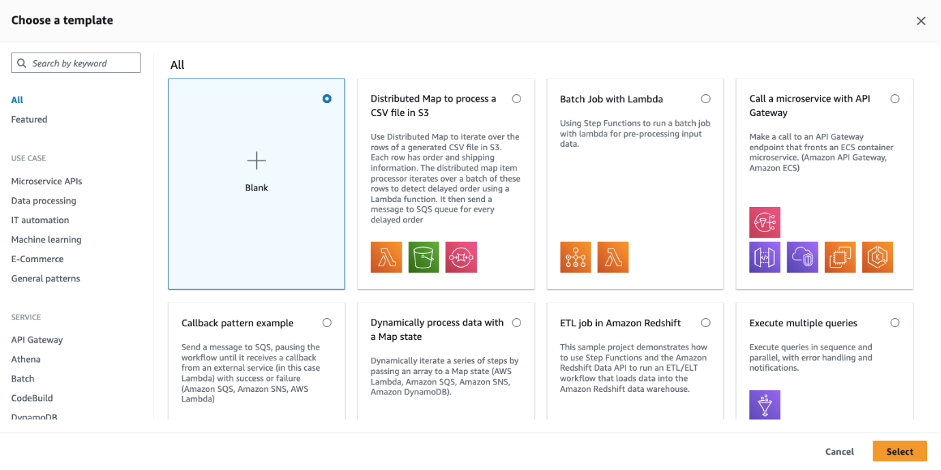
Enhancing Workflow Studio with new features for streamlined authoring
AWS Step Functions is emerging as a foundational tool for building scalable and distributed serverless applications through workflows. In 2021, the Step Functions team launched Workflow Studio, a low-code visual tool for creating Step Functions workflows in the AWS Management Console. This made workflow building accessible even to those with limited coding experience. In response to […]

Python 3.11 runtime now available in AWS Lambda
You can build and deploy functions using Python 3.11 using the AWS Management Console, AWS CLI, AWS SDK, AWS SAM, AWS CDK, or your choice of Infrastructure as Code (IaC). You can also use the Python 3.11 container base image if you prefer to build and deploy your functions using container images.

Deploying an automated Amazon CloudWatch dashboard for AWS Outposts using AWS CDK
This post is written by Enrico Liguori, Networking Solutions Architect, Hybrid Cloud and Sumeeth Siriyur, Sr. Hybrid Cloud Solutions Architect. AWS Outposts is a fully managed service that brings the same AWS infrastructure, services, APIs, and tools to virtually any data center, colocation space, manufacturing floor, or on-premises facility where it might be needed. With Outposts, […]

Secure Connectivity from Public to Private: Introducing EC2 Instance Connect Endpoint
This blog post is written by Ariana Rahgozar, Solutions Architect, and Kenneth Kitts, Sr. Technical Account Manager, AWS. Imagine trying to connect to an Amazon Elastic Compute Cloud (Amazon EC2) instance within your Amazon Virtual Private Cloud (Amazon VPC) over the Internet. Typically, you’d first have to connect to a bastion host with a public […]

Selecting cost effective capacity reservations for your business-critical workloads on Amazon EC2
This blog post is written by Sarath Krishnan, Senior Solutions Architect and Navdeep Singh, Senior Customer Solutions Manager. Amazon CTO Werner Vogels famously said, “everything fails all the time.” Designing your systems for failure is important for ensuring availability, scalability, fault tolerance and business continuity. Resilient systems scale with your business demand changes, prevent data […]

Reserving EC2 Capacity across Availability Zones by utilizing On Demand Capacity Reservations (ODCRs)
This post is written by Johan Hedlund, Senior Solutions Architect, Enterprise PUMA. Many customers have successfully migrated business critical legacy workloads to AWS, utilizing services such as Amazon Elastic Compute Cloud (Amazon EC2), Auto Scaling Groups (ASGs), as well as the use of Multiple Availability Zones (AZs), Regions for Business Continuity, and High Availability. These […]

Best practices to optimize your Amazon EC2 Spot Instances usage
This blog post is written by Pranaya Anshu, EC2 PMM, and Sid Ambatipudi, EC2 Compute GTM Specialist. Amazon EC2 Spot Instances are a powerful tool that thousands of customers use to optimize their compute costs. The National Football League (NFL) is an example of customer using Spot Instances, leveraging 4000 EC2 Spot Instances across more […]

Best Practices for managing data residency in AWS Local Zones using landing zone controls
This blog post is written by Abeer Naffa’, Sr. Solutions Architect, Solutions Builder AWS, David Filiatrault, Principal Security Consultant, and Jared Thompson Hybrid Edge SA Specialist. In this post, we discuss how you can leverage AWS Control Tower landing zone and AWS Organizations custom policies – guardrails – at the root level, known as Service […]

Optimizing Amazon EC2 Spot Instances with Spot Placement Scores
This blog post is written by Steve Cole, Principal Specialist SA, and Robert McCone, Sr. Specialist SA. Getting the compute resources you need, even vCPUS numbering in the millions, and completing a workload using Amazon EC2 Spot Instances is just a configuration away. In this post you will learn how to use Spot placement scores […]