Desktop and Application Streaming
Automate Custom Image Builds with EC2 Image Builder for Amazon WorkSpaces
Introduction
For organizations running Amazon WorkSpaces at scale, a custom image is the foundation of every end user session. Often called a golden image, it defines the operating system configuration, security posture and installed applications. It shapes the user experience that employees interact with every day. Yet for many IT teams, creating and maintaining these images remains one of the most time-consuming and error-prone tasks in their operations.
What if that process can be fully automated using AWS services?
This blog explores how EC2 Image Builder image pipelines eliminate the manual overhead of golden image creation and maintenance. It covers how the resulting images import into multiple services across Amazon WorkSpaces. These include WorkSpaces Personal, WorkSpaces Applications, and WorkSpaces Core (Bundles and Core Managed Instances).
The pain of manual golden image management
Every IT administrator who owns a golden image workflow knows the routine. A base operating system image must be launched and patched to current levels. It must be hardened to organizational security standards and layered with licensed and line-of-business applications. Then it’s tested for compatibility and published for consumption — across multiple regions and accounts. A few weeks later, a new application update drops, or a new patch cycle begins, and the entire process starts over.
This recurring manual workflow presents three significant challenges.
- It is enormously time-consuming. A well-documented runbook requires hours of hands-on work each cycle. This pulls senior engineers away from architecture improvements, security hardening, and user experience optimization.
- It is inherently inconsistent. Manual steps introduce configuration drift between image versions. An application installed interactively on one build might have slightly different customizations than the previous build. This leads to subtle and difficult-to-diagnose user issues at scale.
- It does not scale. Organizations that maintain multiple images for different business units, operating systems, or geographic regions find that the burden multiplies with every additional variant. What starts as one monthly image build quickly becomes a portfolio, magnitudes larger, each demanding individual attention.
Manual image builds are the equivalent to running infrastructure without Infrastructure-as-a-code (IaC) same inputs, same intent, but no guarantee of identical outputs. EC2 Image Builder brings that same IaC repeatability to your golden image lifecycle.
EC2 Image Builder — your automated image pipeline
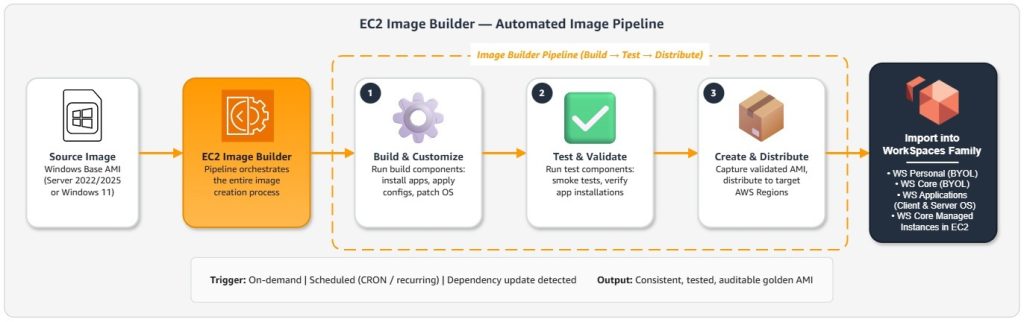
Figure 1: EC2 Image Builder Automated Image Pipeline
EC2 Image Builder is a fully managed AWS service that simplifies the creation, maintenance, validation, and distribution of customized machine images. Administrators define the desired end state of an image as a pipeline rather than performing each step manually. A pipeline includes a source image, build components that install and configure software, test components that validate the output. Finally, distribution settings control where the output image lands.
Once defined, a pipeline runs on demand or runs automatically on a schedule. For example, it can run on the third Monday of every month in alignment with patch cycles. The service handles instance orchestration, component execution, testing, and cleanup. Administrator does not need to remain logged in or monitor progress.
Critically, this is not a lift-and-shift of manual steps into a script that an administrator still has to manage and maintain. EC2 Image Builder manages the complete lifecycle. It launches a temporary build instance, applies components in sequence, and reboots as needed. It then runs validation tests, captures the final image and terminates all temporary resources. If a test fails, the pipeline stops and notifies the team.
Four destinations across Amazon WorkSpaces
The real power of this approach becomes clear when you consider where a single pipeline output goes. EC2 Image Builder produces a validated Amazon Machine Image (AMI). That AMI imports into four distinct services in the Amazon WorkSpaces, each serving a different deployment model.
- WorkSpaces Personal with Bring Your Own License (BYOL) allows organizations with existing Microsoft Windows Desktop licenses to deploy persistent, dedicated virtual desktops. A custom image imported here becomes the base for every new WorkSpace provisioned under the BYOL model. This ensures consistency from day one.
- WorkSpaces Applications supports both Windows Desktop OS and Server OS configurations for application and desktop streaming workloads. Organizations can deliver a single packaged application or a full desktop environment through streaming. Custom images built by EC2 Image Builder serve as the foundation for both client and server-side fleet configurations.
- WorkSpaces Core Bundles with BYOL provides the same licensing flexibility in a streamlined, API-driven model. It’s designed for organizations that use third party connection brokering and client ecosystem. Custom images imported into WorkSpaces Core power these API-managed desktops with the same consistency guarantees.
- WorkSpaces Core Managed Instances in EC2 extend this into the Amazon EC2 environment. It’s an API-driven model for organizations managing their own brokering and client ecosystem. It offers managed virtual desktop instances running directly on EC2 infrastructure in the customer’s account and VPC. Custom images imported allow organizations to leverage familiar EC2 capabilities while benefiting from managed service features
In each case, the same automated pipeline produces a validated image. The administrator decides at distribution time which destinations receive it. This eliminates the need to maintain separate manual build processes for each service.
Benefits of automated image lifecycle management
Adopting EC2 Image Builder for golden image automation delivers measurable operational improvements.
- Consistency becomes the default rather than the aspiration. Every image produced by a pipeline follows the same component sequence, test validations, and distribution rules. It doesn’t matter which engineer started the build or what day it runs.
- Time to production shrinks from hours of manual effort to minutes of automated execution. Administrators define the pipeline once and then focus on improving image content rather than repeating creation mechanics.
- Auditability improves because every pipeline run generates a build log, component version history and test report. When compliance teams ask how a particular image was constructed, the answer is a versioned, reproducible pipeline definition — not handwritten notes.
- Scale becomes manageable. Adding a new image variant means adding a new pipeline configuration, not hiring another engineer to manage another monthly manual build cycle.
What comes next
This blog established why automating golden image creation matters. It covers how EC2 Image Builder pipelines address the pain points of manual workflows across Amazon WorkSpaces. But understanding that automation is possible is the first step.
The builder center article walks through the complete process of building an EC2 Image Builder pipeline from the ground up. It covers defining components, configuring test phases, and setting distribution targets. It also shows how to import the resulting image into each of the four WorkSpaces destinations discussed here.
If you’ve been managing golden images manually and want to reclaim those engineering hours, that step-by-step guide gives you everything you need to get started.
For now, the key takeaway is this: custom image automation for Amazon WorkSpaces is available today. It’s built on services inside your AWS account. It’s ready to replace the monthly manual cycle that your team knows all too well.
About the authors:
 |
Mayank Jain is a Senior Partner Solutions Architect for End User Computing (EUC) at AWS. He works with AWS partners across EMEA to design, build, and scale EUC solutions on Amazon WorkSpaces. His focus spans architecture guidance, technical enablement, and go-to-market support for repeatable migration offerings. Mayank has over 17 years of experience in EUC across Citrix, Omnissa (Formerly VMware), and AWS. |
 |
Shantanu Padhye is a Senior Specialist Solutions Architect at Amazon Web Services (AWS), focused on End User Computing (EUC) services. With extensive experience spanning desktop virtualization, cloud workspace delivery, identity management, and device management at scale, Shantanu brings deep technical expertise to his role. |