Artificial Intelligence

Author: Anastasia Tzeveleka
AgentOps: Operationalize agentic AI at scale with Amazon Bedrock AgentCore
When you build agentic AI solutions, you face unique operational challenges. Agents make unpredictable decisions, costs spiral unexpectedly, and debugging non-deterministic failures seems impossible. Agentic AI applications don’t just execute predetermined workflows. They reason, adapt, and make autonomous decisions, and DevOps practices need to be adapted. That’s where AgentOps comes in, the operational discipline for deploying, managing, and continuously improving AI agents in production.
Operationalize generative AI workloads and scale to hundreds of use cases with Amazon Bedrock – Part 1: GenAIOps
In this first part of our two-part series, you’ll learn how to evolve your existing DevOps architecture for generative AI workloads and implement GenAIOps practices. We’ll showcase practical implementation strategies for different generative AI adoption levels, focusing on consuming foundation models.

Build a multi-tenant generative AI environment for your enterprise on AWS
While organizations continue to discover the powerful applications of generative AI, adoption is often slowed down by team silos and bespoke workflows. To move faster, enterprises need robust operating models and a holistic approach that simplifies the generative AI lifecycle. In the first part of the series, we showed how AI administrators can build a […]
Align Meta Llama 3 to human preferences with DPO, Amazon SageMaker Studio, and Amazon SageMaker Ground Truth
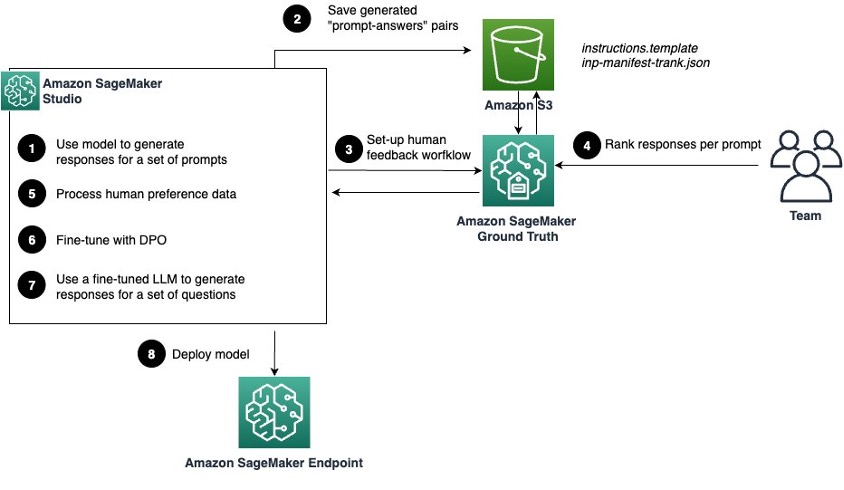
In this post, we show you how to enhance the performance of Meta Llama 3 8B Instruct by fine-tuning it using direct preference optimization (DPO) on data collected with SageMaker Ground Truth.
Use Amazon SageMaker Studio to build a RAG question answering solution with Llama 2, LangChain, and Pinecone for fast experimentation
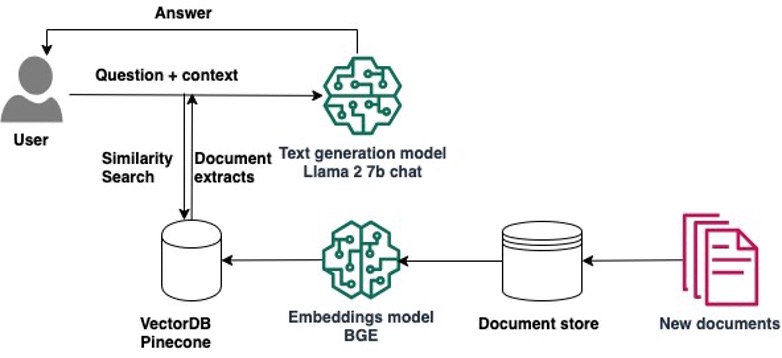
Retrieval Augmented Generation (RAG) allows you to provide a large language model (LLM) with access to data from external knowledge sources such as repositories, databases, and APIs without the need to fine-tune it. When using generative AI for question answering, RAG enables LLMs to answer questions with the most relevant, up-to-date information and optionally cite […]

Training large language models on Amazon SageMaker: Best practices
Language models are statistical methods predicting the succession of tokens in sequences, using natural text. Large language models (LLMs) are neural network-based language models with hundreds of millions (BERT) to over a trillion parameters (MiCS), and whose size makes single-GPU training impractical. LLMs’ generative abilities make them popular for text synthesis, summarization, machine translation, and […]