AWS Public Sector Blog
How Iowa State University’s Translational AI Center is feeding the future with generative AI and computer vision on AWS
From on-premises lab prototype to globally scalable pest intelligence
When a farmer in central Iowa spots an unfamiliar insect on their crop, every hour matters. Waiting days for a county extension agent visit or thumbing through reference guides can mean the difference between a targeted spot treatment and a costly full-field chemical application. Iowa State University’s Translational AI Center (TrAC) asked a bold question:
“What if every farmer had an AI entomologist and agronomist in their pocket?”
The Challenge: $120 Billion in Annual Crop Losses
U.S. agriculture loses an estimated $120 billion annually to pests, weeds, and diseases. Farmers face a time-critical identification challenge—misidentifying a pest or weed by even a few days can mean the difference between a targeted treatment and a full-field chemical application. Traditional identification methods rely on manual scouting, county extension visits, or reference guides, none of which scale to the millions of decisions farmers make each growing season.
Meet TrAC: Iowa State’s AI Research Engine
The Translational AI Center (TrAC) at Iowa State University is a pre-competitive research hub that bridges the gap between academic AI breakthroughs and real-world deployment. With over 70 affiliated faculty spanning seven ISU colleges, TrAC breaks down disciplinary silos and organizes research across thematic areas, including food and energy systems, healthcare, autonomy, materials design, and AI ethics.
TrAC operates through three interconnected pillars: AI-driven research, training, and workforce development, making it both a research engine and an educational hub. Through seminars, workshops, AI microcredentials, and an industry-funded seed grant program, TrAC cultivates the next generation of AI practitioners while accelerating the translation of laboratory prototypes into field-ready tools.
As home to AIIRA, one of the National AI Institutes, and with over $35 million in federally funded AI research, TrAC represents one of the nation’s most concentrated efforts to apply artificial intelligence to agricultural challenges at scale.
PestID: Foundation Models for the Field
PestID is TrAC’s flagship agricultural AI application—a smart phone-accessible tool that provides real-time pest and weed identification in 1–2 seconds. But beneath its simple interface lies a sophisticated AI pipeline built on custom-trained foundation models and generative AI.
Vision Transformer Architecture
At the core of PestID are two domain-specific foundation models developed entirely by the TrAC research team:
- InsectNet — A Vision Transformer (ViT) model trained via self-supervised learning on 60TB+ of image data using approximately 200,000 GPU node hours across 64 A100 GPUs. InsectNet achieves 98.65% mean per-class accuracy across approximately 3,800 insect species, including 16 USDA-listed invasive species. The model maintains consistent accuracy regardless of insect size, validated across specimens ranging from sub-millimeter to 150mm.
- WeedNet — A Global-to-Local AI foundation model achieving 92.6% accuracy across approximately 1,500 weed species, tested on both ground-based and drone-based imagery.
These are not off-the-shelf classifiers. TrAC’s team designed these as true foundation models—producing biologically meaningful embeddings that generalize across species and imaging conditions.
Generative AI for Actionable Guidance
Identification alone isn’t enough. Farmers need to know what to do once a pest is identified. TrAC’s pipeline integrates a Retrieval-Augmented Generation (RAG) module powered by Large Language Models to deliver:
- Regionally contextualized Integrated Pest Management (IPM) recommendations sourced from university extension bulletins, field guides, and peer-reviewed research
- Multi-language conversational support in 12+ languages, making the tool accessible to diverse farming communities globally
- Expert-verified citations ensuring trustworthiness and traceability of every recommendation
The system employs a two-stage architecture: Stage 1 uses vision models for species identification with uncertainty quantification, and Stage 2 deploys a MultiRegionRetriever for location-specific pest management guidance spanning North America, Africa, and India.
Trustworthiness by Design
TrAC embedded guardrails directly into the AI pipeline—including Out-of-Distribution (OOD) detectors, Conformal Set Predictors, and ensemble methods—ensuring the system communicates uncertainty rather than hallucinating answers. When the model encounters an unfamiliar specimen, it says so.
How PestID Works: End-to-End AI Pipeline
The diagram below illustrates the complete PestID workflow—from a farmer’s smartphone photo to a personalized pest management recommendation delivered in 1–2 seconds:
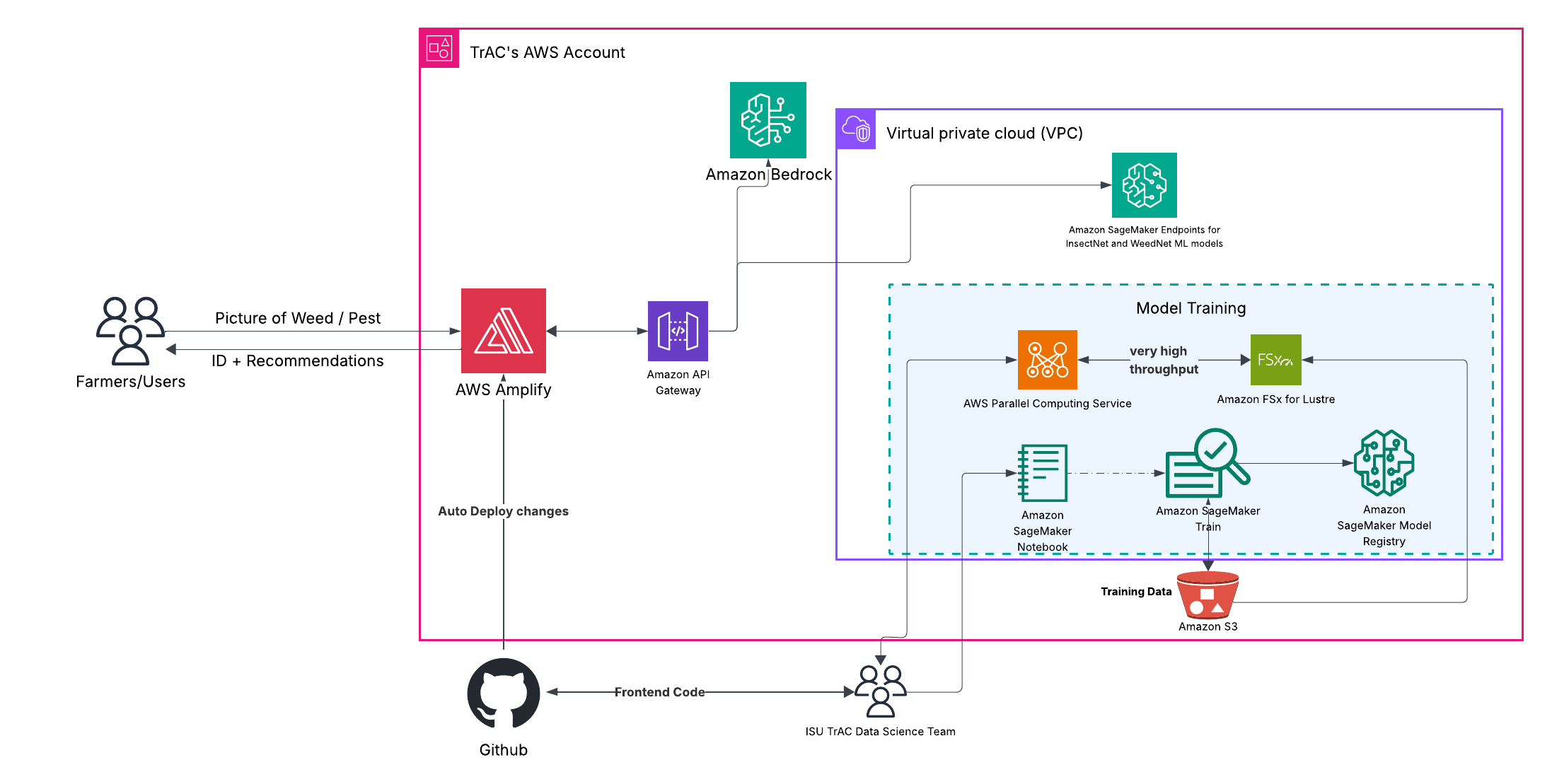
Figure 1: PestID end-to-end pipeline on AWS
Scaling from Lab to Field: The AWS Partnership
TrAC’s models performed brilliantly in the lab. But serving thousands of concurrent farmers during peak growing season from an on-premises university data center presented three critical bottlenecks:
- Concurrency — Limited server capacity couldn’t handle simultaneous requests during pest outbreaks
- Latency — Delays between the generative AI module and users degraded the experience
- Training scale — Retraining foundation models on expanding datasets required computing beyond what the university could provide
AWS partnered with TrAC to architect a phased cloud migration that preserved research agility while enabling production scale:
Phase 1: Auto-Scaling Inference
TrAC deployed InsectNet and WeedNet on Amazon SageMaker endpoints with auto-scaling—chosen because it lets the system dynamically grow from a handful of requests to thousands without manual intervention. Backed by AWS Deep Learning Containers and Amazon S3 for dataset management, this eliminated concurrency constraints. The system now scales on demand, paying only for the inference it consumes.
Phase 2: Cloud-Native Generative AI
The RAG module migrated to Amazon Bedrock, selected for its built-in Bedrock Knowledge Bases and retrieval API—enabling out-of-the-box retrieval-augmented generation without TrAC needing to build and maintain serving infrastructure. This dramatically reduced latency while providing access to state-of-the-art language models for conversational pest management guidance.
Phase 3: Full MLOps Pipeline (Planned)
The team is building an end-to-end machine learning training pipeline using AWS Parallel Computing Service for high-performance job scheduling, Amazon FSx for Lustre for high-throughput storage, and Amazon SageMaker Pipelines for automated model retraining and registry management. Frontend hosting on AWS Amplify enables continuous deployment from GitHub.
Real-World Impact
In pilot deployments across the U.S. Midwest during the 2023–2024 growing seasons, PestID demonstrated measurable impact across approximately 1,000 participating farms:
| Metric | Result |
|---|---|
| Farmers in the pilot | ~1,000 |
| Identifications performed | 10,000+ |
| Estimated savings | $5M+ |
| Pesticide over-application reduction | 30% decrease |
| Response time per identification | 1–2 seconds |
| Insect species covered | ~3,800 species (98.65% accuracy) |
| Weed species covered | ~1,500 species (92.6% accuracy) |
| Languages supported | 12+ |
U.S. growers—particularly in Iowa and the U.S. Midwest states—are among the early adopters of PestID, using it to respond faster in-season, reduce unnecessary chemical inputs, and protect yields.
“PestID is useful to me for identifying the insects and being prepared for unknown pests as we are moving towards a dynamic environment.”
— Iowa Soybean Association Farmer
The Model for Academic–Cloud Partnership
The TrAC–AWS collaboration demonstrates a replicable model for bringing university AI research to a global scale:
- AWS Research Credits — Cloud credits enable researchers to experiment at scale without capital investment, lowering the barrier from prototype to production
- Pay-as-you-go infrastructure — Universities avoid over-provisioning hardware that sits idle outside peak research periods
- Access to foundation models — Amazon Bedrock gives researchers immediate access to frontier LLMs without building serving infrastructure
- Direct engagement with AWS account teams — Comprehensive technical architecture guidance accelerates migration timelines
For TrAC, this partnership means their AI innovations reach farmers faster. For farmers, it means access to PhD-level entomological expertise through a smartphone camera.
What’s Next
TrAC is expanding PestID to serve tens of thousands of concurrent users globally, with planned coverage across Sub-Saharan Africa and South Asia. The team is also exploring drone-based weed detection and expanding the foundation model suite to cover plant diseases.
TrAC is also developing interactive and gamified learning modules for K–16 audiences, covering weeds, insects, plant diseases, and invasive species. These efforts, combined with drone- and rover-based data activities, extend PestID beyond field diagnostics into workforce development and agricultural AI education.
The intersection of generative AI, computer vision, and cloud infrastructure is creating a new paradigm for agricultural decision support—one where academic innovation meets global-scale deployment to advance food security and sustainable agriculture.
Ready to scale your AI research?
Interested in bringing AI-powered agricultural tools to your institution? Contact the AWS Public Sector team to learn how AWS Research Credits can accelerate your path from prototype to production.
Iowa State University’s Translational AI Center is advancing AI-driven solutions across food systems, healthcare, materials design, and beyond. AWS partners with academic researchers worldwide to democratize access to cloud infrastructure and AI tools that accelerate discovery.