AWS Public Sector Blog
How NWS forecasters use generative AI for innovative storm reporting
As part of this mission, it’s critical to capture what’s happening on the ground for situational awareness and evaluation of the forecast. These local storm reports (LSRs) are snapshots of events that include information like wind damage, flooding, hail, and tornado impacts. LSRs are used to verify warnings, improve future forecasts, alert partners, and build a more Weather-Ready Nation.
In collaboration with the Generative AI Innovation Center and Amazon Web Services (AWS), the NWS has developed a proof of concept (POC) to assist with extracting weather and geolocation information from text and images so it can verify the information against scientific data and give forecasters an early start as they document impacts. At the time of writing, the NWS is working on developing and refining this POC and a creating a path forward to transition it into active operations.
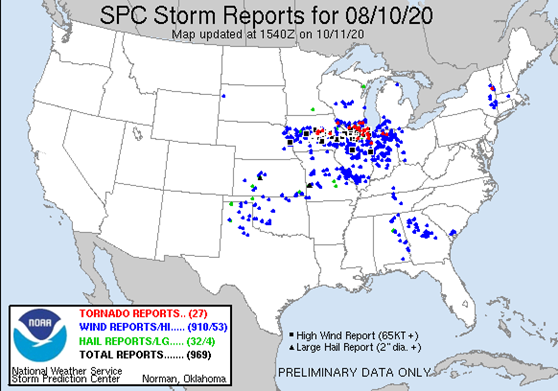
Figure 1: Locations of LSRs from the August 10, 2020 Midwest Derecho
Creating LSRs is a time-consuming manual process. Forecasters must sift through reports from emergency managers, Department of Transportation officials, law enforcement, trained spotters, and the public. These reports arrive by phone, email, social media, and other channels, often while severe weather is still unfolding.
Each report must be verified and cross-checked against other data sources before being used to write precise, structured summaries. This manual, repetitive process competes with higher-priority responsibilities such as issuing warnings, providing briefings, and coordinating with emergency management partners. The following image is an example of an LSR:
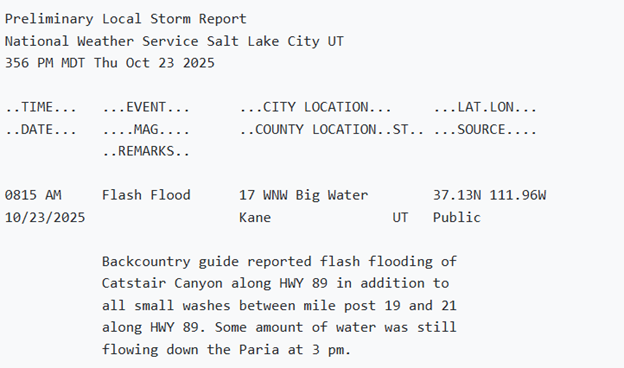
Figure 2: Example of an LSR issued by NWS Salt Lake City UT
LSRs are a critical situational awareness element of NWS warning operations. They help forecasters assess whether warnings are performing as intended; if the warnings need to be upgraded, extended, or cancelled; and if the language in the warning needs to be adjusted to appropriately convey the expected hazards and impacts.
The NWS is exploring how generative AI can augment forecaster workflows by reducing the time it takes to create accurate LSRs. The goal is to increase the consistency, coverage, and number of reports while preserving the scientific rigor the NWS is known for.
The ambition of this POC isn’t to replace forecasters or automate decision-making, but to enhance expert workflows using intelligent, human-in-the-loop AI assistance. The information needed for drafting LSRs is generated using a combination of observational data, natural language processing, and a custom-built verification framework. Forecasters will retain full oversight. When the POC is transitioned into operations, experts will review, edit, and approve each report before it’s finalized.
Designing a More Secure, Scalable Serverless Architecture
At the heart of the draft LSR solution is a fully serverless AWS architecture designed to support real-time operations, handle variable workloads, and enforce strong security principles while reducing the burden on NWS forecasters.
Users can interact with the system through a more secure web interface hosted on Amazon Simple Storage Service (Amazon S3) and distributed globally using Amazon CloudFront for low-latency access. This system is designed with strong authentication and access controls so only authorized NWS personnel can access and manage storm reporting data.
After a user uploads weather-related input such as a PDF, image, or plain-text report, a pipeline of AWS Lambda functions takes over. These include:
- Upload to Amazon S3 – Accepts user submissions and stores them for processing
- Extract Data – Uses Amazon Textract to pull structured information from unstructured sources
- Get Records – Queries observational datasets and external sources like Synoptic using an API
- Get GRIB – Accesses Multi-radar, Multi-sensor (MRMS) data from public Amazon S3 buckets in GRIB format
- Verify Data – Triggers a verification agent framework to cross-reference observations with geospatial and modeled data
These processes interact with downstream services including Amazon DynamoDB for metadata storage, Amazon Bedrock for generative AI model orchestration (including draft generation using Claude), and Amazon Location Service for geographic context and validation.
These components are fully managed, stateless, and event-driven, enabling a highly scalable resilient system designed to meet demand during major storm events without overprovisioning infrastructure.
The system integrates multi-layered authentication, trusted observational datasets, and a human-in-the-loop verification workflow to generate an initial draft of the information needed to produce a LSR, which will be reviewed for scientific accuracy by expert forecasters. The following figure illustrates the generative AI architecture underlying this process:
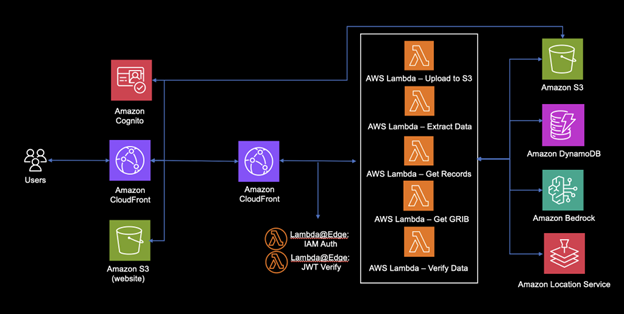
Figure 3: Generative AI architecture
Simulating Meteorological Expertise with an Agentic Framework
To support forecasters during high-impact weather events, the POC includes a domain-specific Verification Agent framework, a system designed to simulate the structured, expert review process meteorologists use to validate storm reports.
The framework is designed to be modular, enabling new agents to be added as capabilities expand beyond the initial POC. These agents automatically evaluate AI-generated LSR drafts by cross-checking reported details such as hail size, rainfall totals, or tornado signature presence against trusted data sources, including:
- MRMS radar data (using GRIB files)
- Observational station data from Synoptic
- Geographic validation through Amazon Location Service
- Public shapefiles for county warning areas and marine zones
Each agent applies domain-specific rules and reasoning patterns, many of which are informed by official NWS meteorological training materials. By grounding agent behavior in real-world operational training and experience, the system better mirrors how forecasters think about storm structure, environmental context, and report plausibility.
After each agent completes its assessment, the Supervisor Agent consolidates their findings and flags any inconsistencies for human review, reinforcing the system’s human-in-the-loop design. The forecaster remains in control while benefiting from AI-generated context that enhances speed, accuracy, and confidence in decision-making. As the tool continues to evolve, the agent framework will remain a cornerstone of building trust, transparency, and scientific rigor into the generative AI workflow.
The figure below illustrates how at the center of the framework is a Supervisor Agent that orchestrates a team of five specialized AI agents, each focused on a different hazard domain, including Observation, Convective, Hydrological, Rotation, and Winter Weather:
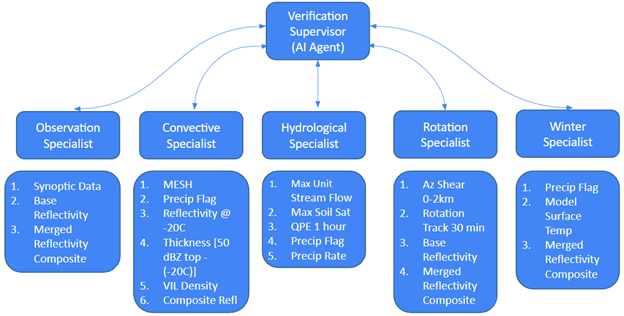
Figure 4: Verification Agent framework
Initial Testing and Evaluation
AWS handed off the project code to NWS on October 1, 2025. Since then, NWS has been working internally to develop an initial evaluation of the solution. The agency is evaluating its performance across diverse hazards and regions of the country to understand the solution’s strengths and weaknesses before wider release and develop a baseline testing dataset. Findings from this evaluation will inform future development and serve as a model to measure future development against.
Scaling Knowledge Through Responsible AI
This project is part of a broader mission to apply generative AI responsibly in the NWS, supporting skilled professionals, improving service delivery, and preserving institutional expertise. The NWS-AWS collaboration showcases how AI can be more secure, auditable, and human-centered in critical domains such as weather and emergency management.
As the system matures, results will be shared across the National Oceanic and Atmospheric Administration and the meteorological community at conferences such as the 106th American Meteorological Society annual meeting. The project can also serve as a blueprint for other scientific agencies that want to improve documentation, reporting, and decision support using generative AI.