AWS Public Sector Blog
Uniting AI and ancient wisdom: How WildTrack and AWS are revolutionizing wildlife monitoring
This is a guest post written by WildTrack, an AWS customer
WildTrack is redefining how we protect endangered species—by looking down
WildTrack is a fast-growing, award-winning nonprofit combining the ancient art and science of animal tracking with cutting-edge artificial intelligence (AI) powered by Amazon Web Services (AWS). The result is a new era in wildlife monitoring that democratizes conservation, empowering local communities to actively protect biodiversity. By merging traditional ecological knowledge (TEK)—refined over thousands of generations by indigenous trackers—with advanced machine learning, WildTrack’s approach transforms something as simple as a footprint into rich ecological insight.
Crucially, decoding animal footprints provides a continuous, 24/7 window into wildlife movement—creating datasets far richer and more comprehensive than conventional (and typically invasive) tracking methods, like collaring and tagging, can achieve over a population landscape scale. This synergy not only accelerates species protection but also captures the nuanced interactions happening in ecosystems—day and night, year-round.
The challenge
Global wildlife populations have declined by an average of 73% over the past 50 years according to the WWF Living Planet Report 2024. This alarming loss of biodiversity is a major economic threat to the foundations of human wellbeing—including clean air, water, soil, food and medicine.
Despite a growing recognition of these issues, there is still a serious lack of up-to-date, large-scale data, especially in regions of rich species biodiversity. Even for iconic species like cheetah, country-sized gaps remain in our understanding of their numbers and movements. Without continuous, reliable data, global biodiversity targets like those in the Kunming-Montreal International Biodiversity Framework remain difficult to measure—let alone achieve.
A global collaboration for wildlife
WildTrack’s dedicated team—which has a hugely diverse range of backgrounds and expertise—works closely with their corporate partners, government agencies, universities, and other non-governmental organizations on more than 30 field projects around the world. Together they share one mission: to deliver accurate and frequently updated data that guides effective conservation strategy.
Now, you can join in. Anyone with a smartphone can contribute using the WildTrackAI app to take images of footprints they see in the great outdoors. Each image becomes data that helps train models, uniting local knowledge with global science in a truly inclusive conservation network.
Come and WildTrack with us—help map the pulse of the planet, one footprint at a time.
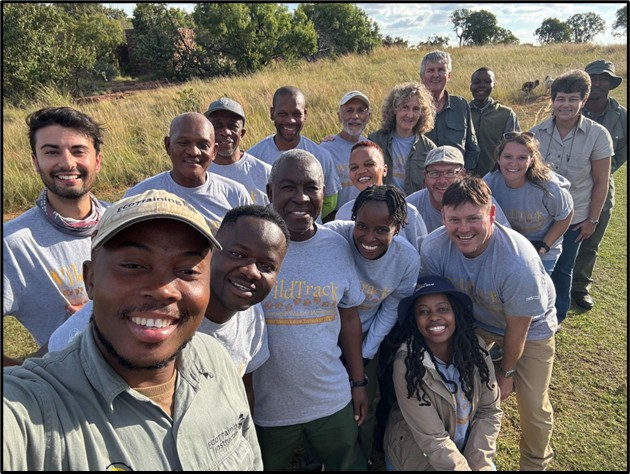
Our field team in South Africa—which includes expert trackers, ecologists, data scientists, engineers, wildlife managers, and students—all contributing different insights to a wildlife monitoring meeting.
A new way forward
WildTrack’s story began in Zimbabwe, where the organization’s co-founders worked with the Department of National Parks to protect rhino. Researchers would hike for miles every day tracking radio-collared rhino, until local trackers showed them something better. “All you need to do,” they said, “is look at the ground.”
Each footprint told a story that the antennas had missed. Experienced trackers could not only identify the species, but often also the individual, sex, and even age—purely from subtle clues in the footprints. Years of research confirmed what those experts already knew: conservation science was overlooking a vital, non-invasive, and omnipresent data source.
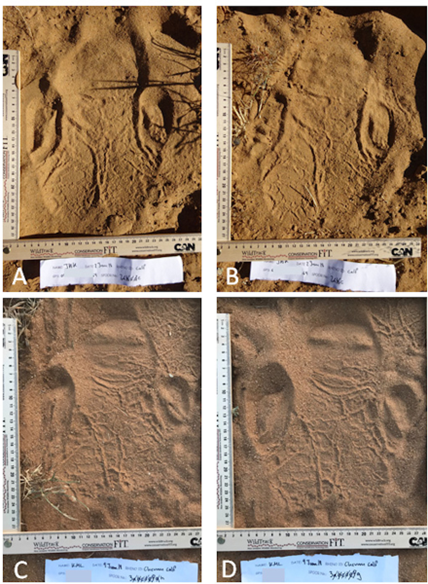
Expert trackers examine the heel lines on rhino footprints. Every single footprint is unique.
Fast forward to today. WildTrack’s peer-reviewed footprint identification technology translates traditional tracking knowledge into a repeatable, scalable, and cost-effective tool for modern science.
Powered by AWS: Building footprint AI at scale
WildTrack’s footprint identification technology uses machine learning to identify the species, individual, sex, and age-classes from simple images of footprints. With help from data contributors around the world (hikers, scientists, trackers, schools, outdoor enthusiasts, and many more), we have built the world’s first large-scale, curated database of wildlife footprints.
Working alongside AWS Partners Provectus and JMP Statistical Software, WildTrack developed a multi-species footprint-powered model, achieving over 90% accuracy across 17 species. The confusion matrix below demonstrates excellent classification accuracy even with extremely similar sub-species of otter.
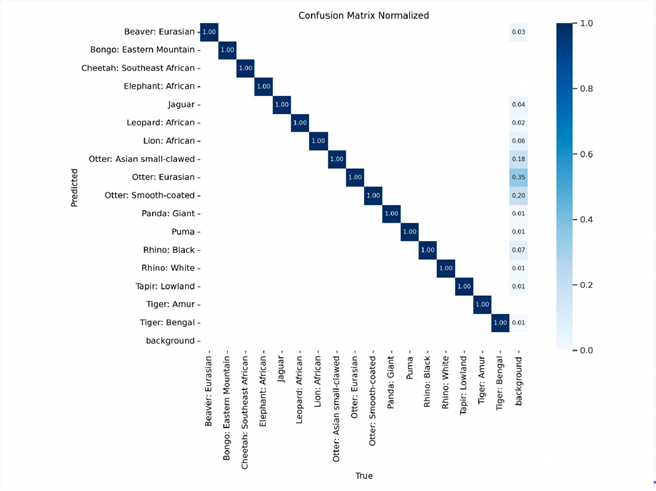
Figure 1: A confusion matrix output from a 17-species classification model built in AWS.
This was made possible by AWS infrastructure that dramatically reduced the training and deployment cycle from weeks to days.
Using AWS Control Tower and Landing Zone Accelerator (LZA) WildTrack created a secure, scalable MLOps foundation. CodeCommit, GitHub, and Docker containers enabled seamless data storage, version control, and continuous integration—all essential for reliable AI in conservation.
This AWS powered architecture now supports more specialized models tailored to real-world conservation challenges—from mitigating human and lion conflict in Botswana to identifying individual rhino in Namibia to guide anti-poaching engagement.
Recent research even explores how tiny mammals, a key part of the ecological pyramid in almost every ecosystem, can be tracked to provide an index on ecosystem health. This is a potentially transformative tool for environmental impact assessment.
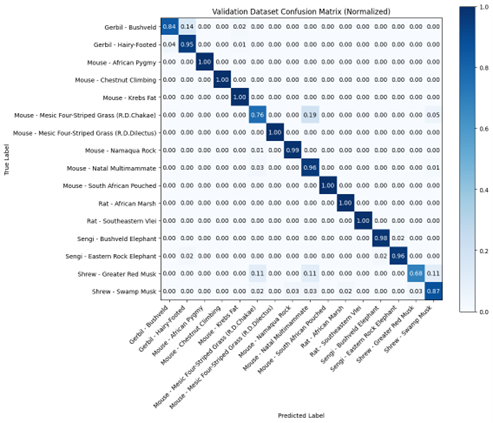
Figure 2: An initial confusion matrix showing excellent classification of 16 small mammal species from their tracks. Some of these species are indistinguishable in hand.
Bridging traditional ecological knowledge and AI
WildTrack is now applying eXplainable AI (XAI) techniques to deepen the understanding of how expert tracking knowledge can help us understand how our AI models make inferences. This two-way exchange enriches both fields—helping AI models become more transparent and strengthening the bridge between ancient expertise and next-generation technology.
Scaling for a planet in need
With a robust AWS foundation, WildTrack is ready to scale. The goal: millions of footprint records across continents, creating an evolving, real-time biodiversity map visible to everyone—from conservationists to policymakers.
Join us
The most challenging and critical task of our time—protecting our natural environment—succeeds through participation. You can help by contributing your field skills and your technical expertise, or by downloading the WildTrackAI app and sharing tracks you see on your next hike!
When technology and traditional ecological knowledge work together, the world’s most threatened species gain new allies—across continents, cultures and generations. Let’s shape the future of conservation—one footprint at a time.
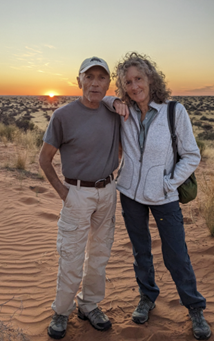
WildTrack Co-founders Dr. Sky Alibhai (L) and Dr. Zoe Jewell (R)