AWS Skilling and Social Impact
How AI-powered weather alerts help mothers survive extreme heat in Sub-Saharan Africa
 Kenya and Nigeria are experiencing increasingly extreme weather events such as heat waves, heavy rainfall, and drought that directly threaten the health of pregnant and postpartum mothers. Research shows a 4-5 percent increase in preterm birth for every degree Celsius rise in temperature, yet mothers and healthcare systems often lack tools to anticipate risks and act before harm occurs.
Approximately 6,000 Kenyan women die during childbirth each year and 90 percent are preventable. Further, one-third are driven by delays in care-seeking; delays that are compounded when extreme weather disrupts access to clinics or escalates unmanaged health risks. Underlying causes of death include maternal dehydration and cardiovascular strain, fetal heat stress (when the fetus runs consistently warmer than the mother), and damage to placental development and function.
In this post, we share how Amazon Web Services (AWS) and Jacaranda Health are using generative AI and event-driven serverless architecture to bridge the gap between a forecasted weather event and timely, trusted, personalized advice — delivered via SMS to mothers in Sub-Saharan Africa who may only have a basic feature phone and no internet access.
Scaling maternal care with open-source technology
Jacaranda Health is a nonprofit operating across Kenya, Ghana, Tanzania, and Nigeria that is dedicated to improving maternal and newborn health outcomes (read the case study). It uses near real-time data and innovative technology to expand access to support systems for mothers and babies. PROMPTS is Jacaranda Health’s AI-powered digital health platform and reaches close to four million enrolled mothers with antenatal care (ANC) and postnatal care (PNC) support.
Initially, PROMPTS did not have the ability to proactively alert mothers about climate-related health risks. There was no mechanism to detect a near-term weather event, identify which mothers are most vulnerable based on their health profiles, or deliver personalized, medically-vetted advice before the climate event occurs.
Jacaranda Health’s data already told part of the story: when temperatures spiked, so did mothers’ distress. Early analysis revealed a correlation between heat spikes and increases in questions from mothers on PROMPTS about symptoms like dehydration, dizziness, and fatigue.
In focus groups with 60 mothers across Kenya, Jacaranda Health learned that most of them recognized climate change, but few connected it to their own pregnancy or their baby’s health, and coping strategies were reactive rather than preventive. Surveys confirmed postpartum women could identify on average only two out of nine recommended protective and care-seeking actions, and only 41 percent of pregnant women considered extreme heat a risk to their pregnancy.
The missing piece was proactive intervention, reaching mothers before the crisis rather than after.
To meet this need, AWS and Jacaranda Health built an event-driven, serverless weather alert system that added a climate intelligence layer to PROMPTS. It detects extreme heat events, defined as daily maximum temperatures exceeding regional thresholds (for example, +35°C in midland regions vs. +38°C in coastal regions, where temperatures are higher in general) for three or more consecutive days. This weather alert system is fully open sourced as an AWS Sample.
Early results from a cross-sectional survey of mothers
To measure whether PROMPTS weather alerts changed what mothers knew and did during hot climate events, Jacaranda Health (supported by The Rockefeller Foundation) conducted a cross-sectional pre-post comparison of 4,933 postnatal mothers across 24 counties: 523 surveyed at baseline (October 2025) and 4,410 at endline (June 2026). Note that baseline and endline are different women and not the same cohort followed over time.
The study found:
- Dehydration recognition improved from a mean of 1.13 to 1.56; statistically significant.
- ANC women reported the delay in clinic visits during hot weather fell from 27 percent to 15 percent; PNC delays fell from 17 percent to 13 percent.
- PNC women reporting protective action for their baby during hot weather rose from 90 percent to 98 percent.
- 17 of 22 women interviewed received the alert during hot weather and said it felt relevant; PNC women described acting on the message the same day.
Through Jacaranda Health’s broader PROMPTS platform, this climate intelligence layer can potentially scale to millions of mothers across Kenya, Ghana, and new markets like Nigeria, where PROMPTS launched in March 2026.
Working backwards from the mother’s experience
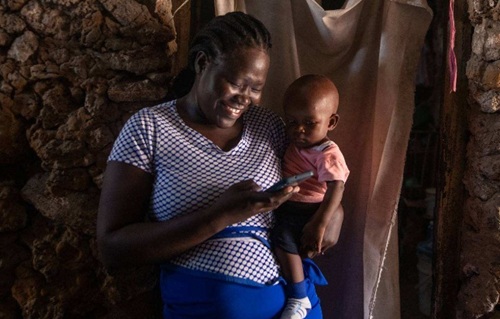 This engagement was led by a small collaborative team from AWS and Jacaranda Health, including both its director and head of technology. On the AWS side, the technical team included an AWS Social Impact Fellow, a rotation program where AWS Solutions Architects who are passionate about supporting social enterprises can work directly with customers to solve urgent and complex challenges across education, health, and climate resilience.
Rather than beginning with the available technology or data sources, the team asked: What does a pregnant mother in Mombasa need to know, and how does she need to hear it, three days before a heat wave arrives?
This framing drove the architectural and product decisions that followed, and user stories were written from the mum’s perspective, such as:
- I want to receive messages that alert me to a predicted weather event at my registered clinic location.
- I want personalized messages based on my stage of pregnancy that tell me what to do if a weather event poses a risk.
- I am assured that messages are vetted by a medical professional before being sent.
Together, the team began with a series of discovery calls to understand existing PROMPTS architecture, SMS delivery pipeline, and user personas including ANC/PNC mums, healthcare workers, helpdesk agents, and supporting family members. The team also explored clinical workflows for message vetting and approval, regional variations in climate thresholds and healthcare access, and data availability for weather forecasting at the required granularity.
These sessions surfaced critical constraints; for example, clinic-based location data was more reliable than home addresses for geolocation, and messages needed to be validated by an OB/GYN before entering the system. The team identified that weather forecast data providers offered the five-day forecast granularity that was needed to give mothers adequate preparation time.
From this foundation, the team followed an Agile scrum cadence with two-week sprints and bi-weekly live demos to stakeholders at Jacaranda Health. This ensured continuous feedback while grounding all generated advice in a knowledge base from Amazon Bedrock that is curated from World Health Organization (WHO) maternal health guidelines and peer-reviewed research on postnatal recommendations.
Building an event-driven, serverless architecture
The weather alert system in PROMPTS runs a daily pipeline that monitors forecasts across all enrolled locations and generates personalized health advice when extreme conditions are predicted. The system comprises six serverless components, each handling one stage of the pipeline. Here’s how it works:
- Amazon EventBridge triggers the workflow daily at 6 AM UTC (9 AM East Africa Time).
- AWS Lambda reads 240,000+ maternal profiles from Amazon DynamoDB and deduplicates by geographic location. This reduces downstream API calls by approximately 80 percent.
- Weather Fetch is a Lambda function that queries a weather forecast API for five-day predictions at each location, filtering for temperatures exceeding regional extreme-heat thresholds.
- Advice Generator is a Lambda function that uses knowledge bases from Amazon Bedrock combined with Anthropic’s Claude 3 Sonnet model to produce personalized health guidance. The knowledge base contains WHO-sourced maternal health guidelines, and the model personalizes delivery based on each mother’s care stage and conditions but cannot generate advice outside the knowledge boundary.
- Alert delivery is the final stage and routes personalized messages to mothers via SMS through Africa’s Talking, a local telecommunications API widely used across East Africa for programmatic messaging. Messages are also surfaced in a monitoring web dashboard for Jacaranda Health’s clinical team to review and audit.
- Lastly, there are reliability mechanisms built in to ensure no mother misses an alert due to a transient failure. Each queue includes dead-letter handling with automatic retries, and Amazon CloudWatch alarms notify the operations team if any stage of the pipeline stalls.
The entire infrastructure is serverless, meaning there are no servers to manage, patch, or pay for when idle. The system spins up automatically each morning to process alerts, then scales back to zero when finished. This is critical for nonprofit sustainability, and Jacaranda Health pays only for the seconds of compute that are used — not for infrastructure sitting idle the rest of the time.
The weather alert system is deployed using AWS Cloud Development Kit (AWS CDK), an infrastructure-as-code framework that defines the entire stack in code rather than manual configuration. This means any organization can clone the open-source repository and deploy an identical system in their own AWS account in under 30 minutes, without needing to reverse-engineer how it was built.
Trust built into every design decision
Per the AWS Well-Architected Responsible AI Lens, AWS takes a people-centric approach that integrates core dimensions across the end-to-end AI lifecycle: safety, privacy, fairness, veracity, robustness, and transparency. This is not a checklist applied after the fact, but a set of design decisions integrated into the architecture from day one.
In Jacaranda Health’s weather alert system, every architectural choice embodies a concrete dimension:
Grounded generation, not open-ended output
The weather alert system in PROMPTS does not allow the large language model (LLM) to generate health advice from training data alone. Every recommendation uses retrieval-augmented generation (RAG) against a curated knowledge base of maternal health guidelines verified by OB/GYN professionals. The model personalizes delivery and considers ANC/PNC status, preexisting conditions, and language, but it does not originate from medical knowledge.
Alert discipline: One message per day
Research on health communication in low-resource settings, such as those with no internet or smartphones, shows that over-notification leads to message dismissal. The weather alert system enforces a strict one-alert-per-day-per-mother policy, meaning mothers get one actionable, personalized message rather than a flood of generic warnings.
Localization as equity
The weather alert system generates advice in both English and Swahili. If an AI system only operates in English, it implicitly excludes millions of the most vulnerable people it’s designed to serve. The system requires no internet connection or smartphone, and alerts reach mothers via standard SMS on basic feature phones.
Privacy by design
No personally identifiable information (PII) exists in the codebase, and all maternal data resides in DynamoDB with strict access controls, readable only by the specific functions that need it. API keys are stored in AWS Secrets Manager to prevent accidental exposure, and all data is encrypted at rest and in transit. Every component operates under least-privilege permissions, and sensitive values are automatically redacted from execution logs. Access to the monitoring dashboard requires authentication through Amazon Cognito.
In a health context, where the data belongs to vulnerable mothers in low-resource settings, this level of architectural privacy is an ethical requirement.
Sustainability through cost constraints
Cost was treated as a first-class design requirement — serverless (scales to zero), intelligent deduplication (80 percent API reduction), controlling API request volume to avoid exceeding free usage limits, and pay-per-use pricing yield — that keeps the balance between cost and performance.
What we learned
Early results are promising as mums who received alerts reported taking protective action, reducing clinic visit delays, and recognizing heat-related danger signs at higher rates than before. Measured outcomes include:
- 240,000+ maternal profiles processed daily via PROMPTS.
- 1,300 unique locations monitored across Kenya. The system deduplicates maternal profiles by clinic location, reducing them to unique geographic points, cutting weather API calls by 80 percent and keeping the solution within AWS Free Tier limits.
- Personalized, bilingual alerts (English and Swahili) delivered during extreme weather events.
- ~$100 per month total infrastructure cost at full production scale.
Based on the team’s experience building Jacaranda Health’s weather alert system for PROMPTS, design principles for AI serving vulnerable populations include:
- Start with the constraint, not the capability. In this use case, end users have a feature phone with no internet; that fact drove each decision about delivery mechanism, message length, and alert frequency.
- Treat cost as a design requirement. Social enterprises in low-resource settings often cannot absorb enterprise cloud costs, so serverless architecture, deduplication, and AWS Free Tier awareness are core constraints.
- Ground AI in human expertise. Generative models can personalize healthcare communication, but it remains a translator of medical expertise rather than the source. RAG ensures the model can only draw from a pre-approved set of clinical documents when composing its response. If the answer is not in the knowledge base, the system will not invent one.
- Build for users who will never file a bug report. Monitoring, retry logic, dead letter queues, and human review are key concerns.
- Open source as an obligation. When a solution addresses humanitarian needs, making it replicable is the right thing to do.
Summary
As extreme heat events become more frequent across Sub-Saharan Africa, pregnant and postpartum mothers face rising risks from preterm birth to preeclampsia, often without knowing a heat wave is coming or what to do about it. The weather alert system for Jacaranda Health’s AI-powered PROMPTS platform bridges that gap.
By combining event-driven serverless architecture with retrieval-augmented generation grounded in WHO-verified clinical guidelines, the solution detects extreme heat days before they arrive, personalizes medically accurate advice for each mother’s care stage, and delivers it via SMS to basic feature phones.
PROMPTS shows what’s possible when cloud-native architecture, generative AI, and deep domain expertise come together in service of a simple but powerful goal: giving every mother the knowledge she needs to protect herself and her baby.
Get started with the open-source AWS Sample that is deployable under 30 minutes.
This post was co-authored by Karthik Rajendran, Sr. Solutions Architect, AWS; Rohini Krishnapura, Sr. Manager – PMT, AWS Impact Solutions; Jay Patel, Director of Technology, Jacaranda Health; and Benjamin Mwalimu, Head of Technology, Jacaranda Health.