AWS Compute Blog
Category: AWS Serverless Application Model

Simplifying application orchestration with AWS Step Functions and AWS SAM
Modern software applications consist of multiple components distributed across many services. AWS Step Functions lets you define serverless workflows to orchestrate these services so you can build and update your apps quickly. Step Functions manages its own state and retries when there are errors, enabling you to focus on your business logic. Now, with support […]

Building scalable serverless applications with Amazon S3 and AWS Lambda
S3 and Lambda are two highly scalable AWS services that can be powerful when combined in serverless applications. In this post, I summarize many of the patterns shown across this series.

Best practices for organizing larger serverless applications
This blog post provides recommendations for designing and managing code repositories in larger serverless projects, and best practices for deploying releases of production systems.

Using dynamic Amazon S3 event handling with Amazon EventBridge
The standard S3 to Lambda integration enables developers to deploy code that responds to bucket- or object-based events. Using Amazon EventBridge, you can employ even more sophisticated routing and filtering of events between S3 and Lambda.

Build a serverless Martian weather display with CircuitPython and AWS Lambda
Build a standalone digital weather display of Mars showing the latest images from the Mars Curiosity Rover. This project uses an Adafruit PyPortal, an open-source IoT touch display. Traditionally, a microcontroller is programmed with firmware compiled using various specific toolchains. Fortunately, the PyPortal is programmed using CircuitPython, a lightweight version of Python that works on […]

Using AWS ParallelCluster with a serverless API
Update – February 22, 2022 : We have released AWS ParallelCluster version 3. It brings with it the new ParallelCluster API and a number of improvements and changes to functionality. Check the Changelog, Instructions for Moving from 2.x to 3.x, or the AWS ParallelCluster documentation for more. This post is contributed by Dario La Porta, […]

Building an automated knowledge repo with Amazon EventBridge and Zendesk
Zendesk Guide is a smart knowledge base that helps customers harness the power of institutional knowledge. It enables users to build a customizable help center and customer portal. This post shows how to implement a bidirectional event orchestration pattern between AWS services and an Amazon EventBridge third-party integration partner. This example uses support ticket events […]
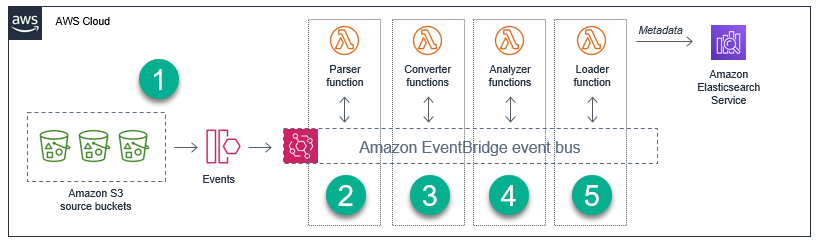
Decoupling larger applications with Amazon EventBridge
This blog post shows how you can use an event-based architecture to decouple services and functional areas of applications. It uses the document repository solution as an example, to compare architecture after shifting to an event-based approach.

Automating scalable business workflows using minimal code
In this blog post, I show how to use a serverless application to build and manage enterprise workflows at scale. This minimal-code solution is highly scalable and flexible, and can be modified easily to meet your needs.

Building well-architected serverless applications: Understanding application health – part 2
This series of blog posts uses the AWS Well-Architected Tool with the Serverless Lens to help customers build and operate applications using best practices. In each post, I address the nine serverless-specific questions identified by the Serverless Lens along with the recommended best practices. See the Introduction post for a table of contents and explaining the example application. Question OPS1: How […]