Intuit reimagines business intelligence with AWS Quick
How Intuit's BI platform team set out to democratize insights at scale — giving every user structured and unstructured data, self-service answers, and the ability to act without leaving the dashboard.
Quick impact
- User provisioning — 3 days → immediate: Access went from a 3-day SLA to immediate, via automation.
- Data unified — Petabytes: Across the AWS data ecosystem, structured and unstructured.
- BI usage — growth of nearly +50% YoY as self service BI scaled across the organization
About Intuit
Serving more than 100 million customers worldwide with TurboTax, QuickBooks, Mint, Credit Karma, and Mailchimp, Intuit is the global technology platform that helps consumers and small businesses overcome their most important financial challenges.
The challenge and use case
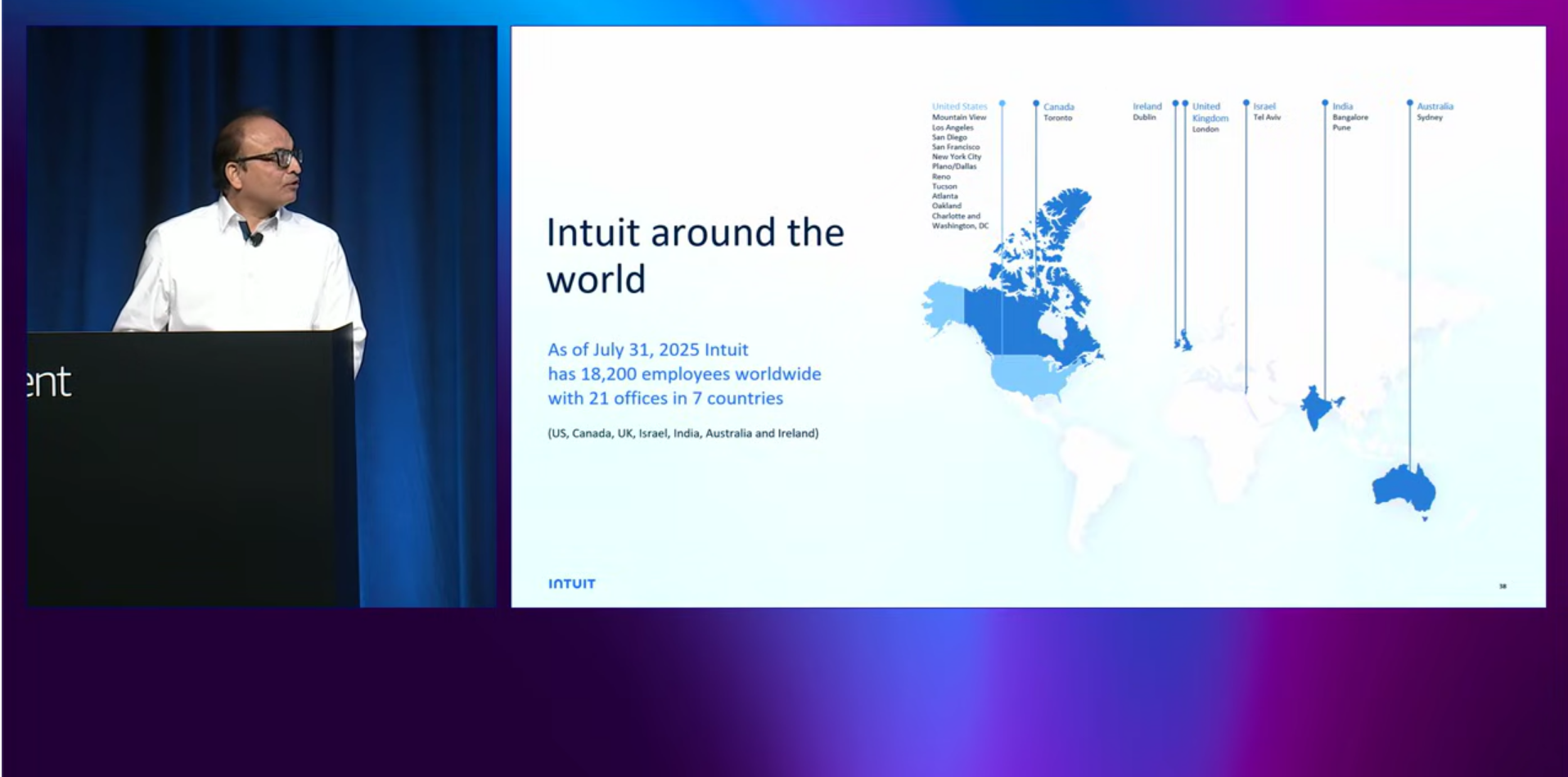
Intuit is an AI-driven platform serving consumers, small businesses, and mid-market customers, with more than 18,000 employees across seven countries and 21 offices. Its mission is to power prosperity around the world. Data sits at the center of that work, and the BI platform team's job is to deliver an AI-enabled BI layer that unlocks the potential of that data for everyone.
The team saw four problems. Generating insight was slow and interactive work on large, complex datasets led to constant follow-ups. A lot of knowledge lived in unstructured data — docs, text, logs — that was hard to turn into insight. Running the platform at scale meant waking up to a dashboard that had not refreshed or an extract that had failed. And even when insight was generated, acting on it meant switching between multiple systems and browser tabs.
A methodical 4E transformation
Intuit moved to AWS Quick with a runbook built on four steps. It started by evaluating the use cases and its own BI needs, then aligning them to the company's strategy. From there it enabled the platform through POCs — establishing data foundations and governance up front, and letting those POCs show which use cases to deliver first. Alongside that, it educated its people, partnering with AWS office hours and building champions who could carry the features into their teams. And finally it expanded, scaling agents and the environment across the organization and promoting what worked.
The evaluation went deep. The team studied customer success, marketing, risk, and product use cases, and asked what an analyst actually needs day to day — dragging and dropping, generative BI, building a dashboard in natural language, working at scale, and combining structured and unstructured data. That produced more than 80 use cases across eight categories, from core BI and generative BI to security, governance, and cost.
"My mission at the BI platform is to deliver an AI-enabled BI platform which can elevate the endless experiences." — Giriraj Bagdi · Engineering Leader, BI Platform, Intuit
The features doing the work
A few capabilities carried the platform. Embeddings let the team build a dashboard once and surface it across their internal portals, for real self-service. Topic Q&A sits on a dataset so users get interactive answers, which avoids spinning up a new dashboard for every complex question. And chat agents — including custom ones — sit alongside a dashboard with workflow automation built in, so a user can act on third-party systems and monitor data without opening another browser tab.
Where Intuit is today
Since January, the number of dashboards has roughly doubled, and both the author and viewer base has grown. The benefits span the eight areas the team set out to improve: more informed decisions from structured and unstructured data, shorter time to insights with chat agents and scenarios, one-click embedding into Intuit's portals, unified data across petabytes, and higher uptime on a scalable, cloud-native architecture. Automation also cut user provisioning from a three-day SLA to immediate access.
Intuit is now expanding into autonomous agents, data stories for its marketing teams, and a health dashboard that flags extract failures in real time, while adding chargeback mechanics for cost and stronger governance to retire dashboards that are no longer used.

Start small and scale up big time. Use governance from day one, and use AI to the largest potential.
Giriraj Bagdi
Engineering Leader, BI Platform, IntuitReady to bring your data into one experience? See what AWS Quick can do for your teams.
More customer stories


Did you find what you were looking for today?
Let us know so we can improve the quality of the content on our pages