Jabil automates engineering and finance work with AWS Quick
One of the world's largest contract manufacturers put agents to work on quoting and accounts receivable. The first two save ~$400,000 a year.
Quick impact
- Annual savings, ~$400K: Run rate across the first two agents.
- Scrap reduction, ~10%: From the quoting and scheduling agent.
- AR emails handled, 12,000+/mo: Invoice emails now processed by the agent, not by hand.
About Jabil
Jabil designs, manufactures, and delivers products for leading global brands, from AI data centers to medical devices. Founded in 1966, it has 140,000+ employees at 120+ sites in 30+ countries.
The challenge and use case
Jabil is one of the world's largest contract manufacturers, a $29.8 billion company (FY25) with more than 140,000 employees across 30 countries, building products for 400-plus of the world's best-known brands across automotive, semiconductor, healthcare, packaging, and cloud and data center infrastructure. Behind that work sits a massive supply chain: more than 38,000 global suppliers and over $25 billion in annual supplier spend.
Two processes were ready for change. On the engineering side, engineers were making avoidable errors because access to lessons learned was inconsistent. When a new request for quote came in, no one could reasonably know every relevant best practice captured across Jabil's operations worldwide. On the finance side, the accounts receivable team was manually working through a high volume of invoice emails, parsing unstructured messages and attachments and updating back-office systems by hand.
Putting agents to work
Jabil did not start with generative AI. It had spent more than seven years on computer vision and machine learning, with a cross-functional council of leaders from HR, finance, IT and elsewhere setting the governance for responsible AI. Jabil built its first assistants on Amazon Q Business for the shop floor and IT, added a debug agent on the manufacturing line with Amazon Bedrock Agents, then brought in AWS Quick for two new agents, starting in early previews about six months ago.
The first agent handles quoting and scheduling for engineering. Engineers were making avoidable errors because the lessons learned were scattered, and no one could know every relevant best practice captured across Jabil's operations worldwide. The agent is keyed into the project management system. The moment a task is assigned, it reads the incoming RFQ, finds the relevant lessons learned, and hands the engineer that context before design begins.
The second handles accounts receivable for finance. It emails each customer a single list of their open invoices, reads the replies (plain text and attachments alike), pulls out the details, and updates Jabil's back-office systems or passes the work to the finance team. It runs on a little over 12,000 emails a month. That work used to be done by hand.
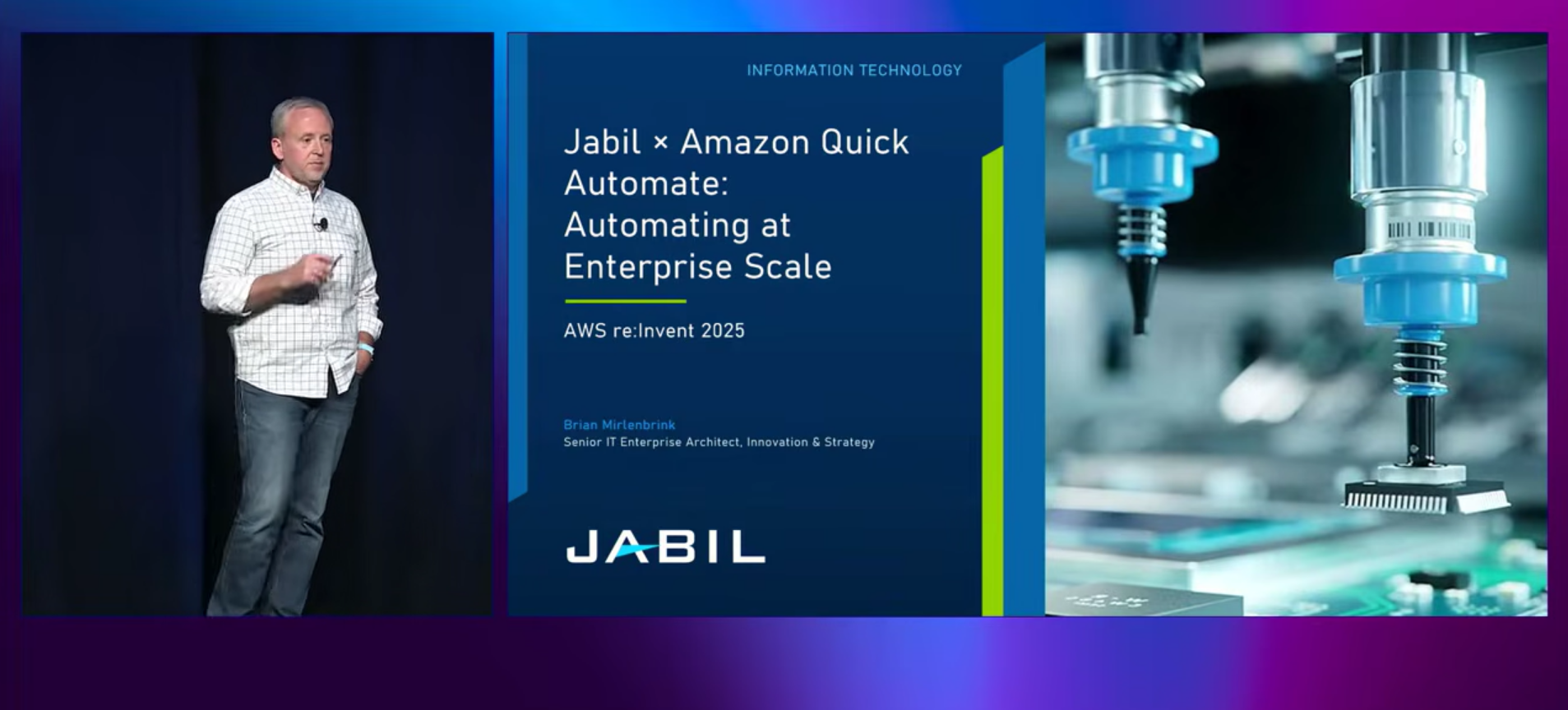
"As soon as the employee knows a task is assigned to them, they already have all the relevant information to begin that design." — Brian Mirlenbrink · Senior IT Enterprise Architect, Innovation & Strategy, Jabil
How the agents are built
Both agents run on a visual canvas in AWS Quick. Each workflow mixes deterministic steps with agentic ones. One step reads the inbox queue. Conditional logic sorts each email by type, such as a payment or a past-due notice, and an agent does the sorting. The team can turn an agent's output into structured data, so it feeds the next step, an API call, or a database update instead of sitting as loose text. They test and debug on the same canvas, then publish to production.
What Jabil learned
Start small. Take a high-value process, break it down, and build toward the goal instead of automating everything at once. Reimagine the process rather than copy what exists today. Where accuracy matters most, give the agent a traditional ML model or a deterministic algorithm to lean on instead of expecting it to do everything. And keep a human in the loop where the process calls for it, with clear rules for when.
"Don't just automate what you're doing today. Rethink how you can reimagine that process, make it more efficient." — Brian Mirlenbrink · Senior IT Enterprise Architect, Innovation & Strategy, Jabil
Where Jabil is today
The two agents improved quote accuracy, cut scrap by about 10 percent, and save ~$400,000 a year. The accounts receivable team now spends its time on higher-value work. These are the first two agents Jabil has built, and it is already moving to inline and multi-agent setups and lining up its next use cases.

It's been a significant benefit to Jabil, and these are just the first agents we've started building.
Brian Mirlenbrink
Senior IT Enterprise Architect, Innovation & Strategy, JabilReady to bring your data into one experience? See what AWS Quick can do for your teams.
More customer stories


Did you find what you were looking for today?
Let us know so we can improve the quality of the content on our pages