Principal Financial Group delivers source-verified insights faster with AWS Quick
How a global financial services firm cut fund research from weeks to a single week with Quick Research — and broke down silos as demand spread across the enterprise.
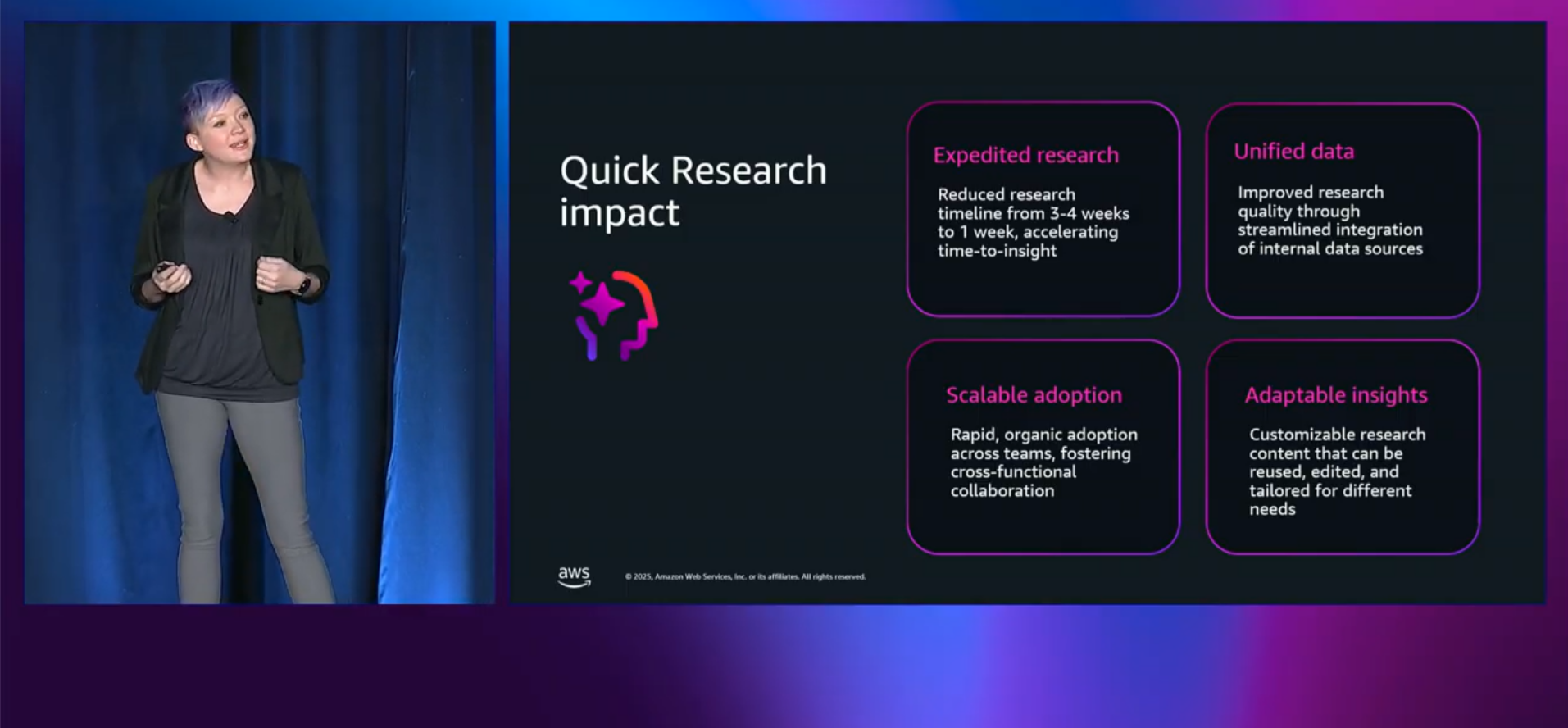
Quick impact
- Researchtime — 3–4 wks → 1 wk: Per-fund research, cut by using Quick Research.
- Adoption — Enterprise-wide: Grew organically from a single use case across teams.
- Unified data: Connecting internal data sources improved research quality across the board.
About Principal Financial Group
Principal Financial Group helps people and businesses make financial progress through retirement, benefits, and investment solutions. Founded nearly 150 years ago, it has about 20,000 employees and a revenue of ~$15.6B (FY25) in 27 nations and territories.
The challenge and use case
Principal Financial Group works across retirement, benefits and protection, and asset management, serving more than 71 million customers in over 80 markets. Establishing a new investment fund is one of its more research-heavy tasks: before the firm can judge whether a fund is viable and how to structure it, teams work through competitive analysis, market opportunity, regulatory requirements, investment strategy, and operational infrastructure.
Principal's private market products team and its real estate asset management division needed to establish two new funds. Manual research ran three to four weeks per fund, and analysts were spending that time gathering information rather than analyzing it. The firm saw an opportunity to accelerate the work with Quick Research, and there was organization-wide demand for faster, reliable insights.
"Our problem was not a lack of expertise. It was where that expertise was going." — Nicki Susman · Sr. Software Engineer III, RIS AI Enablement · Principal Financial Group
Starting with public data
Principal began with Quick Research and used only publicly available data at first, to confirm the approach before connecting internal sources. Two things stood out: the research came back faster, and it was more thorough than the team could normally justify the time for. On public data alone, fund research dropped from three to four weeks to one week.
The change in speed led to a change in behavior. Instead of asking whether there was time to research something, people began asking what else they should be researching.
Breaking down silos across the enterprise
Word spread quickly, and a single use case turned into requests from across the company. Software engineers used Quick Research for technical research and vendor evaluations. Enterprise architects used it for strategy assessments. Investment, marketing, and strategy teams used it for work ranging from due diligence to regulatory research.
Interest did not stop at Quick Research on its own. Teams asked whether they could put research into a shared Space, build on the same material across departments, and set up their own agents and workflows. Persistent research let them return to and refine earlier work; multi-level sharing and ecosystem integration amplified the results; and the move changed how knowledge moved between teams that had worked separately before.
"Quick Research excels when you're trying to uncover solutions that your teams might be blind to." — Nicki Susman · Sr. Software Engineer III, RIS AI Enablement · Principal Financial Group
Driving accuracy and impact
Public data proved the platform, but connecting internal sources is what unified the picture. Principal found that proprietary data was a game changer for accuracy, and that it paid to verify where each answer came from and curate sources for quality. Streamlining those internal data sources improved research quality across the board, and the research itself was adaptable — content teams could reuse, edit, and tailor for different needs rather than starting over each time.
Source-level transparency let users check the reasoning behind a result, and the security controls around confidential data made it safe to use for sensitive work. On prompting, the team found that specificity wins: a precise request, pointed at the right sources, returns something usable rather than generic. Iterating with Quick Chat helped the team craft better prompts over time.
"The technical implementation is straightforward. We already had security groups configured in our Azure tenant that we were able to immediately leverage within Quick Suite." — Nicki Susman · Sr. Software Engineer III, RIS AI Enablement · Principal Financial Group
Where Principal is today
Principal runs Quick Research in production and keeps adding the use cases it considers high value — the ones that best show what the tool can do. The firm is building momentum and shaping its roadmap around the outcomes it is seeing, and the range of teams asking for access keeps growing.
The deeper change is in the questions people ask. Teams began tackling strategic questions they had never proposed before, because the research those questions needed was finally within reach. For Principal, Quick Research is less about getting faster answers than about asking bigger and better ones.

We fundamentally changed our relationship with curiosity, because teams started tackling strategic questions that they had never even proposed before.
Nicki Susman
Sr. Software Engineer III, RIS AI Enablement · Principal Financial GroupReady to ask bigger questions of your data? See what AWS Quick can do for your teams.
More customer stories


Did you find what you were looking for today?
Let us know so we can improve the quality of the content on our pages