AWS Partner Network (APN) Blog
Optimize AI Costs with New Relic Cloud Cost Intelligence on AWS
By: Nava Ajay Kanth Kota, Sr. Partner Solutions Architect – AWS
By: Swatika Gupta, Sr. Customer Solutions Manager – AWS
By: Piyush Bhansali, Director, Product Management – New Relic
By: Muthuvelan Swaminathan, Principal Partner Architect – New Relic
 |
 |
Managing AI costs is one of the top challenges for organizations scaling generative AI on AWS. Amazon Bedrock model invocation APIs and AWS Cost and Usage Reports deliver the granular billing telemetry needed for scalable AI. New Relic Cloud Cost Intelligence (New Relic CCI) builds on this foundation, embedding cost visibility directly into the observability workflows engineering teams already use. Together, AWS and New Relic allow organizations to shift from opaque AI experimentation to disciplined, ROI-driven AI operations with greater cost accountability.
New Relic has already covered CCI’s general availability (April 28, 2026) and AI cost features. This post focuses on how AWS and New Relic work together: how AWS Cost and Usage Report (CUR 2.0), Amazon Simple Storage Service (Amazon S3), and AWS Trusted Advisor provide the data foundation that New Relic CCI turns into engineering-ready insight for Amazon Bedrock workloads, shown through an illustrative use case.
Introduction
A fundamental change is underway in cloud economics: as generative AI workloads scale on AWS, organizations increasingly need to unify performance monitoring and cost management rather than leave cost intelligence siloed in a separate billing tool. New Relic CCI does this by correlating AWS CUR 2.0 data with New Relic telemetry insights, so teams can attribute AI spend to the applications and decisions that drive it.
Observability-native FinOps brings cost intelligence into engineering workflows, tying token-level spending to the context that drives it: deployments, demand spikes, prompt changes, and model selection.
Why AI workloads challenge traditional cost models
The economics of AI are fundamentally different from traditional cloud computing. Unlike Amazon Elastic Compute Cloud (Amazon EC2), where costs scale predictably with provisioned resources, AI services like Amazon Bedrock feature variable token consumption patterns that complicate traditional forecasting. This is a structural challenge that calls for purpose-built cost intelligence capabilities:
- Token-level economics: Costs can vary significantly by model, prompt complexity, and use case, and teams often run multiple large language models (LLMs), which makes comparing price and performance across models difficult.
- Scaling outpaces governance: AI adoption outpaces existing budgeting frameworks, and consumption-based pricing introduces variability that can lead to overruns.
- Attribution gaps: Tying AI costs to specific applications, teams, or business outcomes is hard.
Without a unified view connecting AI spending to the engineering context behind it, organizations struggle to answer the fundamental question of how to measure and attribute their AI return on investment.
How observability-native FinOps connects cost to context
The premise is straightforward: if your engineering team already uses an observability tool to understand application performance, that same tool should surface cost intelligence, correlated with the performance data that explains it. This helps bridge the disconnect where engineers who drive costs and the billing reports they need, live in separate tools, owned by separate teams. New Relic CCI implements this by embedding cloud cost visibility directly into the observability solution.
This is made possible by the AWS investment in cost transparency. AWS CUR 2.0 delivers detailed, hourly billing data, including token-level metadata for Amazon Bedrock invocations, directly to Amazon S3. AWS Trusted Advisor provides optimization recommendations. Together, these form the data foundation that CCI builds upon.
New Relic CCI delivers four key business outcomes:
- Understand where AI spend is going. Token-level cost breakdowns by service, model, and token type give teams immediate visibility into which applications and workloads drive cost, replacing opaque single line items with actionable attribution.
- Spot trends before they become budget surprises. Interactive Sankey charts trace cost flows from account to service to resource. Month-over-month analysis and automated anomaly surfacing keep leadership ahead of cost growth.
- Act on optimization opportunities by pairing insights from AWS Trusted Advisor (such as resource right-sizing and Savings Plans coverage) with New Relic CCI’s savings analysis.
- Help prevent overruns before they happen. Configurable budget thresholds with proactive alerts at customizable utilization levels integrate with existing notification workflows for real-time spend governance.
Additionally, the FinOps Agent, currently in public preview, brings conversational cost intelligence to the New Relic Ask AI interface, allowing teams to query AWS billing and performance data using natural language, such as pinpointing Amazon Bedrock cost drivers or comparing model spend across workloads.
Architecture overview
The following describes how New Relic CCI integrates with AWS billing data to provide AI cost visibility:
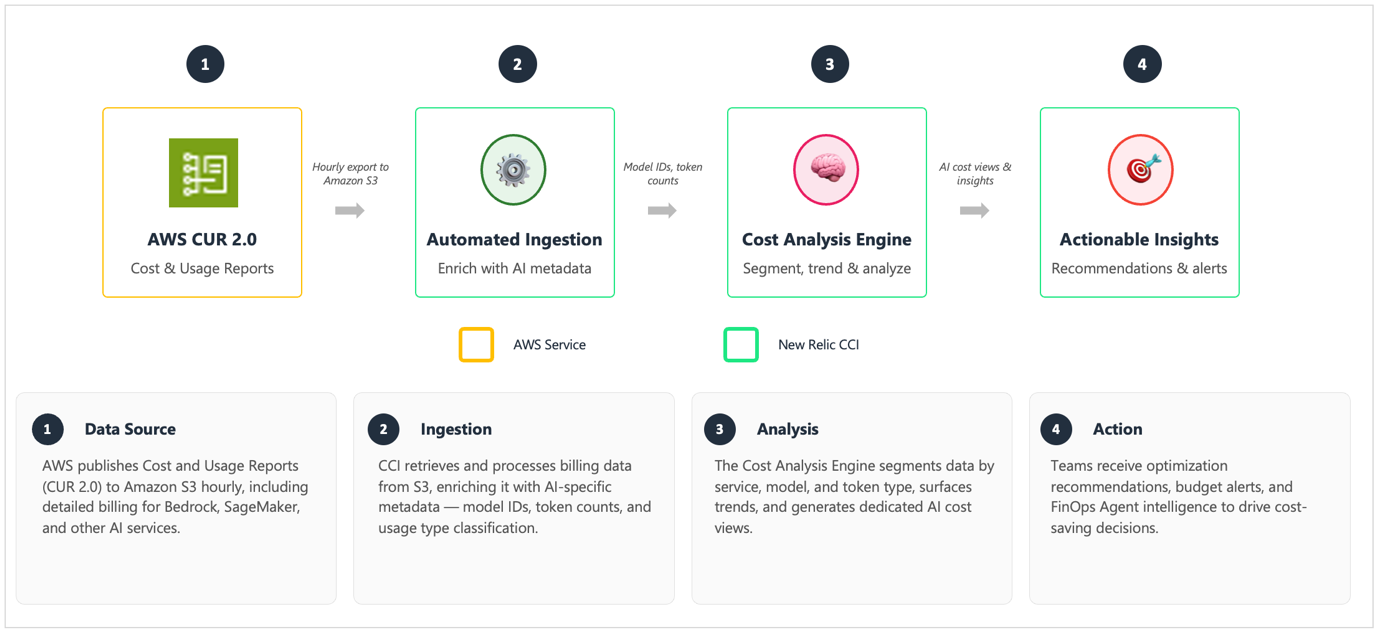
Figure 1 – CCI data flow from AWS CUR 2.0 (Amazon S3) through ingestion and cost analysis to actionable insights
The data flow follows four stages:
- AWS CUR 2.0 delivers cost and usage data to Amazon S3 with up to hourly granularity
- New Relic CCI ingestion retrieves billing data and enriches it with AI metadata (model IDs, token counts)
- Cost analysis engine in New Relic CCI segments by service, model, and token type to surface trends
- New Relic CCI delivers actionable insights including optimization recommendations, budget alerts, and FinOps Agent intelligence to engineering teams
From cost opacity to cost accountability
Consider a mid-size healthcare enterprise running multiple generative AI applications on Amazon Bedrock. This scenario is illustrative. All figures, including those shown in Figures 2 and 3, are synthetic demo data used to show how New Relic CCI attributes cost, not a real customer deployment.
In healthcare, GenAI costs are driven by token economics, model selection, and the overhead of managing sensitive patient data. Regulated workflows add guardrails such as encryption in transit and audit logging, and costs can escalate quickly without clear attribution. Customers building healthcare workloads on AWS use HIPAA Eligible Services under a Business Associate Agreement (BAA) executed through AWS Artifact; use of HIPAA-eligible services alone does not constitute HIPAA compliance, which is a shared responsibility between AWS and the customer. New Relic CCI analyzes billing and usage data, not patient data.
In a typical deployment, spanning a Patient Triage Bot and Clinical Note Summarizer on Claude models, an internal Code Assistant, and a Patient Education Generator, the engineering team sees only a single “Amazon Bedrock” line item in the AWS bill, making it hard to attribute costs or optimize model selection.
With New Relic CCI, the team can:
- Identify cost drivers: The Sankey chart reveals that the Patient Triage Bot is the largest cost driver, consuming 43% of the total Amazon Bedrock spend.
- Optimize model selection: Token-level analysis shows many triage queries are routine FAQ lookups that a lighter model (Anthropic Claude Sonnet 4.6 instead of Claude Opus 4.6) can handle, which can reduce costs.
- Set team-level budgets: Each application team gets a dedicated budget with At Risk alerts at 80% utilization, so that no single team’s experimentation jeopardizes the organization’s AI investment.
- Track optimization impact: Month-over-month trending shows how model-switching recommendations can deliver measurable monthly savings.
The following dashboard views show how New Relic CCI surfaces these insights for AI workloads on AWS. Filtered to AWS, they attribute Amazon Bedrock spend down to the individual Anthropic Claude model and token type, the same model-level visibility that drives the optimization decisions described above:
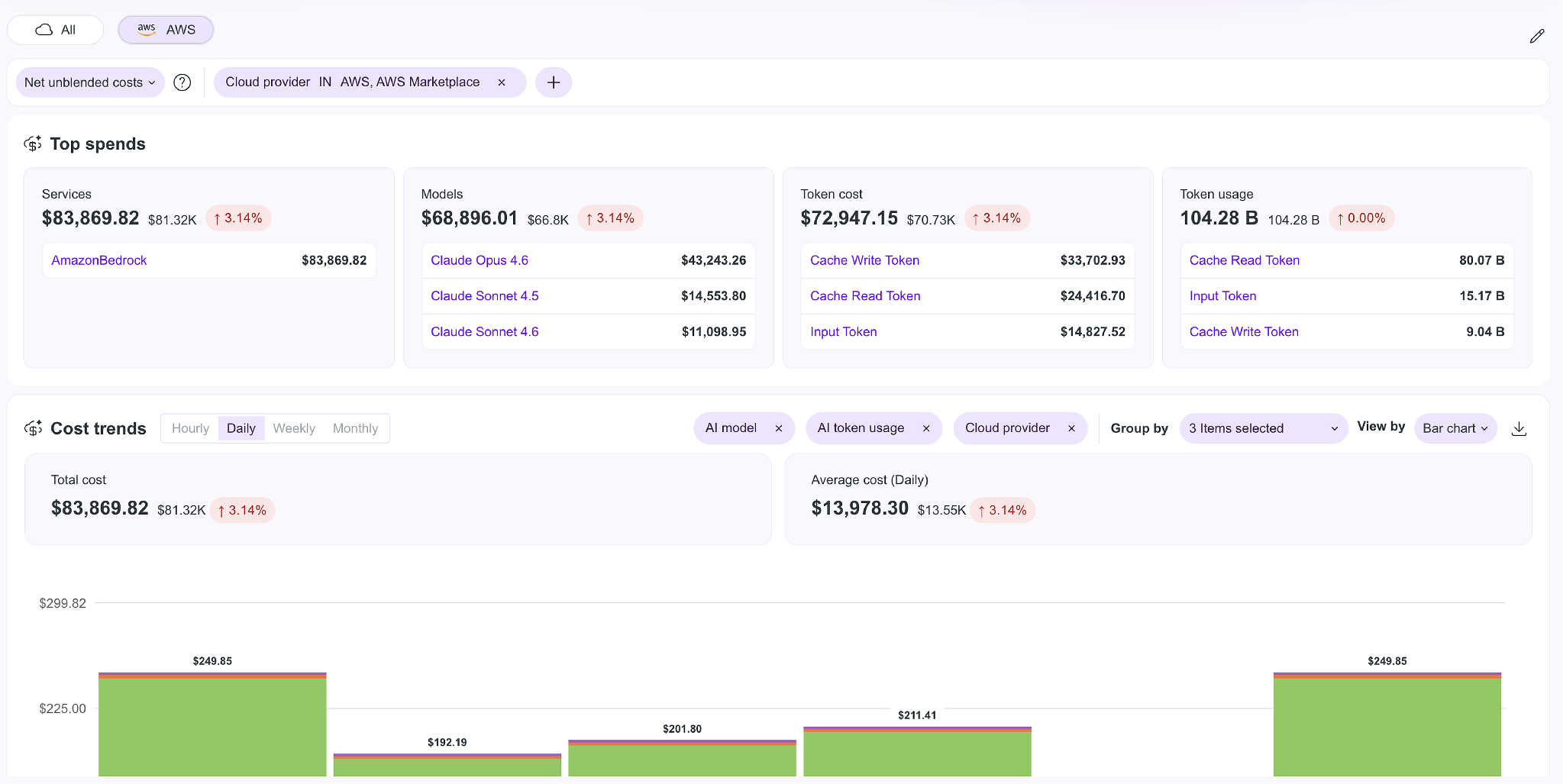
Figure 2 – CCI AI cost view filtered to AWS, attributing Amazon Bedrock spend across Anthropic Claude models (Opus 4.6, Sonnet 4.5, Sonnet 4.6) with token-level cost and usage breakdowns and daily cost trends. Values are synthetic demo data, not a real customer.
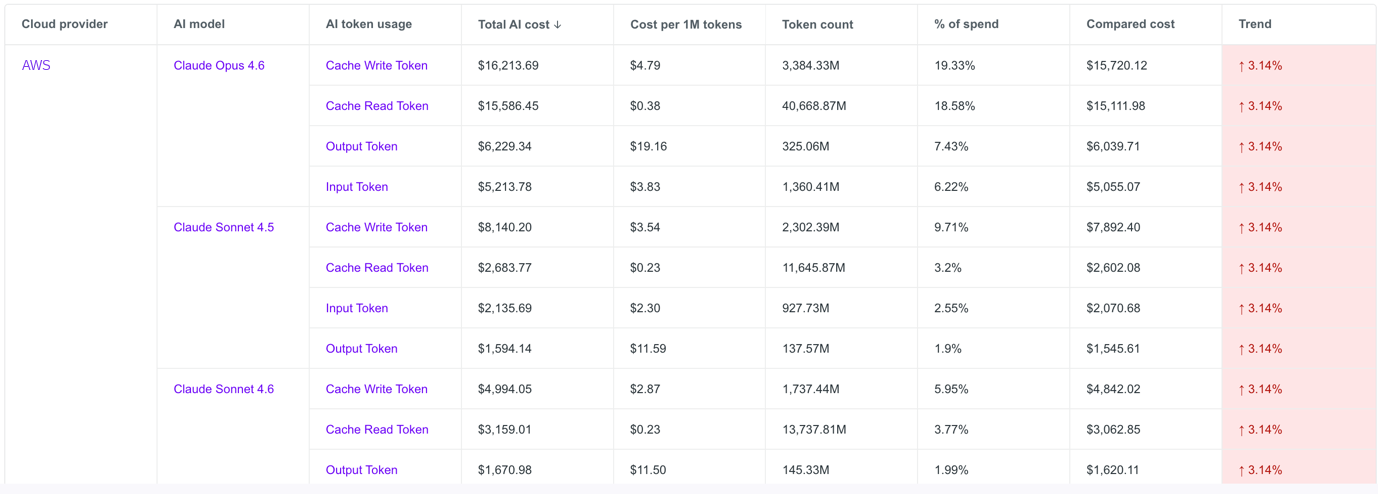
Figure 3 – CCI token-attribution table for AWS, breaking down Amazon Bedrock spend by Anthropic Claude model and token type with total AI cost, cost per 1M tokens, token count, and percentage of spend. Values are synthetic demo data, not a real customer.
Conclusion
For organizations scaling AI workloads, embedding cost intelligence into engineering workflows is key to sustainable growth. With New Relic CCI, teams can correlate token-level visibility with application context, act on optimization recommendations backed by telemetry, and govern Amazon Bedrock budgets in real time. Looking ahead, observability-native FinOps is evolving toward autonomous cost governance and predictive budgeting. Organizations that build this discipline now are better positioned to scale AI confidently.
Explore New Relic CCI on AWS Marketplace to see how observability-native FinOps can work for your AI workloads. To get started, see the New Relic Cloud Cost Intelligence documentation for setup instructions and configuration guides.

New Relic – AWS Partner Spotlight
New Relic is an APN Advanced Technology Partner that has demonstrated technical proficiency and proven customer success with AWS Competencies in Government ISV, DevOps ISV, Retail ISV, Advertising and Marketing Technology Software, Migration and Modernization ISV and Data Software specialized solution areas. Their observability solution helps thousands of organizations optimize cloud performance.