What Is Deep Learning?
- What is deep learning in AI?
- What is deep generative learning?
- Why is deep learning important?
- What are deep learning use cases?
- How does deep learning work?
- What is the difference between machine learning, deep learning, and generative AI?
- What are the challenges of deep learning?
- What are the benefits of generative AI and deep learning in the cloud?
- How can AWS help with your generative AI and deep learning requirements?
What is deep learning in AI?
Deep learning is a subset of machine learning that powers many artificial intelligence (AI) systems. It uses multilayered neural networks that allow computers to process data in a way that is inspired by the human brain. Deep learning models can recognize complex pictures, text, sounds, and other data patterns to produce insights and predictions. You can use deep learning methods to automate tasks that typically require human intelligence, such as describing images or transcribing a sound file into text.
What is deep generative learning?
Deep generative learning is deep learning that focuses on creating new output based on patterns from learned input. Deep learning models are trained with large amounts of data to recognize patterns in the data set and make predictions or classifications.
Deep generative learning adds generation to pattern recognition. Such models look for data patterns and then create novel outputs based on these patterns. For example, they can analyze the text in several books and then use the information to generate new sentences and paragraphs not found in the original books.
Deep generative learning is the basis of modern generative AI and helps in creating foundation models. These models use deep learning technologies at scale, trained on vast data, to perform complex tasks such as answering questions, creating images from text, and writing content.
Why is deep learning important?
Deep learning technology is the basis of many artificial intelligence applications used in everyday products. Deep learning helps in everything from financial fraud detection to building better chatbots and digital assistants for customer service. It is also a critical component of technologies such as self-driving cars, virtual reality, and more.
Businesses use deep learning models to analyze data and make predictions in various applications. Here are the benefits of deep learning.
Enables AI to process unstructured data at scale
Traditional machine learning excels in processing structured datasets but can have difficulties with unstructured formats such as images, audio, and free-form text. Many deep learning systems can process unstructured data types, as they decompose raw input data through their learning processes.
Neural networks with multiple layers can extract meaningful representations within large volumes of training data. Different neural network architectures are optimized to process different types of data:
-
Convolutional neural networks (CNNs) are used for computer vision tasks such as detecting objects and classifying objects.
-
Recurrent neural networks (RNNs) manage sequential data where the precise order of the input sequence is important, such as time-series signal data.
-
Natural language processing (NLP) models can process, interpret, and understand intent from human language.
-
Transformer models are used for all types of input-output sequence conversions, from speech recognition to machine translation and protein sequence analysis, and are the basis of large language models. Vision Transformers (ViTs) are used for computer vision tasks.
Deep learning extends the capabilities of AI systems, making them more flexible and effective at processing all kinds of data at scale.
Enhances automation and reduces manual effort
Deep learning can help organizations by requiring less human intervention to complete tasks. In the engineering phase, data scientists can focus on preparing high-quality training data rather than manually defining rules and engineering features.
In training deep learning models, optimization algorithms will automatically adjust up to trillions of parameters within neural networks to minimize prediction errors.
Deep learning training supports multiple learning types:
-
Supervised learning, where a system uses pre-prepared, labeled data as its source.
-
Unsupervised learning, where a model identifies structure in unlabeled data.
-
Reinforcement learning, where models learn through reward-based feedback.
-
Semi-supervised learning, where models use a small set of labeled data and a larger set of unlabeled data.
-
Self-supervised learning, where a model attaches labels to the data to train itself, much like humans would in supervised learning.
Deep reinforcement learning goes further by combining perception and decision-making to continually iterate and optimize behavior.
Detects complex patterns
Deep learning uses its neural networks, made up of layers of interconnected nodes, to learn intricate dependencies and patterns. While simpler machine learning models must use significant feature engineering design, deep learning advanced models can trace abstract relationships without feature definition. For areas such as facial recognition and fraud detection, where subtle changes need to be identified across millions of examples, deep learning can be a better choice.
What are deep learning use cases?
Deep learning has use cases in all industries, including automotive, aerospace, manufacturing, electronics, medical research, and other fields.
These various use cases of deep learning can be grouped into five broad categories: computer vision, speech recognition, natural language processing (NLP), recommendation engines, and generative AI.
Computer vision
Computer vision automatically extracts information and insights from images and videos. Deep learning techniques enable computers to comprehend images. Computer vision has many applications, such as the following:
-
Self-driving cars use deep learning models for object detection.
-
Defense systems use deep learning to flag areas of interest in satellite images.
-
Medical image analysis uses deep learning to detect cancer cells for medical diagnosis.
-
Factories use deep learning applications to detect when people or objects are within an unsafe distance of machines.
-
Content moderation can automatically remove unsafe or inappropriate content from image and video archives.
-
Facial recognition can identify faces and recognize attributes such as open eyes, glasses, and facial hair.
-
Image classification can identify brand logos, clothing, safety gear, and other image details.
Speech recognition
Deep learning models can analyze human speech despite varying speech patterns, pitch, tone, language, and accent. Speech recognition applications, such as virtual assistants like Amazon Alexa, text-to-speech apps, and speech-to-text software, can perform the following tasks:
-
Assist call center agents and automatically classify calls.
-
Convert clinical conversations into documentation in real time.
-
Accurately subtitle videos and meeting recordings for a wider content reach.
-
Convert scripts to prompts for intelligent voice assistance.
-
Convert one language to another for translation in near real time.
Natural language processing
Computers use deep learning algorithms to gather insights and meaning from text data and documents. This ability to process natural, human-created text has several use cases, including:
-
Automated virtual agents and chatbots.
-
Automatic summarization of documents or news articles.
-
Business intelligence analysis of long-form documents, such as emails and forms.
-
Indexing of key phrases that indicate sentiment, such as positive and negative comments on social media.
Recommendation engines
Applications can use deep learning methods to track user activity and develop personalized recommendations. They can analyze users' behavior and help them discover new products or services. For example,
-
Recommend personalized videos and content.
-
Recommend customized products and services.
-
Filter search results to highlight relevant content based on user location and behavior.
Generative AI
Generative AI applications can create new content and communicate with end users in a sophisticated style. GenAi apps can assist in tasks such as automating complex workflows, brainstorming ideas, and intelligent knowledge searches. For example, with generative AI tools such as Amazon Q Business and Amazon Q Developer, users can:
-
Ask natural language questions and get summarized answers from multiple internal knowledge sources.
-
Get code suggestions, automatic code scanning, and upgrades.
-
Create new documents, emails, and other marketing content faster.
How does deep learning work?
Deep learning models are neural networks that reuse similar language to some of the concepts within the human brain. A human brain contains millions of interconnected biological neurons that work together to learn and process information.
Within deep learning, software modules called nodes use mathematical calculations to process data. Deep learning neural networks, or artificial neural networks, comprise many layers of artificial neurons that work together to solve complex problems.
The components of a deep neural network are the following.
Input layer
An artificial neural network has several nodes to input data. These nodes make up the system's input layer.
Hidden layer
The input layer processes and passes the data to layers further in the neural network. These hidden layers process information at different levels, adapting their behavior as they receive new information during training. Deep learning networks have tens to hundreds of hidden layers that they can use to analyze a problem from several different angles.
For example, if you were given an image of an unknown animal that you had to classify, you would compare it with animals you already know. For example, you would look at the shape of its eyes and ears, size, number of legs, and fur pattern. You would try to identify patterns, such as the following:
-
The animal has hooves, so it could be a cow or deer.
-
The animal has cat eyes, so it could be a wild cat or a domesticated cat.
The hidden layers in deep neural networks work in the same way. If a deep learning algorithm tries to classify an animal image, each of its hidden layers processes a different animal feature and tries to categorize it accurately.
Output layer
The output layer consists of the nodes that output the data. Deep learning models that output "yes" or "no" binary answers typically have only one node in the output layer. On the other hand, those that output a wider range of answers have more nodes. Generative AI has a sophisticated output layer to generate new data that matches patterns in its training dataset.
What is the difference between machine learning, deep learning, and generative AI?
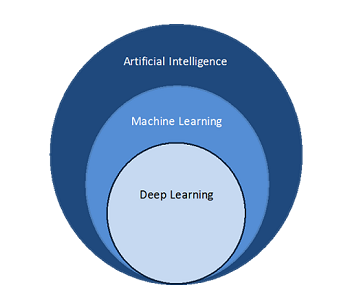
The terms “machine learning,” “deep learning,” and “generative AI” are all fields within artificial intelligence, with deep learning and generative AI involving neural network technology.
Machine learning
Deep learning is a subset of machine learning. Deep learning algorithms emerged to overcome the limitations of traditional machine learning techniques. Traditional machine learning methods require significant human effort to train the software, identifying features.
For example, in an example of house sale price estimation using supervised learning, you need to do the following:
-
Input house sale prices, along with other features such as suburb, area, bedrooms, bathrooms, age, proximity to public transport, distance from a major city, and more.
-
Make the machine learning algorithms process the dataset.
-
Test those algorithms on an already sold set of houses with known features to estimate the sale price.
-
Identify why some results are inaccurate.
-
Improve the dataset by adding new features.
In supervised learning, result accuracy improves only with a broad and sufficiently varied dataset. For instance, the algorithm might perform poorly in outer suburbs where there is little training data.
Benefits of deep learning over machine learning
A deep learning network has the following benefits over traditional machine learning.
Efficient processing of unstructured data
Traditional machine learning methods find unstructured data, such as text documents, challenging to process because the training dataset can have infinite variations. On the other hand, deep learning models can comprehend unstructured data and make general observations without manual feature extraction. For instance, a neural network can recognize that these two different input sentences have the same meaning:
-
Can you tell me how to make the payment?
-
How do I transfer money?
Hidden relationships and pattern discovery
A deep learning application can analyze large amounts of data more deeply and reveal new insights for which it might not have been trained. For example, consider a deep learning model trained to analyze consumer purchases. The model has data only for the items you have already purchased. However, the artificial neural network can suggest new items you haven't bought by suggesting stylistically similar items in different categories.
Volatile data processing
Volatile datasets have large variations, such as network traffic to a website. During a sale event, the website might experience a significant amount of connections. A deep learning neural network can identify the difference between escalating network traffic and a distributed denial of service (DDoS) event.
Generative AI
Generative AI combines multiple technologies to generate new output from input. Input and output vary, depending on the model, and can include text, images, and video. While machine learning and deep learning focus on prediction and pattern recognition, generative AI is able to produce novel outputs based on its learned patterns.
Generative AI technology is typically built on a transformer architecture that uses self-attention to learn relationships about input data. During training, these deep learning networks first convert text, images, and other data into mathematical abstractions and then reconvert them into meaningful new patterns.
What are the challenges of deep learning?
Challenges in implementing deep learning and generative AI are given below.
Large quantities of high-quality data
Deep learning algorithms give better results when you train them on large amounts of high-quality data. Outliers or mistakes in your input dataset can significantly affect the deep learning process. For instance, in our animal image example, the deep learning model might classify an airplane as a turtle if the dataset accidentally introduces non-animal images.
To avoid such inaccuracies, you must clean and process large amounts of data before training deep learning models. The input data preprocessing requires large amounts of data storage capacity.
Large processing power
Deep learning algorithms are compute-intensive and require infrastructure with sufficient compute capacity to function properly. Otherwise, they take a long time to process results.
Explainability
The outputs of deep learning can be difficult to trace through the neural network to determine how the algorithm came to its answer. This makes explainability and proof hard to reproduce and demonstrate.
What are the benefits of generative AI and deep learning in the cloud?
Running generative AI and deep learning on cloud infrastructure helps you design, develop, and train applications faster.
Speed
You can train generative AI and deep learning models faster by using clusters of GPUs and CPUs to perform the complex mathematical operations that your neural networks require. You can then deploy these models to process large amounts of data and produce increasingly relevant results.
Scalability
With the wide range of on-demand resources available through the cloud, you can access fully scalable hardware resources to tackle AI deep learning models of any size. Your neural networks can take advantage of multiple processors to seamlessly and efficiently distribute workloads across different processor types and quantities.
Tools
You can access AI and deep learning tools in the cloud, such as notebooks, debuggers, profilers, pipeline components, AIOps tools, and more. You can work with existing generative AI models from within the cloud as a service without requiring infrastructure to host the model. Teams can start with generative AI and deep learning applications and iteratively learn as they go.
How can AWS help with your generative AI and deep learning requirements?
AWS AI and deep learning services help bridge the gap between AI potential and business results with a comprehensive foundation of models, context, and enterprise-grade security, to turn vision into reality with agents that scale. Reinvent your way of working with the most comprehensive purpose-built services, AI infrastructure, deep learning technology, and generative AI solutions. For example,
-
Amazon SageMaker AI is a fully managed service that brings together the most comprehensive set of AI tools and capabilities to enable high-performance, low-cost AI model development for any use case. With SageMaker AI, you can build, train, customize, and deploy AI models at scale using complete development environments, purpose-built training infrastructure, AI agent-guided workflows, and optimized inference capabilities
-
Amazon Bedrock is the platform for building generative AI applications and agents at production scale. Organizations choose Amazon Bedrock to deliver personalized experiences, automate complex workflows, and uncover actionable insights—all in a comprehensive platform that lets teams innovate fast without compromising on security.
You can also use AWS AI infrastructure to access comprehensive, secure, and price-performing computing, storage, and networking to build any AI application.
Get started with AI deep learning on AWS by creating a free AWS account today.
Browse all cloud computing concepts
Browse all cloud computing concepts content here:
Did you find what you were looking for today?
Let us know so we can improve the quality of the content on our pages